

BuildMEP Hydronic Control Guide
Spend enough time around chilled-water systems and PICVs turn up everywhere — FCUs, AHU coils, chilled beams, actuator swaps, commissioning reports, all of it. The name makes it sound complicated, but once you break down what's actually happening inside the valve, the idea is fairly straightforward.
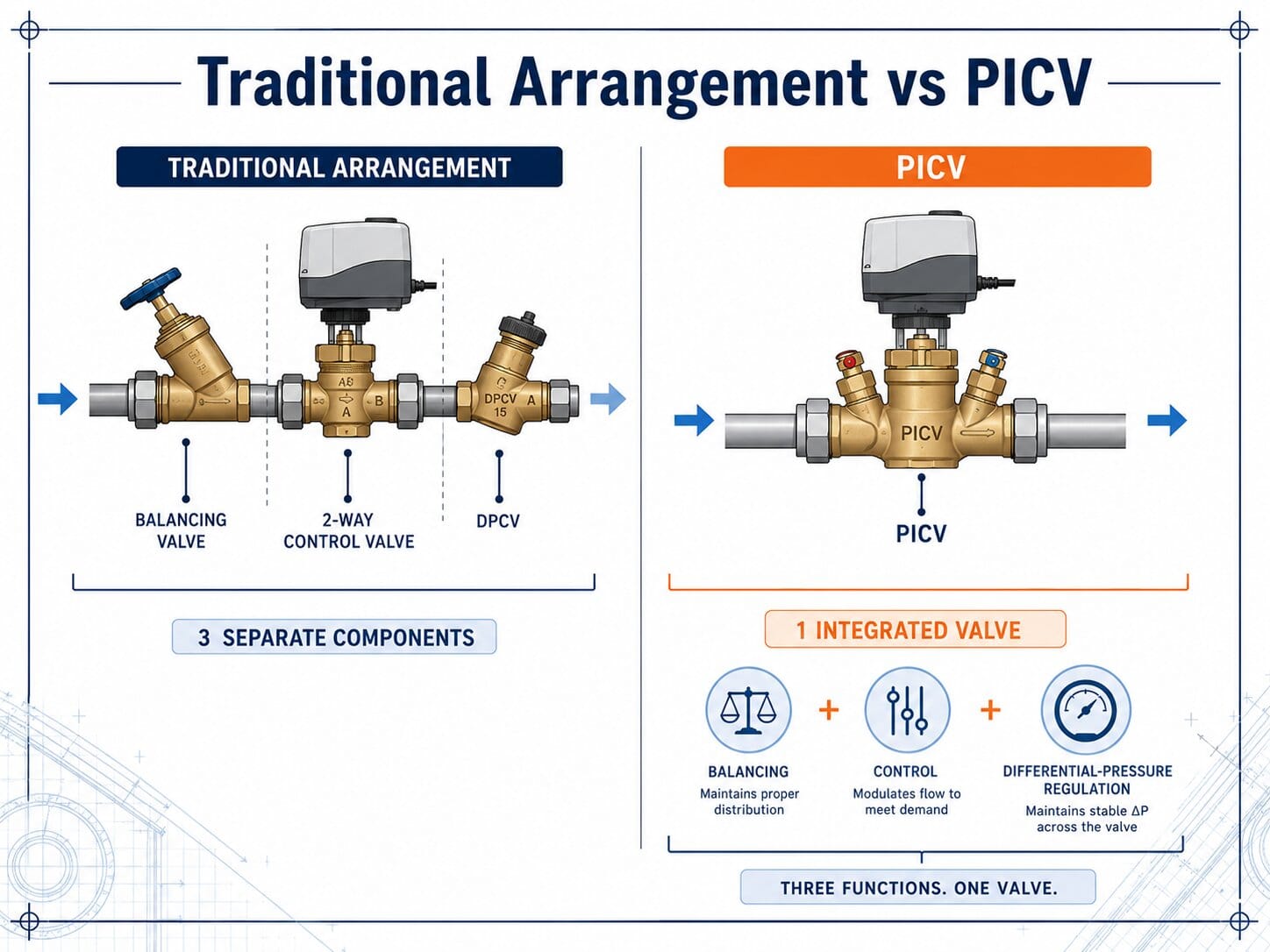
A pressure-independent control valve (PICV) packs three jobs into one body: flow balancing, 2-way modulating control, and differential-pressure regulation. The payoff is much steadier terminal flow when system pressure shifts — as long as the valve has enough differential pressure to work within its published range.
A few other BuildMEP guides already touch on PICVs, especially around actuator replacement and differential pressure. This page fills in the gap.
The easiest way to get your head around a PICV isn't to think of it as some "special control valve." Think of it more as a small hydronic control package squeezed into one valve body.
What a PICV actually replaces
On a traditional hydronic branch, you'd typically have separate components each doing their own job:
Sets the design flow
Modulates with load
Stabilizes differential pressure
That means fewer separate components to select, install and commission at the terminal.
How it works on the inside
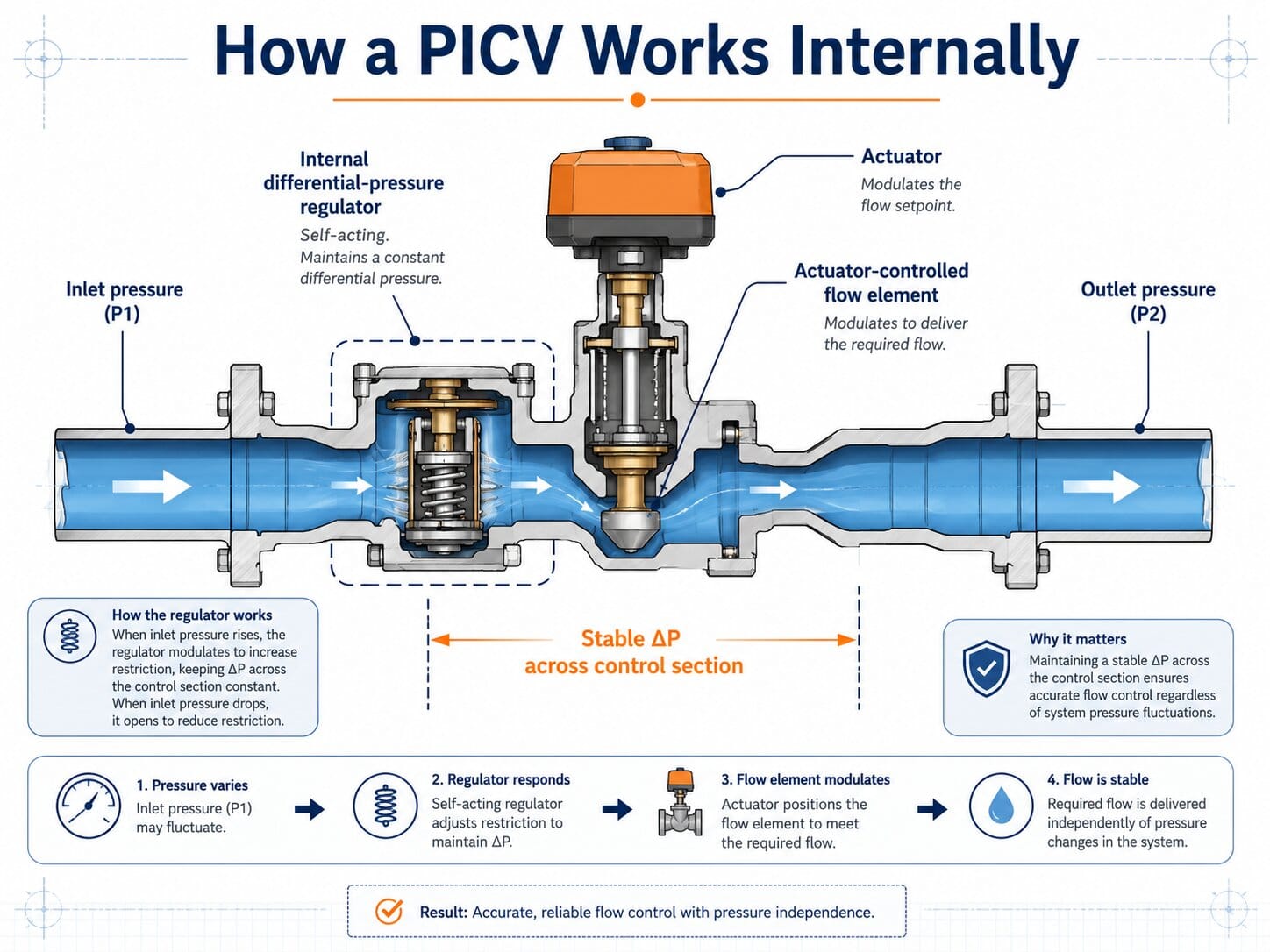
Most PICVs boil down to two functional sections working side by side.
Differential-pressure regulator
A spring-and-diaphragm or piston mechanism responds to pressure changes as water moves through the valve. Its only job is keeping the pressure across the control section reasonably steady.
It handles this mechanically — the BMS never needs to tell it that system pressure has shifted.
Flow-control element
This is the part the actuator actually drives. As the control signal changes, the opening changes with it, and terminal flow tracks the load.
In that respect, this section behaves a lot like an ordinary modulating 2-way control valve.
The key thing is that the internal regulator shields the control section from most of the pressure swings happening elsewhere in the system. That gives the actuator a far more predictable hydraulic condition to work against.
The number I check first: minimum differential pressure
Every PICV needs a certain minimum differential pressure before its regulator can actually do its job. Fall below that available ΔP and the valve can be wide open and still short on design flow.
This is one of those issues that can burn hours during commissioning while the valve itself is completely fine.
When a remote FCU is short on flow, it's tempting to blame the PICV or the actuator first. Before swapping anything out, I check the available differential pressure across the valve and stack it up against the manufacturer's minimum. A low-ΔP branch can make a perfectly good PICV look defective.
PICVs also have an upper limit. More differential pressure isn't automatically better just because the valve is "pressure independent." Push it too high and you can get extra noise and unnecessary stress on the regulating section.
Quick Minimum Differential Pressure Check
Pull the values from the valve datasheet and your system calculation or commissioning reading.
This is a commissioning/design check only. It doesn't replace manufacturer sizing data, valve selection software, or the project hydraulic calculation.
Does a PICV really give perfect valve authority?
You'll hear a lot of people say a PICV has "perfect" valve authority. The idea behind that claim is useful, but I'd stop short of treating it as a blanket rule for every product on the market.
Because the internal regulator holds a fairly stable differential pressure across the control section, the control element can operate with very high authority — and on some product designs, effectively full authority. That's a big part of why PICVs behave far more predictably than ordinary pressure-dependent control valves in variable-flow systems.
For a deeper dive into valve authority and system ΔP, see the BuildMEP differential pressure control guide.
What still sits around a PICV?
A PICV strips out several separate hydronic-control components, but that doesn't mean the terminal ends up as one lonely valve with nothing else around it.
Depending on the project standard and the manufacturer, the terminal assembly may still include:
- Isolation valves for maintenance
- A strainer where required
- A drain point
- Pressure test points, either built into the PICV or fitted separately
- Flexible connections or unions depending on the FCU/AHU arrangement
I'd steer clear of copying one "typical PICV detail" across every brand. Some products come with test points as standard; others make them optional. Let the approved schematic and the valve IOM settle the final arrangement.
Where PICVs make the most sense
PICVs earn their keep in variable-flow chilled-water and heating systems, where system pressure shifts every time other control valves open and close.
Fan coil units
The most common application by far. The PICV caps terminal flow at the selected value while the actuator modulates with room load.
AHU coils
Handy where large pressure swings would otherwise make an ordinary control valve's behavior hard to predict.
Chilled beams
Stable branch flow matters a lot here, since design flow is often small and commissioning accuracy counts.
Reheat and heating coils
Same logic applies on variable-flow heating circuits, where terminal pressure shifts across operating conditions.
What about system ΔT?
A properly selected PICV helps prevent excess flow through a coil, which in turn helps the coil run closer to its intended design conditions and can help protect system ΔT.
That said, I wouldn't pin every low-ΔT problem on bad flow control. Coil fouling, control sequence issues, bad sensors, load conditions, bypassing and plant-side problems can all play a part.
If a project keeps running low ΔT, look at the whole system, not just the valve. A PICV can stop a terminal from overflowing, but it can't fix a dirty coil, a badly placed sensor, or a control sequence that's leaving valves open when it shouldn't.
For related flow and energy-meter considerations, see the chilled-water BTU meter sizing guide.
Manual pressure-independent valve vs actuated PICV
Some manufacturers build the same pressure-independent valve platform into both manual and actuated versions.
| Version | What it does | Typical use |
|---|---|---|
| Manual pressure-independent balancing valve | Holds the preset flow but doesn't take a BMS control signal | Fixed-flow balancing application |
| Actuated PICV | Holds pressure-independent flow control while the actuator modulates with load | FCU, AHU and other variable-load terminals |
So a manual valve and an actuated PICV might share very similar internals, but they're not really doing the same job in the system.
Common mistakes I'd avoid
- Picking an actuator because it physically fits. Check stroke, force, control signal, feedback, fail-safe requirement and the manufacturer-approved pairing.
- Ignoring minimum operating ΔP. A PICV can't regulate properly if the system can't supply the pressure it needs.
- Assuming "pressure independent" means pressure stops mattering. It still has a published working range.
- Assuming a PICV wipes out every balancing consideration in the building. It handles pressure-independent flow regulation at its own terminal; branch and riser design still matter.
- Treating manual and actuated versions as interchangeable. Check what control function the terminal actually needs.
- Copying ancillary components from another brand's detail. Test ports, strainers and connection arrangements vary from one product to the next.
What I check when selecting a PICV
- Design flow rate
- Valve size and available preset range
- Minimum required differential pressure at that flow setting
- Maximum allowable differential pressure
- Control characteristic and actuator compatibility
- Stroke / force / fail-safe requirement
- Control signal and feedback requirement
- Pressure test-point arrangement
- Commissioning access
That list gets you a lot further than just selecting by pipe size.
Frequently asked questions
Does a PICV eliminate the need for a separate balancing valve?
At the individual terminal, generally yes — automatic flow balancing is one of the functions built right into the PICV. That doesn't automatically wipe out every branch- or riser-level hydraulic consideration elsewhere in the system.
Can I turn any 2-way valve into a PICV by adding a DPCV?
Not literally. You can pair a conventional 2-way control valve with a separate differential-pressure controller and balancing arrangement to get similar pressure-independent behavior, but that's still a multi-component setup, not a packaged PICV.
Why isn't my PICV reaching the selected flow?
Check the basics before assuming the valve's bad: available ΔP, preset position, actuator stroke, commissioning valves, strainers, and whether the actual system pressure even falls within the manufacturer's working range.
Do I still need to calculate valve authority for a PICV?
For the PICV's own pressure-regulated control section, the internal regulator largely removes traditional authority problems. Authority can still matter for other pressure-dependent valves elsewhere in the same system.
Can I use any actuator with a matching stroke?
No. Mechanical fit and stroke are only part of the check. Required force, control signal, feedback, fail-safe action and the manufacturer-approved valve/actuator combination all matter too.
Related BuildMEP guides
- Differential Pressure Control in HVAC Explained
- Valve and Damper Actuator Torque Sizing Guide
- Chilled Water BTU Meter Sizing: A Practical Guide
- Frese Optima Compact Actuator Equivalents – Siemens Replacement Guide
- Belimo EP050R+MP Replacement Guide
A PICV is pressure independent only within its published operating range. Always work from the selected manufacturer's flow-setting table, minimum ΔP requirement, maximum differential-pressure rating and approved actuator data for the final design.