

Hydronic controls field guide
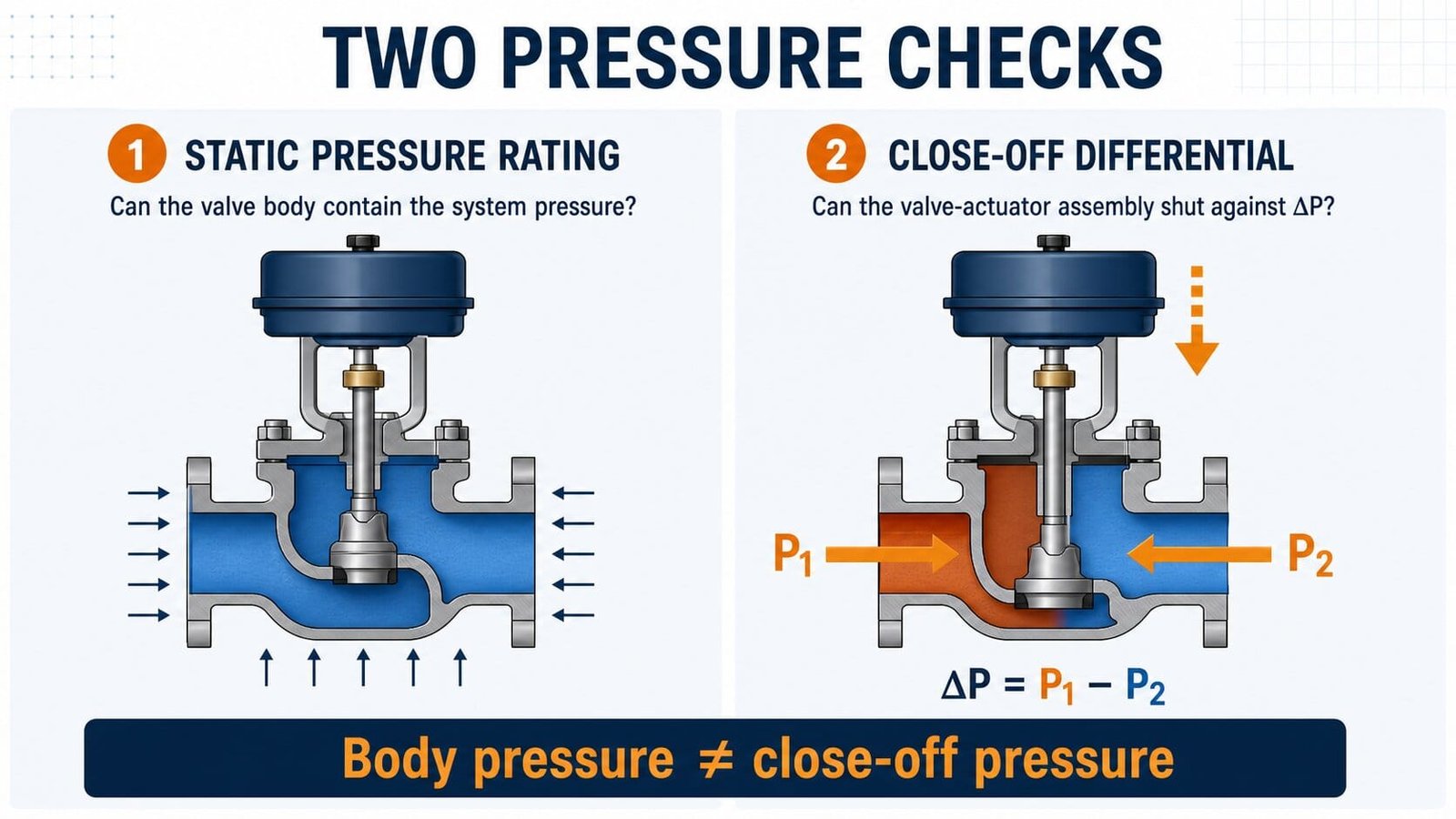
A control valve can be safe at the system pressure and still fail to close. That stops sounding contradictory once you separate five numbers: body pressure rating, close-off differential, valve authority, PICV operating differential and DPCV setting.
Five pressure numbers that should not be mixed up
| Term | What it tells you | Compare it with | If it is wrong |
|---|---|---|---|
| Static pressure rating | The pressure and temperature the valve body can safely contain. | Maximum system fill/operating pressure, including credible transients, using the applicable pressure class and temperature rating. | Body, joint or seal leakage; possible mechanical failure. |
| Close-off differential pressure | The maximum pressure difference against which the complete valve-actuator assembly can achieve its stated shutoff/leakage performance. | Highest credible differential across the closed valve—not simply normal design-flow ΔP. | The valve may pass water, fail to isolate or need a stronger actuator. |
| Valve authority | How much influence a conventional modulating valve has over its circuit. | Valve ΔP at design flow versus the pressure loss of the controlled circuit at that same flow. | Low authority distorts the installed characteristic and can make control abrupt or unstable. |
| PICV minimum ΔP | The differential needed for the internal regulator to maintain pressure-independent flow control. | Available differential across the PICV at the hydraulically critical operating condition. | Below the published operating range, flow becomes pressure dependent and design flow may not be reached. |
| DPCV setting | The branch or subcircuit differential the valve maintains between its impulse points. | Calculated downstream losses at design flow, including the components located between the sensing points. | Too low starves the branch; too high wastes pump head and increases stress/noise at downstream valves. |
Which number should I check first?
- Safety first: body rating. Confirm pressure class, temperature range, medium and connection type against the system design conditions.
- Can it shut? Find the maximum credible differential across the closed valve and compare it with the manufacturer’s close-off rating for the exact valve, actuator, flow direction and leakage class.
- Can it control? For a conventional pressure-dependent valve, calculate authority at design flow. For a PICV, confirm both minimum and maximum operating ΔP.
- Can the circuit receive design flow? Check the pump and control setpoint at the critical circuit. A correctly selected valve cannot create pressure that is not available.
- Can it survive the real system? Review commissioning, fouling, strainers, pump staging, sensor location, DP reset and abnormal modes—not only the tidy design point.
Two-way and three-way valves: use the right worst case
In a variable-flow system, a two-way valve often sees its highest differential as it closes and other branches also throttle. In some layouts, the valve nearest the pump can approach the available shutoff head. But “every two-way valve sees full pump head” is not a universal rule. The actual value depends on pump controls, sensor location, elevation/static effects in open systems, branch location, check valves, bypasses, DPCVs and relief arrangements.
A three-way valve is not automatically an easier close-off selection. Check the manufacturer’s stated close-off for the correct port and flow arrangement—mixing or diverting—and consider the differential created by unequal coil and bypass resistance. Balance the bypass to match the load-side pressure loss where the design calls for constant branch flow. Add margin deliberately for pump tolerance and operating uncertainty; do not apply a universal percentage without the project specification or manufacturer guidance.
Valve authority without the textbook fog
Valve authority describes how strongly a conventional control valve influences the flow in its circuit. Use all pressure drops at the same design flow:
Authority, a = ΔPvalve, open ÷ (ΔPvalve, open + ΔPrest of controlled circuit)
An authority of 0.50 means the open valve and the rest of the controlled circuit each account for half of the relevant pressure drop. ASHRAE guidance commonly places useful HVAC modulating-valve authority around 0.25–0.50, with newer guidance often favoring 0.30–0.50 for typical coil applications. Treat that as a design range, not a magic pass mark: the valve characteristic, coil response, pump control and branch arrangement still matter.
Worked example: conventional coil valve
A coil, strainer and local pipework lose 45 kPa at design flow. The selected open valve loses 30 kPa.
a = 30 ÷ (30 + 45) = 0.40
That is a practical starting point for a modulating coil valve. It does not complete the selection: also verify required flow coefficient, noise/cavitation limits, rangeability, body rating and close-off differential.
Close-off pressure: check the assembly, not the valve body
Close-off is a property of the selected valve-actuator combination. A different actuator force, valve size, flow direction or leakage requirement can change the published value. Confirm it on the exact manufacturer schedule or selection output.
Close-Off Pressure Check
This screening check compares the selected assembly rating with the project differential and an explicit design margin.
A margin is a project decision, not a universal code value. Confirm the project specification and manufacturer data.
Worked example: close-off
The hydraulic review finds 180 kPa as the highest credible differential. With a project-selected 10% allowance, the required rating is 198 kPa. A valve-actuator combination rated 250 kPa passes this numerical screen. The submittal must still confirm flow direction, leakage class, temperature and fail-safe action.
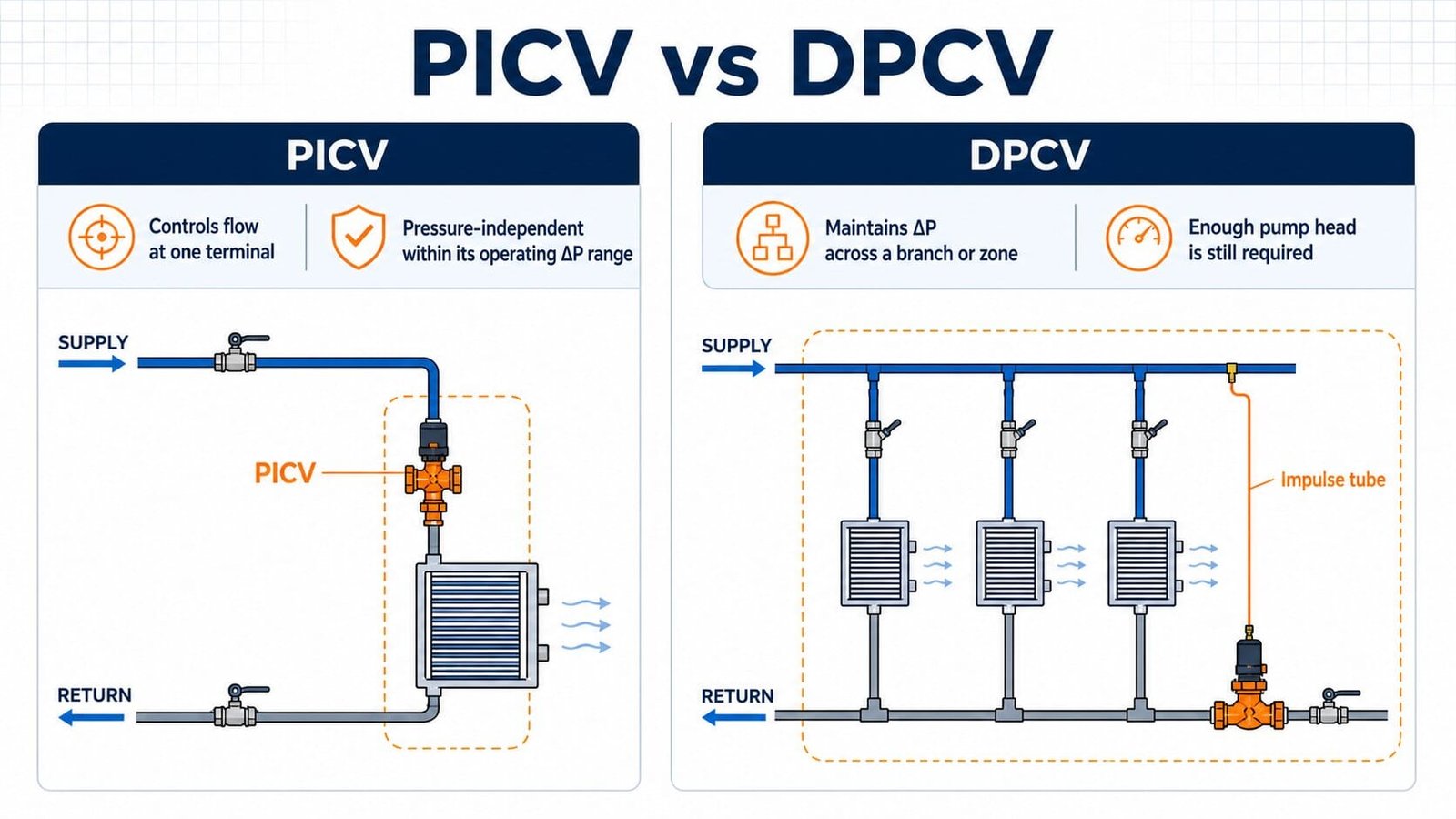
PICV vs DPCV: similar purpose, different boundary
PICV
A pressure-independent control valve combines modulating control with an internal differential-pressure regulator and usually a maximum-flow setting. It stabilizes flow for that terminal while the available ΔP stays within its published operating range.
Use it when: you want terminal-level flow control, simple balancing and predictable flow as system pressure changes.
Check: design flow, minimum/maximum operating ΔP, close-off rating, actuator function, water quality and access for commissioning.
DPCV
A differential pressure control valve maintains a selected ΔP across a branch, riser or subcircuit using impulse connections. Downstream conventional control valves then operate within a more stable pressure environment.
Use it when: several terminals share a branch and you want to limit branch differential, noise and control-valve pressure variation.
Check: design branch flow, required downstream ΔP, DPCV authority/range, minimum available pressure and impulse-tube locations.
Worked example: PICV minimum differential
A selected PICV requires at least 35 kPa at the scheduled flow. At the critical terminal, the calculated available differential is 42 kPa at design duty. The nominal surplus is only 7 kPa. Before accepting it, check pump tolerance, dirty-strainer allowance, pipe calculation uncertainty and the manufacturer’s exact setting-dependent requirement. If the real differential falls below the minimum, the valve no longer regulates flow independently.
Selection and commissioning checklist
| Stage | Record | Field question |
|---|---|---|
| Design | Flow, circuit losses, pump curve, DP setpoint and sensor location | What is the hydraulically critical circuit at full and part load? |
| Selection | Exact valve/actuator combination, pressure class, close-off, operating ΔP range | Are values taken from one valid manufacturer selection? |
| Installation | Flow arrow, impulse-tube connections, straight-run/installation requirements, accessibility | Is the valve installed in the configuration used for selection? |
| Commissioning | Measured ΔP, achieved flow, actuator stroke, pump speed and valve position | Does the critical valve reach design flow without every valve being over-pressurized? |
| Operation | Trend valve positions, branch ΔP and pump speed | Can the DP setpoint be reset from valve demand while retaining critical-circuit flow? |
Concise FAQs
Is static pressure the same as differential pressure?
No. Static pressure is a pressure at a point relative to a reference. Differential pressure is the difference between two points. A closed hydronic loop can have high static fill pressure while a stopped pump produces little or no pump-generated differential.
Does a PICV have perfect valve authority?
It behaves as pressure-independent within its published ΔP operating range because its internal regulator stabilizes pressure across the control element. ASHRAE describes this as operating “as if” it has perfect authority; outside that range, it becomes pressure dependent.
Is 0.50 always the correct valve authority?
No. It is a useful design reference, not a universal requirement. ASHRAE commonly discusses approximately 0.25–0.50, depending on the circuit and control objective. Higher authority improves control influence but costs pump head.
Should I size close-off from pump design head?
Use the highest credible differential across that valve. It may be near pump shutoff head in some two-way-valve layouts, but pump controls and hydraulic location can produce a different value. Check the pump curve and sequence.
Can a DPCV reduce pump energy?
It can prevent excess downstream differential, but the pump-control strategy determines the energy result. A fixed high pump setpoint can waste energy even when branches are locally controlled.
Why is a valve noisy at part load?
Excess differential, high velocity, cavitation or poor valve authority are common causes. Measure ΔP at the actual operating condition and compare it with the valve’s application limits.
Authoritative references
- ASHRAE Handbook—HVAC Systems and Equipment, Chapter 13: Hydronic Heating and Cooling — valve authority, two-/three-way circuits and pump differential-pressure control.
- ASHRAE Handbook—HVAC Systems and Equipment, Chapter 46: Valves — pressure-dependent control, PICV operating range and valve application.
- Belimo Electronic Valve Applications Guide — installed differential-pressure variation and valve-authority definition.
- Danfoss AB-PM differential-pressure controller data sheet — DPCV sizing, required loop differential and minimum available differential.
Engineering note: manufacturer operating limits vary by valve size, setting and actuator. Use this guide to structure the check, then approve the selection from current project-specific data.