
The same is true for all the ‘essential tools for homeowners’ lists—what to purchase, but not what to do with them. An easy part is a tool list. The challenging part is distinguishing between those jobs that you can do and those that require a licence and those that require two tools that are normally standard yet are often purchased for use in a job not safe for their use.
This guide focuses on all three, not a general DIY guide, but a building services guide.
The short answer is, most homeowners are only in need of 6 tools, not 12. Purchase a good plunger, adjustable wrench, insulated screwdriver set, pliers with a wire stripper, CAT III-rated multimeter and a pair of goggles. If a job requires it, use the rest, but not otherwise, and know the precautions of your voltage tester before you rely on it.
First: What You Should Actually Be Doing Yourself in the Home MEP Toolkit
The line isn’t about confidence or skill. It’s about what happens when it goes wrong, and who is liable when it does.
Generally fine to do yourself:
- Clearing sink, tub and toilet blockages
- Replacing tap washers and cartridges, and shower heads
- Resealing around baths, sinks and worktops
- Replacing filters on air conditioning units and extract fans
- Replacing light bulbs and cleaning diffusers
- Resetting tripped breakers and RCDs/GFCIs (once — see below)
- Testing outlets and checking for obvious faults
- Bleeding radiators
Get a licensed professional:
- Anything inside a distribution board or consumer unit
- Adding, moving or extending circuits and outlets
- Gas appliances, without exception, in essentially every jurisdiction
- Anything touching the refrigerant circuit of an air conditioner — refrigerant handling is licensed nearly everywhere, and venting is an offence in many jurisdictions
- Main water shut-off valve replacement
- Any work on a heat exchanger or flue
A note on repeated trips. A breaker or RCD that trips once may be a one-off. A breaker that trips repeatedly is telling you there is a fault — an overload, a short, or deteriorating insulation. Resetting it again and again does not fix the fault; it removes the only thing standing between the fault and a fire. If it trips twice, stop resetting it and get it investigated.
Check your local rules. Notifiable electrical work varies significantly by country and often by region. In parts of the UK, EU, Australia and the Gulf, work a US homeowner could legally do themselves requires a licensed contractor and a certificate. Doing notifiable work yourself can also invalidate home insurance and complicate a future sale. Check before you start, not after.
The Two Tools People Buy Wrong
1. Multimeters: The CAT Rating Is the Safety Spec
Every multimeter shows a maximum voltage on the display or the box. That number tells you what the meter can display. It does not tell you what the meter can survive.
Real electrical systems carry transients — brief, high-energy voltage spikes from motors switching, faults upstream, or lightning. They last microseconds but carry enough energy to make a meter arc over internally. The specification that describes a meter’s ability to survive that is the measurement category, defined under IEC 61010:
| Category | Where it applies |
|---|---|
| CAT I | Protected electronics not connected to mains |
| CAT II | Plug-in loads — appliances, portable tools, things at the socket |
| CAT III | Fixed building wiring, distribution boards, breakers, hardwired equipment |
| CAT IV | Service entrance, utility meter, origin of the installation |
The category and the voltage have to be read together. A meter marked “CAT III 600V, CAT II 1000V” is safe to 600V at a distribution board and to 1000V at a socket — two different promises on one label.
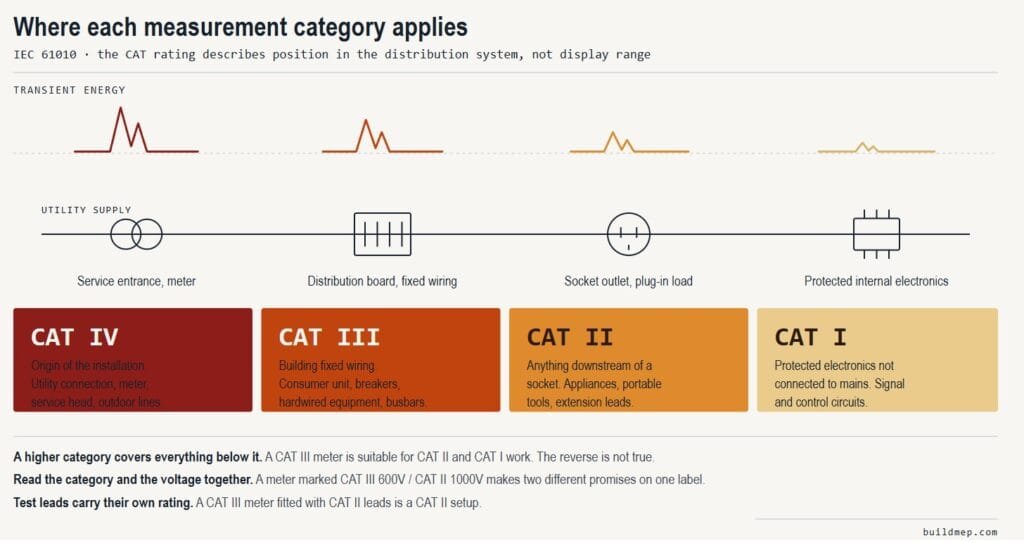
What this means in practice: a cheap meter rated CAT II is fine for checking a plug-in appliance or a battery. It is not adequate for anything at a distribution board. If you buy one meter, buy CAT III rated at or above your local supply voltage — it covers everything below it too, and it’s the difference between a meter that fails safely and one that fails in your hand.
Two things people miss:
- Test leads carry their own rating. A CAT III meter with CAT II leads is a CAT II setup. Match or exceed the meter’s rating.
- The marking is manufacturer-declared. IEC doesn’t certify individual meters. Look for an independent testing mark alongside the CAT claim, particularly on budget instruments where the printed rating may be optimistic.
2. Non-Contact Voltage Testers: Useful, But Never Proof
The pen-style tester that beeps near a live wire is a genuinely useful screening tool. It is also the single most misunderstood item in the average home toolkit, because it has a failure mode that looks exactly like good news.
It can tell you a circuit is definitely live. It cannot tell you a circuit is dead.
Documented conditions under which a live circuit produces no alert:
- Metal conduit, armoured or metal-clad cable, or a metal enclosure — the metal acts as a shield and blocks the field the tester detects. This is the most dangerous case.
- Low or dead battery — sensitivity drops before the tester stops working entirely
- DC circuits — these testers sense an alternating field; solar, battery and DC control circuits produce nothing to detect
- Voltage below the tester’s threshold — a unit rated from 90V will not see a 24V control circuit, which can still deliver a shock
- Bundled conductors, where fields from adjacent wires partially cancel
- Distance or thick insulation attenuating the field
- User isolation — insulating footwear or a mat can weaken the capacitive path the tester relies on
The reverse also happens: a dead conductor running parallel to a live one picks up induced “ghost” voltage and triggers a false alert.
The correct procedure is live–dead–live. Test the tester on a known-live source. Test your target. Test the tester on the known-live source again. If the tester passes both bookend checks and reads nothing on your target, that’s meaningful — and for anything beyond a screening check, confirm with a contact meter.
Manufacturers state this themselves in their own instructions. It is generally worded as: do not assume that no indication means the circuit is de-energised.
The Core Kit
Grouped by what actually goes wrong in a home.
Drainage and Water
Plunger — a flange plunger for the toilet and a flat-cup one for sinks and baths. They are not interchangeable; a flat cup can’t seal a toilet outlet. Buy both, keep them separate.
Hand auger (drain snake) — reaches blockages a plunger can’t shift, and clears them mechanically rather than chemically. Worth noting that chemical drain cleaners can damage older pipework and traps and make a subsequent plumber’s job hazardous.
Adjustable wrench — 6″ and 10″ covers most domestic fittings. On chrome or plated fittings, a cloth around the jaws prevents marking.
Sealing and Air
Caulking gun and sealant — use sanitary-grade silicone in wet areas; it contains a fungicide that standard sealant doesn’t. Cut the nozzle smaller than you think and remove the old sealant completely, or the new bead will fail at the joint.
Infrared thermometer — genuinely useful for building services: checking supply and return air temperature at a diffuser, finding cold spots and draughts, checking a radiator is heating across its full surface. Read the emissivity limitation — infrared thermometers read poorly off shiny and bare metal surfaces, which reflect rather than emit. A strip of matte tape on the surface gives a far more reliable reading.
Electrical
Insulated screwdriver set — look for VDE marking, which indicates testing to the relevant insulation standard rather than a plastic handle that merely looks insulated.
Pliers and wire stripper — needle-nose, combination, and a dedicated stripper. Stripping with a knife nicks the conductor and creates a weak point that heats under load.
Multimeter — see above. This is where the money goes.
Socket/outlet tester — the plug-in type with indicator lights. Genuinely useful for finding reversed polarity and missing earth. Note that the common three-light testers cannot detect a bootleg ground (earth bonded to neutral at the socket), which reads as correct and is not. If a result surprises you, get it checked properly.
Access and Protection
Step ladder — check the duty rating against your weight plus what you’re carrying, not just your weight. Use the top platform as a tool rest, not a step.
Eye protection and gloves — the one item nobody regrets and everybody skips. Note that general work gloves are not electrical gloves and provide no shock protection.
Tape measure — 5 m covers domestic work.
What You Can Usually Skip
Being honest about this is more useful than padding a list to a round number:
- A dedicated non-contact voltage tester, if you’re buying a decent multimeter—the meter does the job more reliably, and the tester’s limitations mean you shouldn’t be relying on it alone anyway
- A full socket set — most domestic MEP work is served by the adjustable wrench
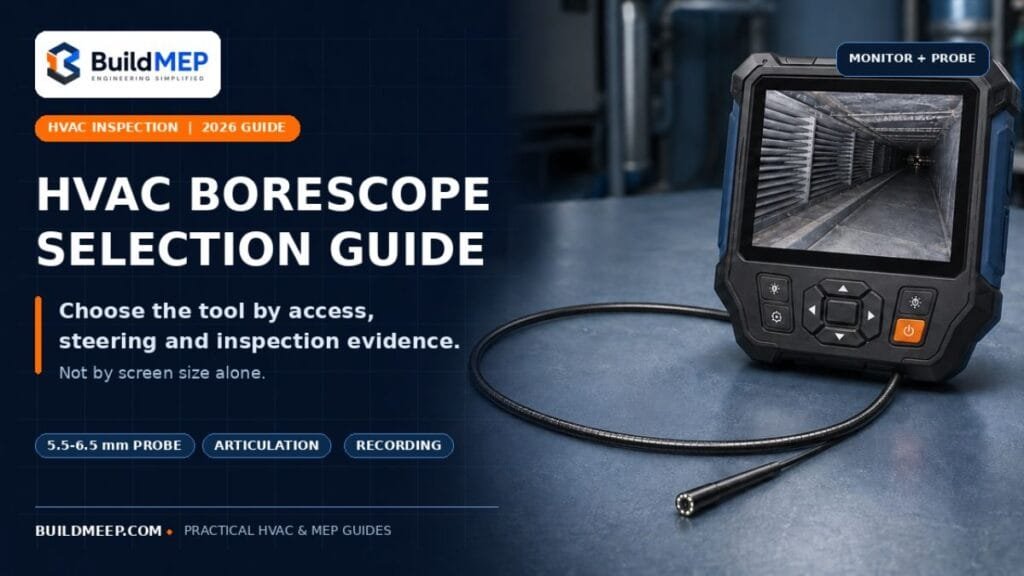
- A borescope—genuinely useful, but this is a professional diagnostic tool. If you need to see inside a duct or wall cavity, you’re likely at the point of calling someone. (If you do want one, our HVAC borescope selection guide covers what actually matters.)
- A pipe wrench, unless you have exposed iron pipework—it will mark and deform chrome and copper fittings
Related Reading
- How to reduce your AC bill in summer — practical energy savings that don’t need tools
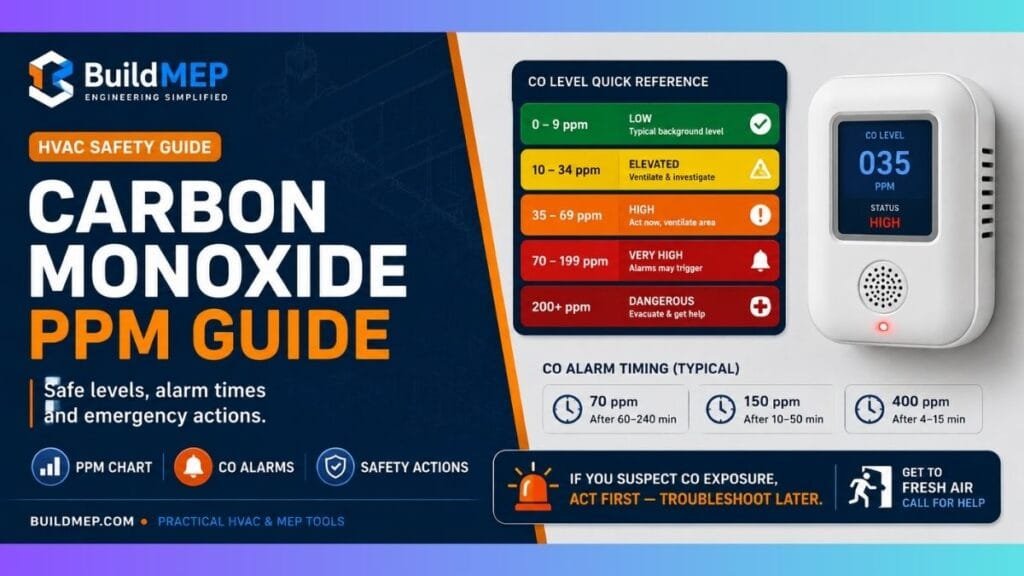
- Carbon monoxide safe levels and action guide — worth reading if you have any fuel-burning appliance
- HVAC borescope selection guide — for when a visual inspection is the job
Frequently Asked Questions
What CAT rating multimeter do I need for home use?
CAT III rated at or above your local supply voltage. It covers CAT II and CAT I environments as well, so one meter does everything. CAT II-only meters are adequate for plug-in appliances but not for anything at a distribution board.
Can I trust a non-contact voltage tester to tell me a wire is dead?
No. It reliably tells you a circuit is live; it cannot prove a circuit is dead. Metal conduit, shielded cable, DC circuits, low battery and low-voltage circuits all produce no alert on a live system. Use live–dead–live procedure and confirm with a contact meter.
Why does my breaker keep tripping, and can I just keep resetting it?
A repeatedly tripping breaker indicates a fault — an overload, short circuit or insulation failure. The breaker is doing its job. Resetting repeatedly defeats the protection without addressing the cause. Have it investigated.
Is it legal for me to do my own electrical work?
It depends entirely on where you live, and the differences are large. Some jurisdictions permit homeowner work on their own property; others require a licensed contractor and a certificate for anything notifiable. Unauthorised work can also affect home insurance and property sale. Check your local requirements first.