
BuildMEP HVAC Controls Guide
Spring return is one of those actuator specifications that looks simple on a datasheet — until you have to decide what the damper or valve should actually do when power disappears. That is where the real engineering question starts.
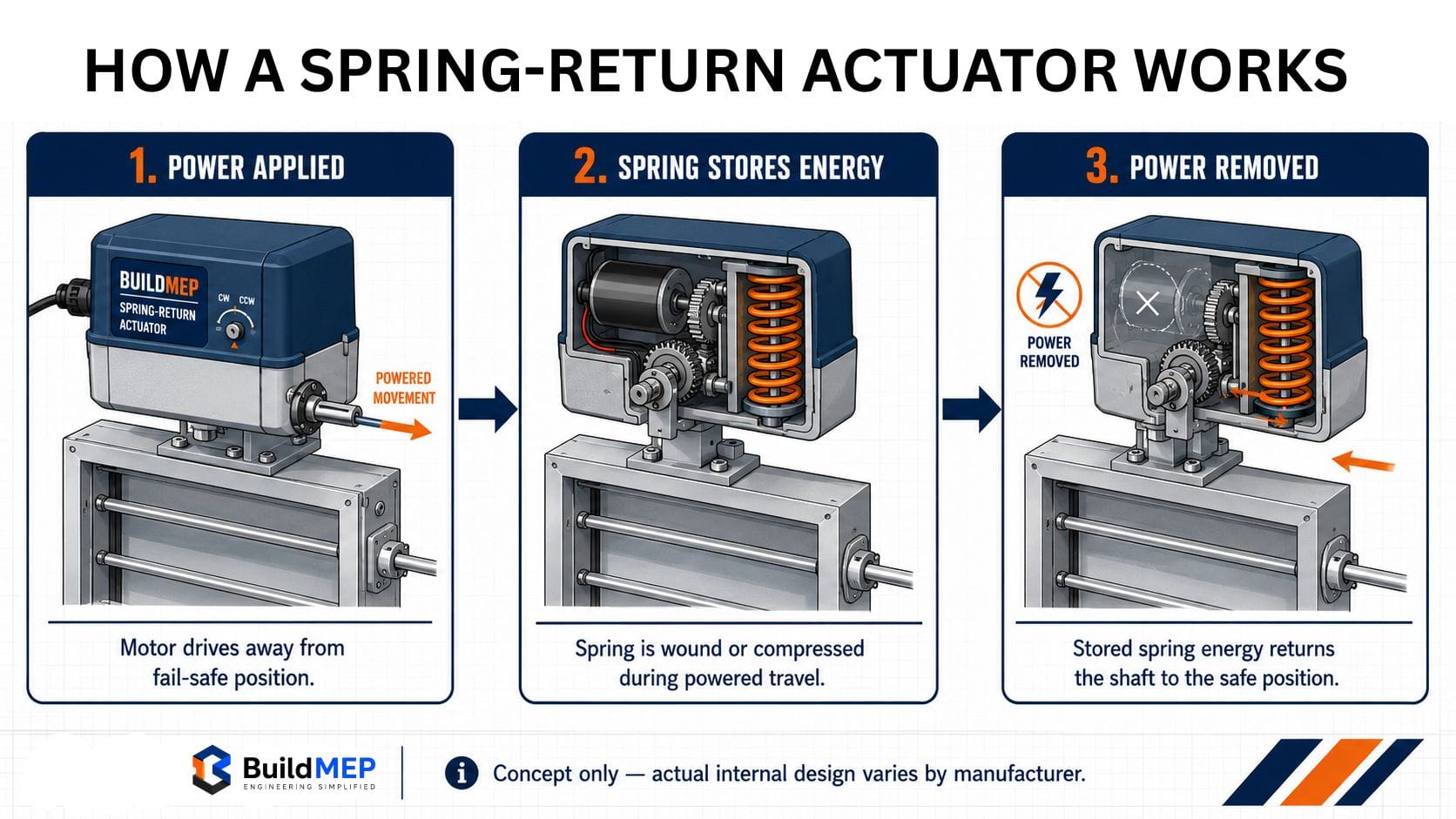
A spring-return actuator stores mechanical energy in a spring while it moves away from its fail-safe position. When power is removed, the spring drives the actuator back toward that preset safe position. The important selection questions are not only torque and voltage, but also fail position, running time, control signal, mounting direction, and whether the application requires a listed life-safety actuator.
Several BuildMEP actuator guides mention “spring return,” “fail-safe,” or “fail closed” as if everyone already knows what happens inside the actuator. This guide fills that gap.
Why fail-safe exists
Imagine an outside-air damper serving an AHU in a cold climate. If the system loses power and that damper is left open, cold outside air can continue reaching the coil. Depending on the system and weather conditions, that can increase the risk of freeze damage.
A fail-safe actuator gives the designer a defined answer to the power-loss question: where should this damper or valve go when control power is no longer available?
Before looking at actuator model numbers, ask one sentence: “If this actuator loses power right now, which position is safer for the equipment and the building?” That answer usually tells you whether you need fail-safe action and which direction it should move.
How a mechanical spring-return actuator works
Motor drives away from fail-safe position
Spring is wound or compressed
Spring drives actuator to fail-safe position
The exact internal mechanism varies by manufacturer, but the principle is the same. The motor moves the actuator in the powered direction while the spring stores energy. When power is removed, that stored mechanical energy returns the shaft to the fail-safe end position.
Do not assume that every non-spring-return electric actuator actively “holds” its position by running the motor continuously. Many modern actuators use gearing and electronic control that allow them to remain in position with very low holding power. The important distinction is simpler: a normal non-fail-safe actuator has no guaranteed stored-energy return unless the product is specifically designed for it.
Fail closed or fail open?
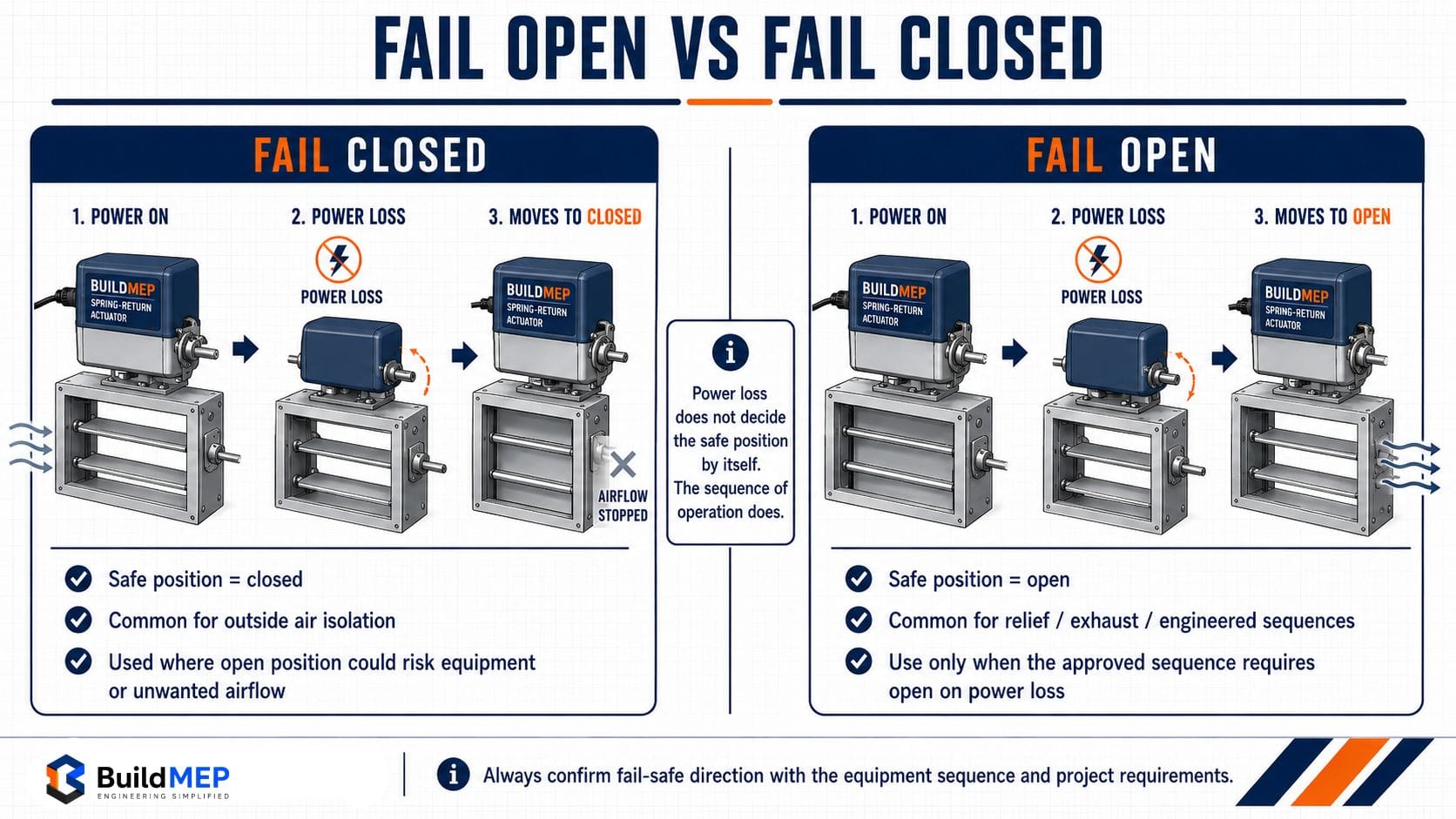
“Spring return” does not automatically mean “spring closed.” Depending on mounting and actuator design, fail-safe rotation can often be arranged clockwise or counter-clockwise.
Safe position = closed
Common where the safe response is to stop outside air, isolate a path, shut a valve, or close a damper as part of the approved sequence.
Safe position = open
Used where maintaining an open path is the safer condition, such as certain exhaust, pressure-relief, or engineered smoke-control sequences.
Spring return does not automatically mean “double the torque”
This is one claim I would avoid using as a rule.
The spring mechanism is part of the actuator’s design, so the motor and gear train are selected by the manufacturer to provide the actuator’s published torque. Size the actuator against the required damper or valve torque, then choose a spring-return model whose published torque meets that requirement.
Do not say, “The old actuator is 10 Nm, so I need another 10 Nm actuator.” First confirm the actual application torque and whether the replacement needs fail-safe operation. Then select from the manufacturer’s spring-return range.
For the full torque-selection method, see the BuildMEP actuator torque sizing guide.
Spring-return speed and motor speed can be different
A spring-return actuator often has two running-time values: one for powered movement and another for fail-safe return. They can be very different.
The point is not that spring return is always a particular number of seconds. It is that you must check both times separately, especially where the sequence requires a fast response.
Can spring return be used during normal control?
Yes. This depends on the actuator and control method.
Many spring-return actuators are intentionally designed so that applying power moves the actuator one way and removing power allows the spring to return it. In a simple two-position application, that may be the normal control sequence — not an emergency-only event.
For modulating applications, the actuator may position normally under powered control while retaining the spring as the fail-safe mechanism. Always follow the product’s own operating description rather than applying one maintenance rule to every spring-return actuator.
Mechanical spring vs electronic fail-safe
A spring is not the only way to create fail-safe movement.
Mechanical spring return
Energy is stored mechanically. When power is removed, the spring returns the actuator to its fail-safe position.
Electronic fail-safe
Some actuators use stored electrical energy, commonly capacitors, to drive the motor to a selected fail-safe position after power loss.
So “fail-safe” and “spring return” are related terms, but they are not exactly the same thing.
What about fire and smoke dampers?
This is where actuator selection moves beyond ordinary HVAC preference.
Smoke and combination fire/smoke damper assemblies have specific listing, control and fail-safe requirements. Do not read “fire/smoke damper” and simply buy a general-purpose spring-return actuator with enough torque.
For the wider damper-selection and installation requirements, see the BuildMEP fire and smoke damper guide.
Quick Fail-Safe Logic Helper
This is a design-thinking helper, not a code checker. Use it to identify what you should verify next.
Always confirm final fail-safe requirements against the approved sequence of operation, project specification, applicable code/listing, and actuator manufacturer data.
What I check when replacing a spring-return actuator
- Required torque or thrust
- Spring return / electronic fail-safe / non-fail-safe
- Required fail position
- Supply voltage
- Control signal
- Motor running time
- Fail-safe running time
- Rotation angle or stroke
- Feedback signal
- Auxiliary switches
- Shaft size, mounting arrangement and available space
- Life-safety listing where applicable
The model number is useful, but the sequence of operation is more important. Two actuators can have the same voltage, torque and shaft size and still be wrong replacements if one fails open and the other fails closed.
Common mistakes
- Assuming spring return always means fail closed. The fail direction depends on actuator arrangement and system intent.
- Applying a made-up torque multiplier. Use the application torque and the manufacturer’s published spring-return actuator rating.
- Checking motor speed but ignoring fail-safe speed. Both can matter to the sequence.
- Calling every fail-safe actuator “spring return.” Electronic fail-safe products also exist.
- Replacing a fire/smoke actuator with a general HVAC model. Life-safety assemblies require the correct listed arrangement.
- Matching the old model only by voltage and torque. Fail direction, signal, feedback, running time and mounting can still make it incompatible.
Frequently asked questions
Does every HVAC actuator need spring return?
No. Fail-safe action matters where the system needs a defined position after loss of power. Many ordinary comfort-control dampers and valves can use non-fail-safe actuators if the design does not require a specific power-loss position.
Does spring return always mean fail closed?
No. Depending on the actuator and mounting arrangement, the fail-safe direction may be configured toward open or closed. The required position comes from the system sequence.
Is spring return always faster than motor operation?
Not as a universal rule. Motor and fail-safe running times are separate manufacturer ratings. Check the datasheet.
Can a capacitor actuator be fail-safe without a spring?
Yes. Electronic fail-safe actuators store electrical energy and use it to move to a selected safe position when power is lost.
Can I use a normal spring-return actuator on a fire or smoke damper?
Do not assume so. Fire and smoke dampers are life-safety assemblies. The actuator must be suitable for the listed damper arrangement and applicable project requirements.
Related BuildMEP guides
- Valve and Damper Actuator Torque Sizing Guide
- Fire & Smoke Damper Selection and Installation Guide
- Complete Belimo Retrofit Guide
- Siemens GCA166.1E vs GCA161.1E Comparison
Technical references
- Belimo — Fail-Safe Damper Actuators
- Siemens — Damper Actuator Selection for HVAC Systems
- NFPA — Basics of Fire and Smoke Damper Installations
“Fail-safe” is a system behaviour, not just a feature printed on the actuator label. Start with the required safe position and sequence of operation, then select the actuator technology, torque, signal, speed and listing that satisfy it.