

You are probably one of three users who would have searched for “HAP 6.2 free download”: you have a project without a license to size, you are studying load calculation, and you can’t afford the license for a particular project that calls for version 6.2.
Monthly Engineering Briefing
Get notified when new BuildMEP guides and tools publish. One concise email a month.
The honest answer differs for each. Here it is up front, then the details.
The short version
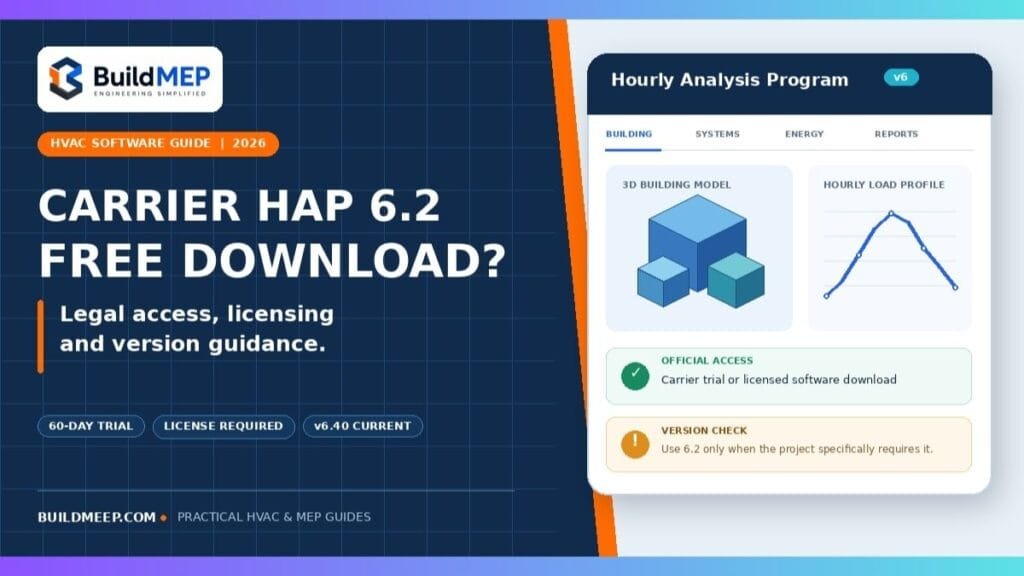
Carrier’s Hourly Analysis Program is not legally free, and there is no legally free version of 6.2. Carrier licenses HAP on an annual basis: a 1st-year fee, then renewal fees.
What is available, for free:
- A 60-day trial of the eDesign Suite, requested directly from Carrier. Full program, time limited.
- A student and training route through Carrier University’s HAP v6 courses which will be available to existing licence holders and others at course rates.
One thing to note before diving deeper into the topic is that this version 6.2 is currently three releases behind. The carrier shipped v6.3, then v6.3.1 in January 2026, then v6.4 in April 2026. If nothing is forced.
Getting HAP legally
Ask for the 60-day trial. This is dealt with by the Carrier’s eDesign Trial page. You request one and installation instructions and a licence key are sent by email. It’s not just the eDesign Suite, but the entire suite of HAP — and it’s not a feature-stunted trial, it’s the full program, so it’s actually useful in one’s first project, or to learn the workflow right.
If you’re already licensed, go to the Carrier’s Software Downloads page and enter the key you received in the Key Field. One convenient thing to know is that v6.4 is free of licence changes, therefore if you were on 6.3, it will be a seamless upgrade and you will not need to change anything.
If you need 6.2 specifically, contact Carrier Software Systems. They’re able to guide customers that are stuck on one version to the right build. This is a genuine situation and they deal with it routinely — don’t assume you have to go around them.
Do you actually need 6.2?
Usually not, and the version-handling rules matter more than people expect.
Data conversion runs one way. Open a 6.0 or 6.1 project in 6.2 and HAP converts it automatically, inserting “(converted)” into the project name so you don’t overwrite the original. Once converted, that project cannot be reopened in the older version. If you might need to inspect the original later, save the converted copy under a separate name before you do anything else.
Newer versions coexist. v6.4 does not overwrite or replace v6.3 — both run on the same machine. That’s the sane setup for anyone maintaining older project files alongside new work.
Results will shift between versions. This is the part that catches people mid-project. The calculation engine changed in 6.2, which alters how loads are computed for zones containing multiple spaces. Converting an in-flight project can change your numbers, sometimes materially. Finish the project on the version you started it on, or budget time to re-run and re-check everything.
So the case for insisting on 6.2 comes down to: a spec or client standard names it, or you’re maintaining a model that was built in it and you don’t want the results to move. Otherwise, take the current release.
What HAP 6.2 actually introduced
Carrier’s own New Features Guide for 6.2 lists four areas of change.
gbXML import. An “Import gbXML” option was added to the Project menu, letting you bring 3D building geometry straight out of a BIM or CAD tool. HAP builds the model from the file — levels, spaces, walls, floors, ceilings, roofs, with window, door and skylight openings positioned in the envelope.
This is the feature people most often expect to work magically, so a caution from experience: it only works if the source drawing is clean. You need complete geometry, closed volumes with surfaces actually connected, and every surface associated with a space. A messy Revit model produces a messy HAP model, and cleaning that up afterward can take longer than building the space model by hand would have. Check the export before you import it.
LEED v4.0 and Appendix G. HAP 6.2 added the ability to generate a LEED v4.0 Summary Report from a Standard 90.1 Appendix G performance rating analysis. The significant part is automation: HAP now generates the 90°, 180° and 270° baseline rotations itself, so you no longer build input data for each one manually. You define the Proposed alternative fully, duplicate it as your 0° Baseline, modify that to meet Appendix G baseline requirements, and let HAP handle the rest at report time.
The resulting Performance Rating Summary report carries data for all four baseline alternatives plus the proposed case, a tabulation of baseline and proposed envelope areas by exposure, and a LEED v4 credit points table.
One setup detail people miss: you have to select the LEED rating system in project preferences when you create the project. Doing it later is not the same thing.
EnergyPlus 23.2 engine. The calculation engine moved to EnergyPlus 23.2, and the change to multi-space zone handling is more consequential than a version bump sounds. Previously, calculating a zone containing several spaces meant merging them into one large enclosed volume first, and the more surfaces that produced, the slower it ran. Engineers who sketched detailed floor plans and dropped every space on a level into one zone could wait a very long time.
EnergyPlus 23.2 drops the merge step and calculates spaces individually. Carrier reports calculation time reductions on the order of 10x in extreme cases. It also removes the discrepancy between total zone load and zone conditioning that showed up on the Air System Heat Balance Summary for zones with very large space counts, and it allows daylighting control calculations per space rather than per zone.
Smaller changes worth knowing. Work-in-progress files moved out of the Windows TEMP folder into a subfolder under your user directory — a direct fix for cases where Storage Sense or antivirus was deleting live project data unrecoverably. HAP also gained the ability to run multiple instances at once, so you can input one project while another calculates. Hourly CSV exports went from one decimal place to three, taking electrical power resolution from 100 W down to 1 W.
System requirements
- OS: Windows 10 or 11, 64-bit
- Disk: roughly 1 GB free
- RAM: 8 GB minimum, more if you’re modelling large multi-space projects
Activation is by licence key delivered via email. For IT staff doing silent installs or installing to remote drives, Carrier publishes a separate eDesign Advanced Installation Guide.
On ASHRAE Standard 140
HAP documents testing per ANSI/ASHRAE Standard 140 – Standard Method of Test for Evaluating Building Energy Analysis Programs.
It’s worth elaborating on what this means, as it is misinterpreted in submittals: Standard 140 is a method of test, not a certification. No “pass” or “fail” marking. The tests are conducted by the vendors, and their results are published. Carrier does so, as do the other significant tools. Use it as a comparative behavior marker, not an accreditation badge, and, if a reviewer requests that you show you are compliant, refer them to the published results, not tell them that the software is “certified.”
Why pirated copies fail in practice
Aside from the legal issues, why pirated copies don’t work in practice…
- No weather data updates. Design conditions get revised. Sizing against stale data is a defensible error until someone checks the source.
- No support path. If the plant calculation fails or the report generates an error in the middle of submission, who do you have to call?
- No audit trail. In projects that must include energy modeling documentation, a reviewer has the right to ask for details of the version and the build that generated the results. The answer of “unknown” does not pass the muster of review.
- Liability exposure. If your load calculations are on a stamped drawing, it’s not something you want to have reviewed on the provenance of the tool used to make the drawing.
The trial period is valid for 60 days, and that’s a reasonable amount of time to try out a project. The licence fee is negligible when it comes to an ongoing project, compared to the cost of a resized chiller.
Free alternatives that are actually free
If the licence isn’t happening, these are legitimate options rather than workarounds:
- OpenStudio with EnergyPlus — open source, free, and running the same underlying engine HAP uses. Steeper learning curve, no commercial support, but genuinely capable for energy modelling.
- Carrier Block Load — lighter than HAP and also licensed, but a smaller fee if all you need is block load sizing rather than full 8760 modeling.
- Our free heat load calculator — Carrier E20-style Excel sheet for room-level cooling load. Not a substitute for hourly energy modelling, but it handles preliminary sizing and equipment selection, which is what a lot of “I need HAP” situations actually turn out to be.
- HVAC unit converter and duct sheet calculator for the supporting calculations around it.
FAQ
Can I get a permanent free HAP 6.2?
No. Only the 60-day trial is free. Any permanent installation requires a purchased or renewed licence from Carrier.
Is HAP 6.2 still supported?
Carrier’s current release is v6.4, shipped April 2026. Support and updates follow the current versions. If you’re on 6.2 by choice rather than requirement, you’re missing three releases of fixes.
Does HAP 6.2 support LEED and 90.1 workflows?
Yes. It added Appendix G performance rating analysis with automatic baseline rotations and a LEED v4.0 Summary Report.
Will my 6.1 projects open in 6.2?
Yes, with automatic conversion, but the conversion is one-way, and calculation results may differ because of the engine change. Save converted projects under a new name.
What are the minimum specs?
Windows 10/11 64-bit, about 1 GB free disk space, 8 GB RAM or more.
Where do I find training?
Carrier University offers HAP v6 courses, free to current eDesign licence holders and available to others at course rates. Carrier also publishes HAP training videos covering installation, preferences and the building wizards.






2 Comments
need to hap software
Hi Abdullah, HAP is not available as a free full version. You can use the official trial version for now or consider one of the free alternatives mentioned in the article. You can also try BuildMEP’s web-based load calculators. I hope this helps.