
Energy Meter Inspection & Commissioning Report Template
This energy meter inspection report template is the first release in BuildMEP’s HVAC pack — a practitioner-written Word template for inspecting, testing and commissioning cooling energy meters (BTU meters) on chilled water and district cooling projects. It was built from a real site inspection report on a hotel project in Qatar, written by a working MEP applications engineer, not copied from a standard’s appendix.
It’s delivered as an editable Word file, so you can add your project name, logo and report reference and take it to site the same day. The tests follow the order a commissioning engineer actually works through, and the sign-off covers every party a consultant expects to see: supplier, MEP contractor, consultant and client/FM.
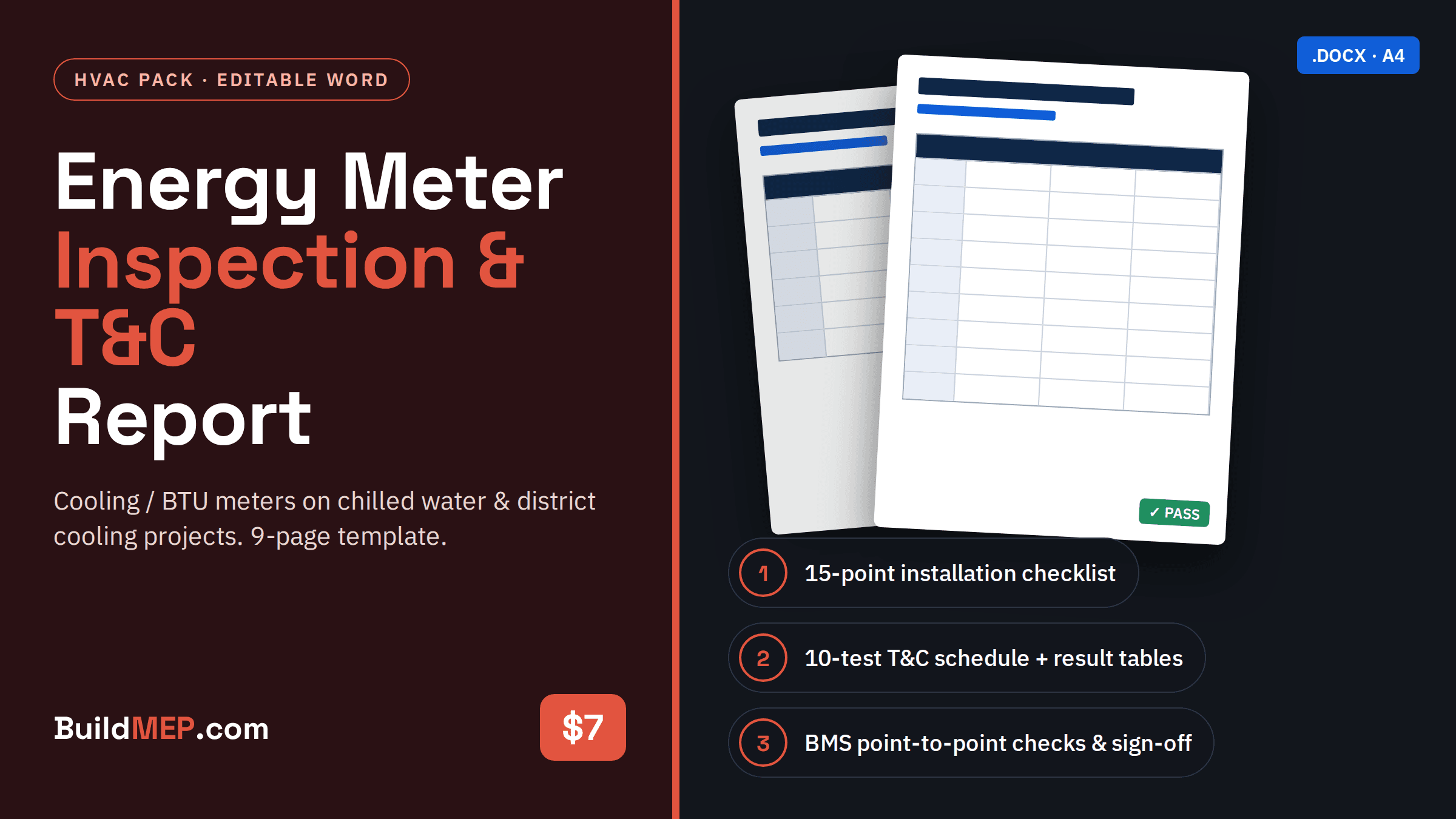
Cooling Energy Meter (BTU Meter) Inspection & T&C Report Template
A 9-page, fully editable Word document: meter register and inspection baseline, 15-point installation checklist, a 10-test functional schedule (T1–T10), temperature/ΔT and flow/power/energy result tables, BMS point-to-point and trend checks, snag log, photo record and 4-party sign-off.
It goes further than a generic checklist: a power cross-check (P = 1.163 × flow × ΔT for water), zero-flow and totaliser tests, and a field-notes appendix listing the 9 things that usually fail on site — swapped temperature sensors, the flow sensor in the wrong pipe, BMS scaling errors, and readings taken from different display loops. Acceptance criteria are left blank for your project specification, so it fits any meter brand.
Who this energy meter inspection report is for
MEP contractors, meter suppliers and manufacturer representatives, commissioning engineers, consultants reviewing T&C records, and facility teams taking over chilled water systems with sub-metering or district cooling tariffs.
Why energy meter commissioning matters
An energy meter drives someone’s bill. A meter that shows an active display and no fault code can still under-read for years because of a short sensor pocket, a swapped pair or a wrong BMS scaling factor. A photo of the display proves the meter is powered — it doesn’t prove it’s accurate. This template makes the checks that do prove it quick to record and hard to skip.
Sizing comes first — see the Chilled Water BTU Meter Sizing guide. If your meters sit on PICV-controlled circuits, the PICV explainer covers how flow behaves at part load. Fire protection documents are in the Fire Protection Pack.
Energy meter inspection report FAQ
What should an energy meter inspection report include?
At minimum: a meter register (make, model, serial, size, flow sensor position, comms type), the reading at inspection with the display loop it came from, visual installation checks, functional tests (temperature sensors, ΔT sign, flow plausibility, power cross-check, zero-flow, totaliser, communication), BMS point-to-point results, a snag log, photos and signatures. This template has a section for each.
Does it work for any meter brand?
Yes. The tests are brand-neutral, and acceptance criteria are left for you to fill in from the project specification and the manufacturer’s instructions, so it works for ultrasonic and mechanical cooling energy meters from any manufacturer.
Is it only for inspection, or also for testing and commissioning?
Both. It starts with a visual inspection baseline and continues through a 10-test T&C schedule, so the same report covers the first site visit and final acceptance.
What format is the energy meter inspection report?
A 9-page Microsoft Word (.docx) file, A4, with editable styles and [bracketed] placeholders for your company, project and report reference. It opens in Word, Google Docs and LibreOffice.
Which standards does it reference?
It lists EN 1434 (thermal energy meters) and OIML R 75 by title only, alongside the project specification and manufacturer instructions. Confirm the edition and accuracy class your project calls up.
More HVAC documents in progress
Chiller, AHU/FCU, ductwork and chilled water piping documents are in preparation for the HVAC pack, followed by Electrical and Plumbing packs.