
Part of Fire Protection Systems: The Complete BuildMEP Guide →
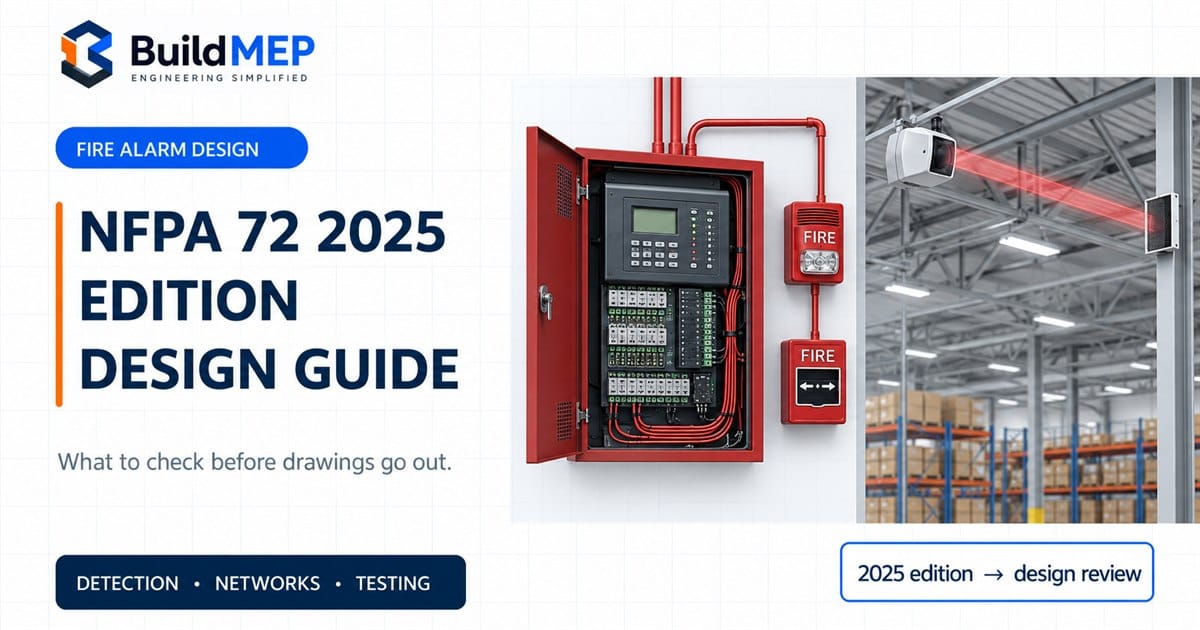
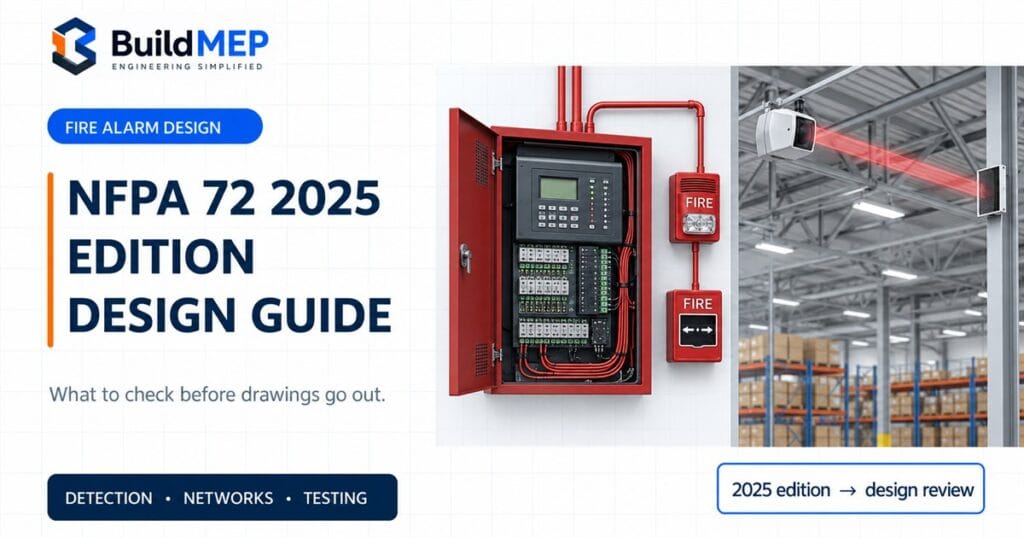
| On a fire alarm drawing, the difficult questions usually appear where a standard detail meets an unusual space: a high warehouse roof, a detector near strong supply air, or a communicator routed through the building network. The 2025 edition of NFPA 72 makes several of those decisions more explicit. Here are four changes worth checking against the edition adopted for your project. |
1. Smoke detection above 40 ft needs an engineered approach
Section 17.7.4.2.3.1 keeps the familiar prescriptive spacing approach for spot-type smoke detectors on ceilings up to 40 ft (12.2 m). Above that height, spacing must be based on performance criteria. A 30 ft grid copied from a typical office floor is not enough for a high-bay warehouse or atrium.
2. Cybersecurity has moved into Chapter 11
The 2025 edition brings cybersecurity provisions into the main code. This does not mean that every panel with an Ethernet port automatically needs the same cybersecurity plan. Chapter 11 applies where governing laws, codes, standards or another part of NFPA 72 require it. Confirm the adopted edition and the project’s specific trigger with the authority having jurisdiction (AHJ).
For a network-connected system, I would still raise the question early: who controls remote access, software updates and the connection to the building network? On a BMS integration, the interface drawing may show the cable while leaving ownership of the network switch or access credentials unclear. Record the responsible party and the required documentation before procurement, when these gaps are easier to close.
3. Two detection technologies have clearer rules
The 2025 edition adds requirements for acoustic leak detectors and thermal image fire detectors in Chapter 17. Acoustic devices listen for ultrasonic energy from a pressurized gas leak. Thermal image devices evaluate a scene for abnormal heat or fire signatures. They solve different problems, so they should not be treated as interchangeable additions to a conventional smoke detector schedule.
Consider the actual hazard and the manufacturer’s listed application before selecting either device. For thermal imaging, check the field of view, obstructions and what temperature or fire condition must be detected. For acoustic detection, check whether the expected leak will be audible to the detector in the operating environment. In both cases, ask how the contractor will prove coverage and test the alarm at acceptance. Code recognition does not remove the need for an engineered selection.
4. The communication path needs an IT conversation
For fire alarm signals sent over network-based paths, the 2025 provisions address compatibility with the communication protocol’s latency and jitter. Premises equipment in the signal path also needs appropriate listing and secondary power. Section 26.6.3.13.1 generally calls for 24 hours for the relevant premises transmitters and shared equipment, with specific permitted alternatives, including an AHJ-accepted risk analysis for some shared equipment.
This is easy to miss when the fire alarm scope ends at an RJ45 outlet on the drawing. Identify the router, switch, power source and person responsible for maintaining them. Then confirm the path remains supervised and available when normal power or the building network fails. A panel battery calculation alone does not establish the resilience of equipment outside the panel.
What to check on your next submittal
- High ceiling: show the detection objective and performance basis for spot detectors above 40 ft.
- Connected system: identify whether Chapter 11 is triggered and who owns network access and updates.
- New detector type: confirm the device listing, coverage, location and acceptance test.
- Off-premises signal path: show the shared equipment, supervision and secondary power arrangement.
Start with the locally adopted edition, project specification and AHJ requirements; adoption of the 2025 text is not automatic. The best review question is simple: can the contractor show how this particular system will detect, communicate and be tested in the space actually being built?
Code references: NFPA 72 (2025), sections 11.1.1, 17.7.4.2.3.1 and 26.6.3.13.1. See NFPA’s 2025 edition information and its cybersecurity overview. Confirm exact text and local amendments in the adopted code.
Related reading: Fire Damper vs. Smoke Damper vs. Combination Fire/Smoke Damper and Fire Alarm Conduit Installation Method Statement.