
A check valve is a single line of defense against backflow, and it depends entirely on a disc or ball seating perfectly against scale, debris and years of wear for as long as the pipe stays in service. A backflow preventer assumes that seal will eventually fail, and is built so the failure is detectable, testable, and in the reduced pressure assembly, visible before contaminated water ever reaches the potable side. Choosing between a PVB, a DCVA and an RPZ is not a cost decision first. It is a hazard-degree decision, and the code table that drives it does not care which one happens to already be sitting in the plumbing contractor’s van.
Decision brief
The hazard on the downstream side of the connection sets the minimum assembly type, not the other way around. A non-health hazard connection, one that could only degrade water aesthetically, can usually be protected with a double check valve assembly. A health hazard connection, one where backflow could introduce something that makes people sick, needs a reduced pressure principle assembly in nearly every plumbing code built on USC FCCCHR or AWWA guidance. Continuous pressure versus intermittent use decides whether a vacuum breaker is even eligible, as a separate question from the hazard degree.
Use this guide for
- Selecting between AVB, PVB, DCVA and RP/RPZ assemblies for a specific cross-connection
- Understanding why an assembly passes or fails its annual test
- Spotting the installation mistakes that turn a correctly specified assembly into a code violation or a flooded mechanical room
- Setting up a testing and record-keeping routine that actually holds up over the life of the connection
Do not use this guide for
- Sizing the pipe run itself. That is a fixture-unit and pressure-loss exercise, covered in the Domestic Water Pipe Sizing Guide
- Fire-line detector assembly sizing against sprinkler demand, which belongs alongside fire pump sizing work
- A substitute for the local water authority’s adopted list of approved assemblies. Approval lists vary by jurisdiction and change over time
Why a check valve is not enough
Backflow happens two distinct ways, and an assembly that stops one does not automatically stop the other.
Back-pressure occurs when downstream pressure exceeds the supply pressure: a boosted irrigation pump, an elevated tank, thermal expansion in a closed water heater loop, or a fire pump on a combined system. The downstream side simply pushes past a worn check.
Back-siphonage occurs when supply pressure drops below downstream pressure: a water-main break, a large firefighting draw nearby, or an upstream valve closed for repair. Nothing needs to push. The system falls toward the lower pressure, and if a hose end or fixture outlet happens to be submerged in a contaminated source at that moment, the contamination gets pulled backward through it.
A vacuum breaker, atmospheric or pressure type, only interrupts back-siphonage. Neither is rated for back-pressure, because neither has a mechanism to resist pressure arriving from the downstream side. If a connection can ever see back-pressure, an AVB or PVB is the wrong assembly regardless of the hazard degree involved.
Hazard degree decides the assembly, not the budget
Most plumbing codes split cross-connections into two hazard classes.
A non-health hazard, sometimes called a pollutant, could make water unusable or unpleasant without making anyone sick: a fouled irrigation line, a cooling tower running without biocide dosing, a fire sprinkler system carrying plain water.
A health hazard could introduce something that causes illness or worse: chemical feed systems, boiler and steam treatment chemicals, medical and laboratory equipment, commercial dishwashing chemical dispensers, mortuary and veterinary equipment, and any irrigation system with a fertilizer or pesticide injector.
The health-hazard question has to be answered honestly, including for connections that started out as non-health hazard and were modified later. An irrigation system that gets a chemical injector added after the backflow assembly was already installed is now under-protected, even though nothing changed at the assembly itself. This is the single most common way a correctly specified system quietly becomes a code violation years after commissioning.
The four assemblies, compared honestly
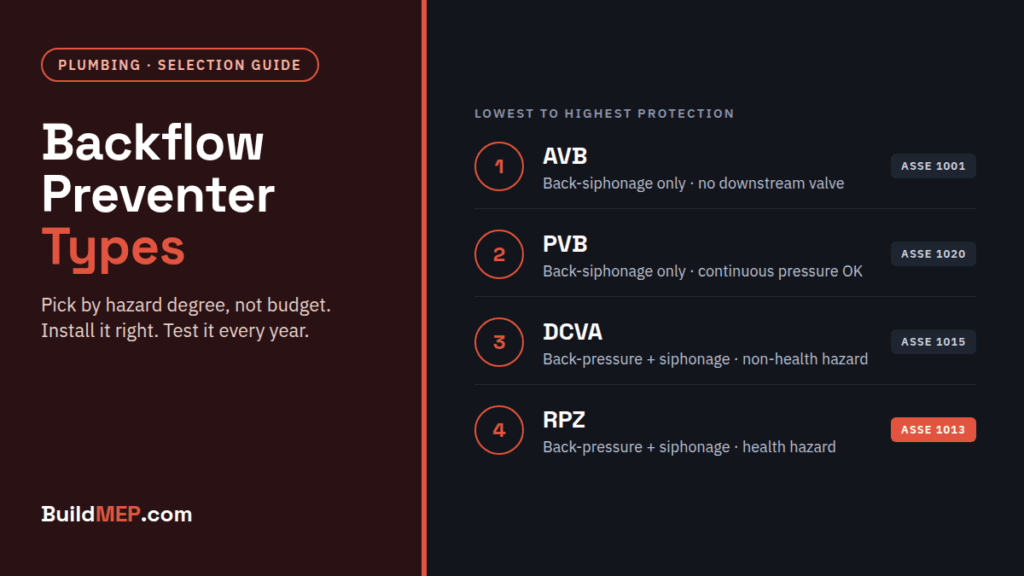
| Assembly | ASSE standard | Protects against | Hazard rating | Continuous pressure | Typical use |
|---|---|---|---|---|---|
| Atmospheric Vacuum Breaker (AVB) | ASSE 1001 | Back-siphonage only | Health or non-health, per listing | No. Cannot be under continuous pressure or have a shutoff downstream | Hose bibb vacuum breakers, some lab and dental equipment |
| Pressure Vacuum Breaker (PVB) | ASSE 1020 | Back-siphonage only | Health or non-health, per listing | Yes | Irrigation systems, some standpipe connections |
| Double Check Valve Assembly (DCVA) | ASSE 1015 | Back-pressure and back-siphonage | Non-health hazard only | Yes | Fire sprinkler systems without additive, irrigation without chemical injection |
| Reduced Pressure Principle Assembly (RP / RPZ) | ASSE 1013 | Back-pressure and back-siphonage | Health hazard | Yes | Chemical feed, medical and lab equipment, commercial kitchens, boiler treatment chemicals, any connection where the hazard is uncertain |
Detector variants, DCDA and RPDA, add a bypass meter around a fire-line assembly to flag unauthorized water draw. The underlying check or relief mechanism is still the same DCVA or RP logic, sized for fire flow rather than domestic demand. Confirm the exact ASSE listing on the manufacturer’s current submittal rather than assuming it from the product name. The same model family is often sold in variants that are not interchangeable on plan review, and listings do get revised between code cycles.
Reading the RPZ’s relief valve correctly
The reduced pressure assembly is not simply two check valves in series like a DCVA. Between the two checks sits a chamber held at a pressure a few psi below the upstream supply. If either check valve leaks even slightly, that chamber pressure rises, and a differential relief valve dumps water to atmosphere before backflow can actually occur.
That discharge is not a malfunction. It is the assembly doing exactly what it was designed to do. A dripping or steadily running relief port means one of the checks needs attention, not that the relief valve itself is broken. Piping that discharge to a closed drain defeats the entire design, because it can backpressure the relief valve and stop it from opening when it actually needs to.
Installation mistakes that undo a correct selection
| Mistake | What actually goes wrong | How it shows up |
|---|---|---|
| RP installed in a below-grade pit with no floor drain | Every relief discharge floods the pit and can submerge the assembly | Standing water and corrosion found at the annual test |
| PVB or AVB installed with a valve or fixture downstream of it | Assembly cannot vent to atmosphere on back-siphonage because downstream pressure is trapped | A backflow event traced to an assembly that should have stopped it |
| DCVA specified where the connection is actually a health hazard | Under-protection. A single failed check goes unflagged until the next test, or worse | Passes a casual walk-through, fails a proper hazard-degree review |
| No clearance left around the assembly for test cocks and gauge | The annual test cannot be performed without partial disassembly | Tester logs it as untestable rather than pass or fail |
| No freeze protection in an unheated space | The body cracks over winter, sometimes only discovered at spring start-up | No flow at all, or a leaking body on first pressurization |
| Orientation ignored, an assembly listed horizontal only installed vertically or the reverse | The relief mechanism cannot function correctly relative to the internal chamber | An erratic or untestable result at the annual check |
Testing is not optional maintenance, it is the whole point
Annual testing by a certified backflow tester is the baseline requirement in most jurisdictions that have adopted a cross-connection control program, and it exists because these assemblies fail quietly. A worn check valve does not usually announce itself with a leak or a noise. It just stops doing its job, and the only way anyone finds out is by testing the differential pressure across each check and the opening point of the relief valve with a calibrated test kit. Many authorities also require a test at initial installation and again after any repair or relocation, not only on the annual cycle.
| Test result | Likely cause | Correction |
|---|---|---|
| First check fails to hold the minimum differential | Debris on the seat, a worn disc, spring fatigue | Clean and inspect the seat, replace the disc and spring kit if fatigued |
| Relief valve will not open at the required differential | Diaphragm stuck or fouled, sensing passage blocked | Clean the sensing passages, rebuild the relief valve |
| Relief valve leaks continuously at rest | Most often the first check is not sealing (debris or a worn disc), letting zone pressure rise toward supply pressure. Less often the second check is leaking under back-pressure | Clean and inspect the first check, then the second. Rebuild the relief valve only if both checks hold their differential |
| No stable reading achievable | Trapped air in the assembly, test cocks not fully opened, gauge not zeroed | Bleed air, confirm test procedure, recheck gauge calibration before condemning the assembly |
Setting up a maintenance and record routine that actually holds
A backflow preventer that has not been tested on schedule is functionally the same as one that has already failed. Nobody knows which state it is in until it gets tested. Treat the test due date the way a fire extinguisher inspection tag should be treated, or the way a PPM checklist item that gets ticked without actually being checked eventually causes a failure nobody saw coming: a dated record, an assigned owner, and an occasional independent spot check rather than blind trust that the checklist was followed.
Keep the record simple. Log the assembly’s make, model, ASSE listing and serial number once, at installation. After that, the test date, the tester’s certification number, and the pass or fail result are the only fields that matter on an ongoing basis, and they should reach whoever owns compliance submissions on the project or the facility, not sit in a drawer until someone asks for them.
Standards and where to verify them
The ASSE numbers referenced above (1001, 1013, 1015, 1020) are the commonly cited assembly standards behind these products in North American plumbing codes. Detector-assembly listings, exact minimum clearance dimensions, discharge sizing, and which specific assemblies a given water authority has actually approved all vary by jurisdiction and change between code cycles. Verify each of those against the currently adopted code, the manufacturer’s current listing sheet, and the local water authority’s approved-assembly list before finalizing any submittal.
- International Plumbing Code, Section 608, Backflow Prevention, or the equivalent section in the code edition actually adopted for the project
- AWWA Manual M14, Recommended Practice for Backflow Prevention and Cross-Connection Control
- USC Foundation for Cross-Connection Control and Hydraulic Research, Manual of Cross-Connection Control
- ASSE 1001, 1013, 1015 and 1020 product standards, current editions
- The local water authority’s approved backflow assembly list and its testing and certification requirements
Frequently asked questions
Do I need a backflow preventer if a check valve is already installed?
A plain check valve is not a tested, code-recognized backflow assembly. It has no way to verify it is still sealing, no relief mechanism, and it will not appear on any approved-assembly list. It can sit ahead of or behind an approved assembly as extra protection, but it does not replace one.
What is the real difference between an RPZ and a DCVA?
A DCVA is two independently acting check valves in series with no relief path. If both leak, contaminated water can pass through. An RPZ adds a monitored, reduced-pressure zone between the checks with a relief valve that dumps to atmosphere the moment either check starts leaking, which is why it is the one rated for health hazard connections and the DCVA is not.
How often does a backflow preventer need to be tested?
Annual testing by a certified tester is the common baseline across most jurisdictions, with an additional test required after any repair, relocation or initial installation. Confirm the exact interval and reporting requirement with the local water authority, since some require more frequent testing on higher-hazard connections.
Can a pressure vacuum breaker be installed horizontally?
Most pressure vacuum breakers are listed for vertical installation only, with the air inlet on top. Check the specific model’s listing before assuming otherwise. Installing it in an unlisted orientation can stop the float and disc from seating and venting correctly, and it will likely fail inspection regardless of how well it performs under flow.
Does a residential irrigation system really need a backflow preventer?
Yes, in nearly every adopted plumbing code, because irrigation heads sit at or below grade and are a textbook back-siphonage path. Many residential systems also end up with a fertilizer or chemical injector added later, which quietly changes the hazard degree without anyone updating the backflow assembly to match.
Related reading
- Domestic Water Pipe Sizing Guide, for the pressure-loss allowance a backflow assembly takes out of the design budget
- Fire Pump Sizing Mistakes: NFPA 20 Explained, for the fire-line side of a combined domestic and fire water supply
- FCU Drain Tray Maintenance, for the same checklist-discipline problem on a different piece of equipment