
BuildMEP fire protection • edition review
Use this NFPA 25 2026 edition changes guide to review your water-based fire protection maintenance scope, identify affected assets, and turn an edition update into traceable work orders.
Technical review: 1 October 2026 · Scope: selected changes affecting existing sprinkler systems; confirm the adopted edition and local amendments.
Part of Fire Protection Systems: The Complete BuildMEP Guide.
Decision brief: update the asset schedule after checking the governing edition
Start with the edition required for the facility, then review each affected system. A newly published standard does not automatically replace the edition adopted by the authority having jurisdiction (AHJ). The maintenance contract, insurer’s requirements and local amendments also need review.
Prioritize valve inspection tasks, electrical supervision interfaces, ice findings, listed sprinkler accessories, corrosion mitigation equipment and older dwelling-unit sprinklers. Record the source requirement, affected asset, responsible contractor and acceptance evidence for each change.
What NFPA 25 covers—and what the review must establish
NFPA 25 addresses inspection, testing and maintenance (ITM) of water-based fire protection systems. It is used for systems already in service, including sprinklers, standpipes, fire pumps and water storage. An ITM report is not a blanket confirmation that the original design remains suitable for today’s occupancy.
I maintained fire and life-safety systems as part of facility engineering work in healthcare and food-industry buildings. The practical problem is getting a standard change into the task performed at the valve room, ceiling or maintenance workstation. A revised checklist needs an owner and evidence of completion.
NFPA 25 2026 edition changes: the maintenance review
| Affected asset or finding | Review focus | Evidence to put in the asset record |
|---|---|---|
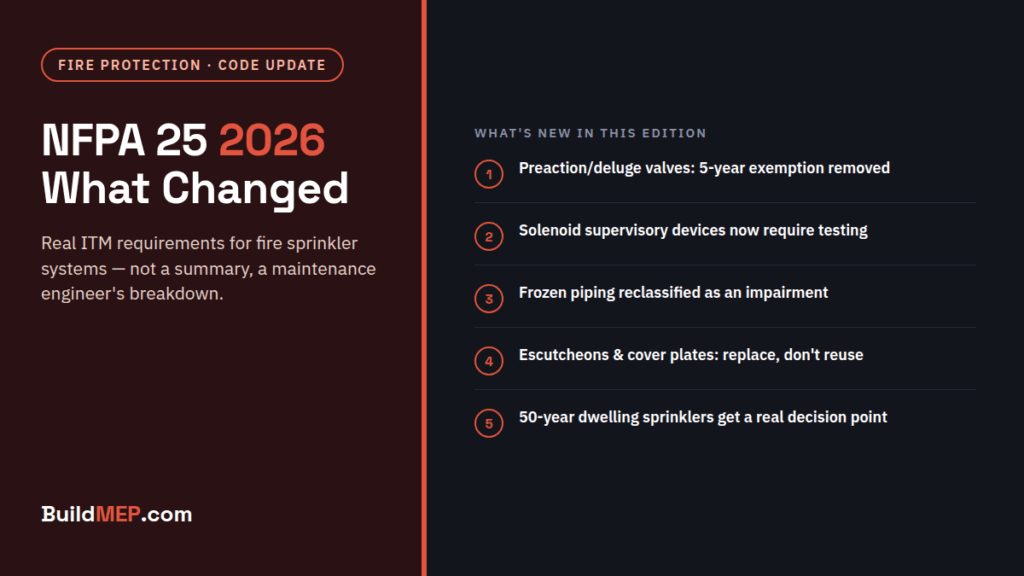
| Externally resettable preaction/deluge valves | NFPA’s published 2026 summary confirms annual internal inspection also applies to externally resettable valves. Retire the previous extended interval where the 2026 edition governs. | Valve model, approved procedure, completed internal inspection and next due date. |
| Solenoid coil-position supervision | Review the separate supervisory-device test task and its interface with the releasing panel. | Device identity, expected signal, witnessed result and restoration record. |
| Piping containing ice | Handle the finding through the impairment process. | Affected zone, notifications, protection measures and verified restoration. |
| Listed escutcheons/cover plates | Inspect condition, attachment and compatibility with the sprinkler assembly. | Sprinkler identification, photographs and listed replacement part. |
| Corrosion mitigation with hydraulic design credit | Check both equipment maintenance and the system’s documented design basis. | Design C value, technology, manufacturer ITM instructions and accountable service provider. |
| Older dwelling-unit sprinklers | NFPA identifies new replacement/testing requirements for sprinklers installed in dwelling units around the 50-year service threshold. | Installation history, population grouping and laboratory or replacement plan. |
1. Internal inspection is distinct from resetting or trip testing
An externally resettable valve can be returned to its operating condition without opening the body. That feature does not demonstrate the condition of internal seats, seals or passages. In the revised maintenance scope, distinguish internal inspection, external inspection and trip testing. A contractor’s single line saying “annual valve service” is too vague to show which task was completed.
Check the manufacturer’s disassembly and restoration instructions, required parts, access, drainage and the protection arrangements for the shutdown. Record the as-found condition and the final operating state.
2. Coil-position supervision needs its own acceptance evidence
The NFPA second-revision record specifies quarterly testing of coil-position supervisory signal devices for preaction and deluge valves. This is a supervision test, not a substitute for release or trip testing. Verify the issued text before setting the task frequency.
Viking’s CoilKeeper explanation shows the purpose: removal of a monitored coil causes a supervisory condition at the releasing panel. That detects a physical assembly problem; it does not establish that the complete hydraulic release sequence will operate correctly.
3. Ice calls for an impairment response
The revision record treats ice in piping between the supply and discharge devices or hose connections as an impairment, with thawing or replacement and restoration required. Determine the affected protection area and apply the approved impairment plan. Do not assume every case uses the same fire-watch arrangement.
Document who coordinates the response, who receives notifications and what must be witnessed before restoration is signed off. A work order closed because a room warmed up is weak evidence: the team needs to establish that the affected system has been restored.
4. Cover plates and escutcheons are part of the listing
The revision addresses missing or damaged listed accessories, detrimental corrosion/loading/paint, attachment to walls or ceilings, and unavailable listed replacements. Avoid treating a concealed cover plate as a generic decorative disc. Use the manufacturer’s part identification and assembly listing.
Before ceiling painting, agree an approved protection method with the sprinkler contractor and arrange a post-work inspection. Do not advise general painters to remove sprinklers or cap piping. If replacement is needed, record the actual sprinkler and accessory model rather than ordering by appearance alone.
5. Hydraulic credit creates a maintenance dependency
Errata 25-26-1 identifies dry pipe and preaction systems designed with C = 120 using approved corrosion mitigation technologies. These include nitrogen generation, vapor corrosion inhibitors, negative-pressure systems and other approved methods. The equipment must be maintained to the standard and manufacturer instructions.
If the design credit cannot be maintained, the corrected text provides a path involving hydraulic verification using the lower C value and modifications as necessary, or repair/replacement of the mitigation equipment. The responsible fire protection engineer must assess the applicable design basis. “C = 100” is not a universal value for every pipe material and sprinkler system.
6. Sprinkler age needs a population record
The revision record sets a 50-year dwelling-unit decision: fast-response replacement or representative thermal-sensitivity testing with the specified acceptance criterion. Confirm the final sampling rules and applicable limits with the issued standard and testing laboratory.
Age, sprinkler type, environment and prior modifications matter. The 50-year dwelling-unit provision is not permission to defer every other sprinkler test until that age. Ask the contractor to identify the population being evaluated and explain how samples represent it.
A workflow for updating the PPM schedule
- Confirm the governing documents. Record the adopted NFPA 25 edition, amendments, contract obligations and insurer requirements. Resolve disagreements before labelling the facility noncompliant.
- Build an affected-asset list. Use valve nameplates, releasing-panel drawings, sprinkler records and hydraulic calculations. Mark unknowns for survey rather than assuming a component exists.
- Map each requirement to a task. Give internal inspection, signal testing, age testing and mitigation maintenance separate descriptions and evidence fields.
- Assign the interface owner. Identify who coordinates the sprinkler contractor, fire alarm contractor and facility impairment coordinator.
- Plan safe access and restoration. Include shutdown arrangements, parts, drainage, notifications and return-to-service checks in the work package.
- Close with evidence. Keep results, photographs, laboratory reports, repair records and the approved next due date in the asset record.
Worked maintenance handoff: a preaction-protected server room
Assumed case: the facility has confirmed that the 2026 edition governs its ITM contract. The valve is externally resettable, coil-position supervision is installed, and the hydraulic file identifies corrosion mitigation as part of the design basis.
The old work order contains only “annual preaction test.” The revised package separates internal valve inspection from the required trip tests, adds the applicable supervision task, and attaches the mitigation equipment’s manufacturer instructions. The facility coordinator books the sprinkler and alarm contractors together where the test crosses their scopes.
Acceptance: retain the valve inspection result, expected/actual supervisory signal, mitigation service evidence, final valve and panel state, and restoration notifications. If the design file or device identity is missing, survey it before approving the revised schedule. This example defines a handoff; it is not a valve test procedure.
Failure modes to remove from the revised scope
| Mistake | Consequence | Observable symptom | Correction |
|---|---|---|---|
| Copying a new edition into every site | Conflicting obligations and unsupported compliance claims. | No adoption record attached to the schedule. | Document the governing basis per site. |
| One task for all valve activities | Missing work hidden behind a completed tick box. | No separate inspection and test results. | Split tasks and acceptance evidence. |
| Mitigation equipment outside both contracts | Hydraulic dependency loses its service owner. | No current service record or responsible contractor. | Assign scope and engineering escalation. |
| Restoration assumed after testing | Protection may remain unavailable. | Missing final valve/panel state and notifications. | Require a witnessed restoration record. |
Related BuildMEP guidance
Evidence trail and edition boundary
- NFPA 25 document page: access to editions, corrections and development records. Use the issued standard for requirements.
- NFPA 25 Handbook, 2026 edition details: publisher confirmation of selected changes, including internal valve inspections, older dwelling-unit sprinklers and corrosion inhibition.
- NFPA Errata 25-26-1, issued 7 October 2025: corrected corrosion-mitigation and repair paragraph placement.
- NFPA 2026-cycle Second Revision Report: primary revision history for coil supervision, ice, listed accessories and dwelling-unit sprinklers. Draft record; confirm final wording in the issued edition.
- Viking: Potter CoilKeeper solenoid supervision: manufacturer explanation of coil-position monitoring; device-specific information.
This review selects maintenance issues from the 2026 cycle. It does not reproduce the full frequency tables or establish a facility’s adopted requirements. Verify the exact clause, amendments, product instructions and AHJ acceptance before revising an ITM contract.
Questions before approving a contract revision
Does publication of the 2026 edition make an older schedule invalid?
Publication alone does not establish the facility’s legal obligation. Check adoption, local amendments and contractual requirements, then assess whether individual tasks need revision.
Should the contractor simply write “NFPA 25 compliant”?
Ask for the edition, asset scope, exclusions, applicable task schedule and reporting requirements. A broad label gives the owner little evidence about what was inspected or tested.
Does this mean no capital work will be needed?
No. Findings can require replacement components, sprinkler replacement, mitigation repairs or hydraulic review. Separate routine schedule changes from corrective work and have the relevant qualified professional approve the latter.