
Part of Fire Protection Systems: The Complete BuildMEP Guide →
BuildMEP fire protection design guide
This guide supports fire extinguisher selection, rating and preliminary placement for commercial buildings, including server rooms and energized electronic equipment. It uses NFPA 10 (2022) as its reference basis; the adopted code and authority having jurisdiction (AHJ) govern each project.
Decision brief
Choose the agent from the credible fuel and equipment consequences first; then size and locate the extinguisher from its listed rating, hazard level and travel path. Floor area alone does not complete the design.
- Identify every expected fire class: A, B, C, D or K.
- Check whether residue, conductivity or oxygen displacement creates a second hazard.
- Apply the adopted NFPA 10 edition and local amendments.
- Check area coverage and actual walking distance; the more restrictive result governs.
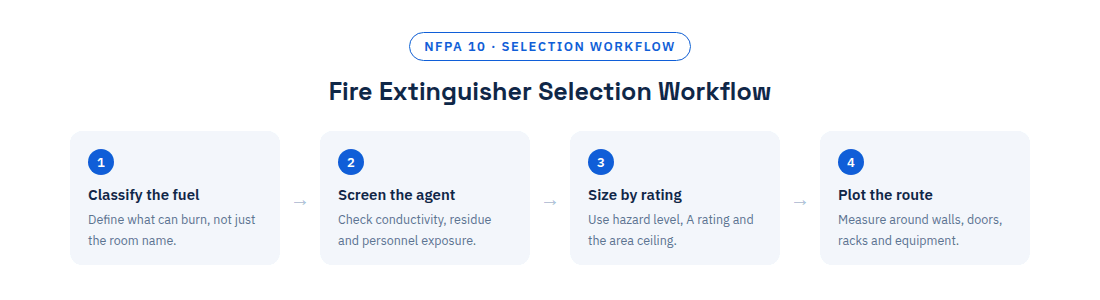
Fire extinguisher selection workflow
Match the fire class to the actual hazard
| Class | Fuel or condition | Design implication |
|---|---|---|
| A | Wood, paper, cloth, rubber and many plastics | Provide the required A rating and verify 75 ft maximum travel. |
| B | Flammable or combustible liquids and gases | Select rating for hazard severity; permitted travel is typically 30 or 50 ft. |
| C | Energized electrical equipment | Use nonconductive media; size from the underlying A or B hazard. |
| D | Combustible metals | Match the agent to the metal, particle form and manufacturer data. |
| K | Commercial cooking oils and fats | Use a listed Class K unit within 30 ft and coordinate with the hood system. |
Select the agent without creating a second loss
| Agent | Common use | Important limitation |
|---|---|---|
| Water | Class A cooling | Not for energized equipment or flammable-liquid fires. |
| Foam | Listed A/B applications | Check conductivity and environmental/product restrictions. |
| ABC dry chemical | General A/B/C coverage | Powder can impair visibility and contaminate equipment; NFPA 75 does not permit it in applicable IT equipment areas. |
| Carbon dioxide | Class B/C | Residue-free but typical units lack an A rating; oxygen displacement matters in small spaces. |
| Listed clean agent | Electronic and high-value equipment | Confirm exact rating, occupied-space suitability, environmental rules and temperature range. |
| Wet chemical | Class K | Coordinate the unit, placard and fixed kitchen system. |
| Class D powder | Specific metals | One Class D agent is not suitable for every combustible metal. |
Server-room decision
A server room contains ordinary plastics and cable insulation as well as energized equipment. The schedule therefore needs the Class A requirement and an agent suitable for energized electronics.
Practical selection
Where NFPA 75 applies, provide listed carbon dioxide or halogenated-agent portable extinguishers for electronic equipment and a listed extinguisher with at least a 2-A rating for ordinary combustibles. One listed clean-agent model may satisfy multiple ratings when its nameplate confirms the required A, B and C classifications.
Do not specify ABC dry chemical inside an NFPA 75 information-technology equipment area. The standard prohibits it, and discharged powder can contaminate sensitive equipment.
Portable extinguishers are the manual first-response layer. Detection, sprinklers and any gaseous total-flooding system are separate project decisions governed by the adopted code, NFPA 75 and the applicable suppression standard.
NFPA 10 Class A sizing basis
This excerpt follows NFPA 10 (2022). Confirm the edition adopted for the project before using it in construction documents.
| Hazard | Minimum rating | Maximum area per unit of A | Maximum per extinguisher | Travel |
|---|---|---|---|---|
| Light | 2-A | 3,000 ft² | 11,250 ft² | 75 ft |
| Ordinary | 2-A | 1,500 ft² | 11,250 ft² | 75 ft |
| Extra | 4-A | 1,000 ft² | 11,250 ft² | 75 ft |
Calculation ledger
Coverage per extinguisher = lesser of (area per unit of A × selected A rating) and 11,250 ft².
Quantity by area = protected floor area ÷ coverage per extinguisher, rounded up.
Independent check = plot actual travel paths and add or relocate units until every applicable point is within the permitted distance.
Class A area calculator
Preliminary quantity only. It does not check travel routes, Class B geometry, local amendments or product listing.
Worked case: 18,000 ft² ordinary-hazard floor
Assumed: one 18,000 ft² floor is ordinary hazard for Class A contents; listed 4-A units are selected.
- Area basis = 1,500 ft² per unit of A.
- Coverage = 1,500 × 4-A = 6,000 ft² per extinguisher.
- Area quantity = 18,000 ÷ 6,000 = 3 extinguishers.
- Plot 75 ft travel paths around partitions and locked doors. Add or relocate units if three do not cover every route.
A different hazard classification, rating, adopted edition, subdivision or travel route changes the answer.
Placement checks
- Confirm access: locate units along normal paths and sign obstructed locations.
- Verify mounting: top no higher than 5 ft for units 40 lb or less, or 3.5 ft when heavier; bottom at least 4 in above floor.
- Check Class C: space from the underlying A or B hazard while retaining a listed C-rated medium.
- Check Class D: keep the correct agent within 75 ft and follow data for the metal and physical form.
- Check Class K: keep the unit within 30 ft and coordinate the operating placard with the fixed system.
Failure-mode register
| Mistake | Consequence | Correction |
|---|---|---|
| Reading area per unit of A as area per extinguisher | Incorrect quantity | Multiply by the selected A rating, then apply the 11,250 ft² ceiling. |
| Checking area but not travel | Unit cannot be reached in time | Measure the walking path and add or relocate units. |
| Treating a C mark as safe for electronics | Equipment contamination | Check NFPA 75 and specify a listed residue-free agent where required. |
| Using one generic Class D powder | Ineffective or adverse reaction | Identify the metal and use tested manufacturer data. |
| Omitting the adopted edition | Approval conflict | Record the code, edition, amendments and AHJ decision. |
Design and site verification handoff
- Confirm the adopted NFPA 10 edition and local amendments.
- Record the Class A hazard level and each special B, C, D or K hazard.
- Compare every scheduled model’s listed rating with required capacity.
- Plot travel around fixed obstructions, doors and equipment.
- Verify brackets, cabinets, mounting height, signage and access.
- Coordinate portable units with detection, sprinklers and fixed suppression.
- Approve final locations with the AHJ and record as-built changes.
Evidence trail
- NFPA, Fire Extinguisher Location and Placement (December 2024): classes, travel and mounting; references NFPA 10 (2022).
- NFPA 75 (2024): IT-equipment-area portable-extinguisher requirements.
- OSHA extinguisher placement and spacing: Class C relationship to the underlying A or B basis.
- Amerex Halotron I manual (2022): product-specific applications and limits.
Technical review: 22 September 2026. Governing code, listed data and AHJ approval remain project-specific.
Related BuildMEP guidance
Coordinate this layer with the fire and smoke damper selection guide and the fire alarm conduit installation method statement.
Frequently asked questions
What extinguisher should be used in a server room?
Where NFPA 75 applies, listed carbon dioxide or halogenated-agent units protect electronic equipment, while at least a 2-A rating is required for ordinary combustibles. Confirm every required rating on the nameplate.
Does Class C mean the agent cannot damage electronics?
No. It means the medium is electrically nonconductive under the classification test. Residue, cleanup and compatibility need a separate check.
How many extinguishers are required?
Round up the area calculation, then test actual travel paths. Whichever check requires more units governs.
Can CO₂ protect energized equipment?
A listed C-rated CO₂ unit is nonconductive and residue-free, but its B:C rating and oxygen-displacement hazard must suit the room and fire load.
Part of a BuildMEP guide
This article is one step in Fire Protection Systems: The Complete BuildMEP Guide. It organises dampers, pumps, sprinklers, hydrants and extinguishers by protection layer, with the standards and site mistakes for each.