
BuildMEP HVAC selection guide · Updated 12 September 2026
A Belimo valve or actuator can be replaced by another make, but only after the replacement is checked as an assembly: valve function, control signal, hydraulic capacity, close-off duty, mounting, electrical supply and commissioning response.
Decision brief
Do not cross-reference by brand, pipe size or actuator torque alone. A candidate is acceptable only when every critical requirement is satisfied and the valve manufacturer approves the actuator–valve pairing or publishes the required torque/thrust, stroke and mounting data.
- Same valve function and porting
- Compatible control and feedback signals
- Suitable Kv/Cv, characteristic and pressure limits
- Correct torque or thrust and fail-safe action
- Verified interface, travel and available space
- Required enclosure, approvals and documentation
Why consider a Belimo alternative?
The engineering case is usually continuity, not a claim that one brand is universally better. A site may need a locally stocked actuator, an approved vendor-list option, a standardized controls platform or a replacement for an obsolete assembly. A technically equivalent option can reduce downtime and improve spare-parts coverage.
Price may also matter, but no defensible percentage applies across regions, specifications and project terms. Compare total installed cost: valve and actuator, adapter or linkage, wiring changes, control-program changes, commissioning time, warranty and future spares.
Do not treat it as a routine swap when…
- the device is part of a listed, certified or packaged assembly whose approval or warranty depends on the original component;
- the valve performs a smoke-control, life-safety, potable-water or other regulated duty;
- the original is pressure-independent, electronically characterized, networked or sensor-integrated and the proposed unit does not reproduce those functions;
- the existing valve body is seized, leaking, eroded or undocumented; or
- the project specification or authority having jurisdiction requires a named product, certification or witnessed change-control process.
Capture the installed assembly before requesting a quote
Photograph the actuator label, valve-body markings, port labels, wiring terminals and full mounting arrangement. Then record the operating duty, not merely the model number. Belimo itself provides retrofit forms and tools because a reliable replacement depends on application data, actuator data and linkage geometry—not a single catalogue suffix.
| Group | Record | Why it matters |
|---|---|---|
| Valve duty | 2-way or 3-way; mixing/diverting port arrangement; isolation or modulating control | A physically similar 3-way valve can reverse the intended flow path if A, B and AB are not mapped. |
| Hydraulics | Design flow; Kv/Cv; design valve Δp; maximum operating differential; close-off requirement; flow characteristic | Pipe size does not define control capacity or shutoff capability. |
| Pressure and medium | PN/class; water or water-glycol concentration; fluid and ambient temperature | Pressure rating, seals and allowable temperature are product-specific. |
| Control | On/off, floating/3-point or modulating; working range; feedback; communications | “0–10 V” at the controller does not prove the actuator uses the full 0–10 V as its working range. |
| Electrical | Supply voltage/frequency; VA/W; conductor count; auxiliary switches | Voltage, transformer loading and wiring topology must all remain valid. |
| Safety position | No fail-safe, spring return or electronic fail-safe; required de-energized position | The safe state must be defined from the system sequence, not copied from an arrow on the housing. |
| Mechanics | Torque or thrust; rotary angle or linear stroke; running time; shaft/stem dimensions; bracket and coupling | Travel, alignment and allowable load decide whether the assembly can operate without binding or damage. |
| Environment | IP/NEMA enclosure, indoor/outdoor exposure, condensation, corrosion and available clearance | An electrically compatible actuator can still be unsuitable for the plantroom or ceiling void. |
| Approval | CE/UKCA declarations, UL/cULus listing where specified, RoHS/REACH documents, potable-water approvals and project submittals | Marks and approvals are model-, market- and manufacturing-location-specific. |
Download already available on BuildMEP: HVAC Valve Replacement Checklist.
Belimo valve alternative cross-reference workflow
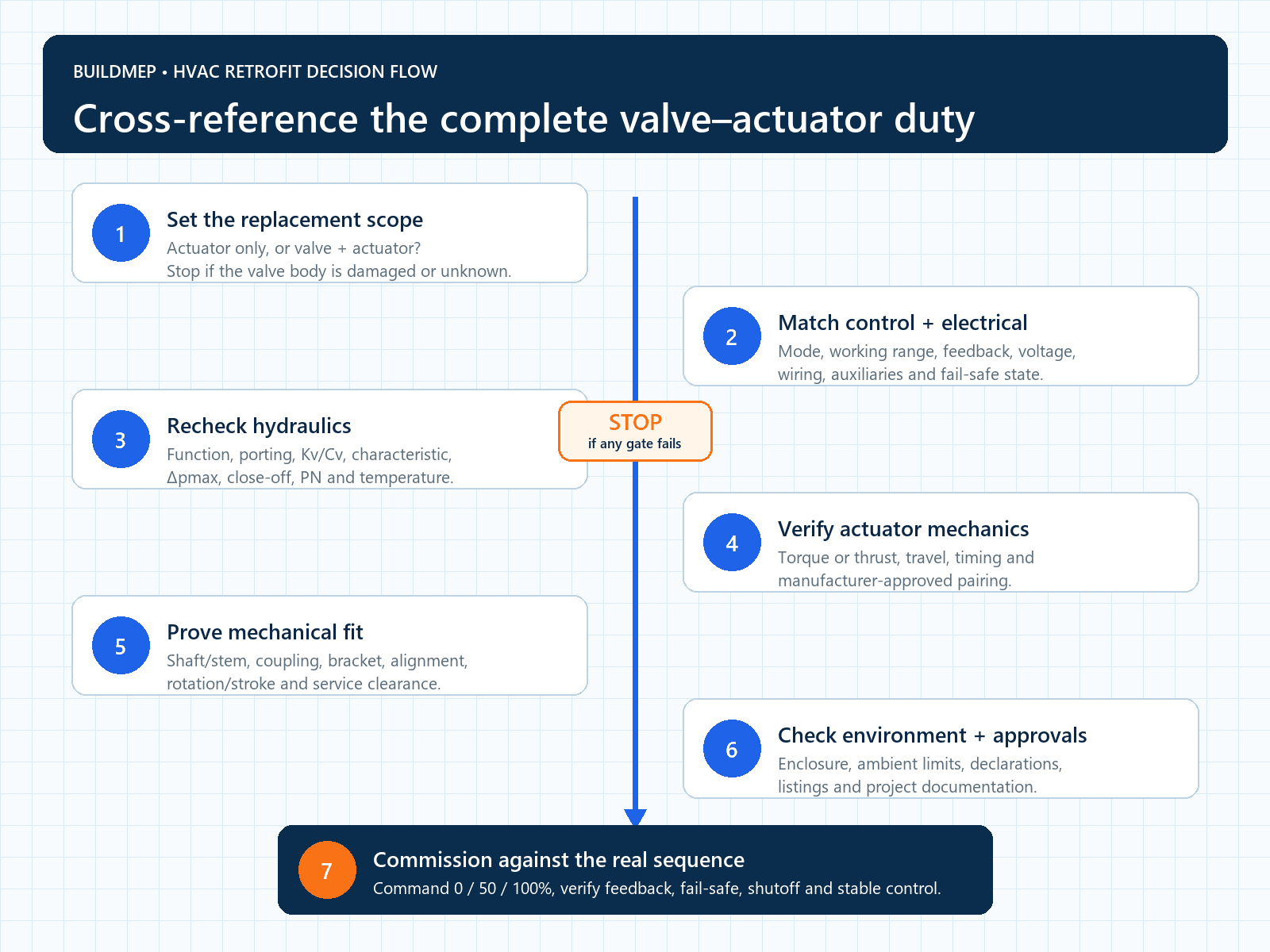
1. Decide whether to retain the valve body
If the body is sound, accessible data are reliable and a purpose-designed retrofit linkage exists, actuator-only replacement may reduce disruption. Replace the complete assembly when the body leaks, binds, has unknown capacity/porting, lacks a supported linkage or cannot meet the revised duty.
2. Match the control function and electrical interface
Keep on/off, floating/3-point and modulating functions distinct. For a modulating actuator, match the controller output, the actuator’s actual working range and any position-feedback signal. Confirm supply voltage, frequency, power consumption, conductor count, signal common, rotation sense and auxiliary contacts.
A programmable or “universal” actuator is useful only when the selected configuration is documented, locked where necessary and tested through the BMS sequence.
3. Recheck the valve hydraulics
For water at normal HVAC conditions, Kv is the flow in m³/h that produces a 1 bar pressure drop across the fully open valve. The working relation is Δp (bar) = (Q/Kv)². Use the project fluid correction when density differs materially from water.
Match the required capacity and characteristic; do not automatically select a higher Kv. Oversizing reduces valve pressure drop and authority, which can make the control loop coarse or unstable. Check maximum differential pressure and close-off pressure separately: they are not interchangeable catalogue values.
For more detail, use BuildMEP’s flow coefficient Cv/Kv guide.
4. Verify torque or thrust as part of the assembly
Rotary valves require torque; globe valves generally require linear force and stroke. The replacement must satisfy the valve manufacturer’s requirement at the stated differential pressure and service condition. “Equal or higher actuator torque” is not a complete rule: an oversized actuator or incorrect linkage can exceed stem, coupling or seat limits.
Prefer a manufacturer-approved valve/actuator combination. For an actuator-only retrofit, obtain the valve requirement, coupling geometry and allowable loads in writing. See the BuildMEP actuator torque sizing guide.
5. Prove the mechanical interface
Confirm rotary angle or linear stroke, stem/shaft shape and dimensions, flange or clamp pattern, bracket stiffness, coupling engagement, anti-rotation restraint and service clearance. Order the exact mounting kit with the actuator—do not leave adapter selection for the installer.
ISO 5211 is conditional, not universal. ISO 5211:2026 covers part-turn actuator attachments for industrial valves. Its application to control-valve attachments is subject to agreement between supplier and purchaser. Use it only when both valve and actuator documentation identify compatible ISO interfaces; many HVAC assemblies use product-specific direct mounts, clamps or linkages.
6. Check environment, approvals and submittals
Compare the exact model’s enclosure rating, ambient range, humidity/condensation limitations, cable entry and installation orientation. Then verify only the approvals required by the project and jurisdiction. CE is a manufacturer’s conformity marking, while UL/cULus status and enclosure type must be checked on the specific product documentation.
7. Commission the replacement against the sequence
Isolate safely, inspect free valve movement, install and align the linkage, configure rotation and signal range, then run a full stroke. Command minimum, midpoint and maximum positions from the controller; verify physical position, feedback, fail-safe action, end switches, leakage/shutoff and stable coil response. Record the final configuration and update the asset register.
For the physical sequence, see the Belimo retrofit actuator installation guide.
Why model numbers cannot be used as a valve cross-reference
A model suffix can identify actuator behavior, but it may not identify the valve body, porting, flow coefficient or close-off capability. The examples below are included to show the decoding problem—not to recommend a substitute.
| Model | Manufacturer data | What remains unknown |
|---|---|---|
| NR230-3 | Rotary actuator for mixing valves; 10 Nm; AC 230 V; 3-point; 140 s/90°; IP40. | The installed valve body, Kv, PN, porting, close-off duty and linkage condition. |
| LR24A-SR | Rotary actuator; 5 Nm; AC/DC 24 V; 2–10 V working range and feedback; 90 s/90°; IP54. | Whether it is installed on a 2-way or 3-way body, plus that body’s hydraulic and pressure data. |
| TR230-3 | Rotary actuator for ball valves; 2 Nm; AC 230 V; 3-point; 105 s/90°; IP40. | The valve body and duty. The unsuffixed shorthand “TR230” is not enough for a purchase decision. |
Shortlist brands, then qualify products
Siemens Acvatix, Honeywell, Danfoss, Johnson Controls and specialist valve/actuator manufacturers all offer relevant product families in some markets. That makes them candidates, not automatic equivalents. Availability, approvals and exact ranges vary by country and date; require a datasheet-based comparison for the exact ordered model.
Worked case: stop an oversized replacement before ordering
Assumed chilled-water coil duty
- Design water flow: 1.50 m³/h
- Target full-open valve pressure drop: 30 kPa
- Remaining controlled-branch loss at design flow: 30 kPa
- Control: 24 V AC, 2–10 V modulating, 2–10 V feedback, fail closed
- Maximum differential to be closed against: 150 kPa
- Values are engineering assumptions for method demonstration; confirm the real project data.
1. Estimate the required Kv
Kv = Q / √Δp(bar) = 1.50 / √0.30 = 2.74.
2. Compare available valve bodies
Candidate A, Kv 2.5: Δp = (1.50/2.5)² × 100 = 36.0 kPa.
Candidate B, Kv 4.0: Δp = (1.50/4.0)² × 100 = 14.1 kPa.
3. Check authority at design flow
Using a = Δpvalve / (Δpvalve + Δprest):
Candidate A: 36.0 / (36.0 + 30) = 0.55.
Candidate B: 14.1 / (14.1 + 30) = 0.32.
Good swap, risky swap and rejection conditions
| Condition | Consequence | Field symptom | Action |
|---|---|---|---|
| Function, signal, hydraulics and approved fit all match | Low implementation risk after project review | Full travel, stable response and correct shutoff | Proceed through documented commissioning |
| Pipe size matches but Kv is higher | Reduced valve authority and coarse control | Hunting, temperature swings or valve operating near closed | Recalculate at design flow; select by Kv/characteristic |
| 0–10 V assumed equivalent to 2–10 V | Dead band or incorrect end response | No movement at low command or mismatched feedback | Match and configure the actual working range |
| 3-way porting not mapped | Incorrect mixing/diverting path | Reverse response, bypass flow or loss of coil flow | Trace A/B/AB and flow arrows before isolation |
| Torque copied without valve requirement | Failure to close or mechanical damage | Stalling, leakage, bent linkage or premature wear | Use approved pairing or written torque/thrust data |
| Adapter “made to fit” on site | Misalignment and unreliable travel | Binding, noise, lost motion or loose fasteners | Use a documented mounting kit and verify full travel |
| Integrated/networked function omitted | Sequence or monitoring no longer works | Alarms, missing data or uncontrolled flow | Reject or redesign through formal controls review |
Copy-and-paste supplier enquiry
Ask the supplier to complete the blanks and return exact datasheets for the valve, actuator and mounting kit.
- System/loop:
________ - Replace: actuator only / complete assembly
- Valve function: 2-way / 3-way mixing / 3-way diverting
- Size/connection: DN
__; BSP / NPT / flange__ - Design flow:
__m³/h - Required Kv/Cv:
__ - Design valve Δp:
__kPa - Maximum operating differential:
__kPa - Required close-off:
__kPa - PN/class:
__ - Fluid/glycol:
________ - Fluid/ambient temperature:
__ / __°C - Control/working range:
________ - Supply:
__V AC/DC;__Hz - Feedback/auxiliaries:
________ - Fail-safe position: open / closed / hold
- Torque/thrust and travel:
________ - Running time:
__s - Mounting kit: exact part number
________ - Enclosure/approvals:
________
Site and commissioning sign-off
- Confirm the isolated valve moves freely through its required travel.
- Compare ordered model numbers with approved valve, actuator and adapter submittals.
- Measure supply voltage and verify transformer/relay loading.
- Command minimum, midpoint and maximum positions from the real controller.
- Witness correct rotation, port action, feedback and de-energized fail-safe position.
- Verify shutoff/leakage and stable flow or leaving-water temperature under operating Δp.
- Record configuration settings, stroke time, test points and final wiring.
- Update the asset register, as-built drawings and spare-parts record.
Frequently asked questions
Can I replace only the Belimo actuator?
Yes, when the valve body is serviceable and documented, and a supported linkage provides the required travel, alignment and torque/thrust. Replace the complete assembly when body condition, capacity, porting or mounting cannot be verified.
Does a higher torque rating make the alternative safer?
No. The actuator must meet the valve requirement without exceeding the allowable loads of the stem, coupling, bracket or seat. Use a manufacturer-approved pairing or written sizing data.
Can a universal actuator replace on/off, 3-point and 0–10 V models?
Only if the exact product supports the required mode, voltage, working range, feedback and fail-safe behavior. Configure it deliberately and test it from the BMS; do not rely on the word “universal.”
Is ISO 5211 enough to prove the actuator will fit?
No. Even where both products use ISO 5211, confirm flange size, drive dimensions, torque class, coupling, bracket, travel and clearance. For HVAC control valves, product-specific mounting arrangements are common.
Evidence trail and limits
- Belimo, Electronic Valve Sizing and Selection — supports the required sizing/selection inputs and water-valve flow relationships. The document is older guidance; exact product data remain controlling.
- Belimo, Electronic Valve Application Guide — supports valve-authority reasoning and the need to size a modulating valve by circuit pressure relationships.
- Belimo RetroFIT+ replacement products and retrofit linkage instructions — support the need for application-specific linkages and verified travel.
- ISO 5211:2026, Industrial valves—Part-turn actuator attachments — defines the attachment scope and states that use for control-valve attachments is subject to supplier–purchaser agreement.
- Belimo product pages/datasheets for NR230-3, LR24A-SR and TR230-3 — support only the exact actuator data shown in the model-decoding table.
Project limit: This guide is a cross-reference method, not a substitute approval. The designer, supplier and commissioning authority must verify the exact ordered assembly against the adopted specification, jurisdiction, system sequence and operating conditions.