
Honeywell RTH9585WF thermostat – evaluate its capabilities against Nest, and then call it a day. That is not the real mistake that people make.
The RTH9585WF will need a “C-wire”, a common wire with constant 24V supply. The thermostat will not work or it will work but from time to time: losing Wi-Fi, rebooting, and losing its schedule. This is the only most common cause of a smart thermostat installation not working and is independent on whether the thermostat is good or bad.
Always test wiring first before you do a feature comparison. Five minutes and it’s the rest of the day.
Short answer: A good durable programmable WiFi thermostat that lacks auto-learning and has a large colour touchscreen. With a C-wire, it’s a simple suggestion for those who prefer to make a schedule instead of letting someone else guess. Don’t have a C-wire? Factor in an adapter or wire pull, or use a thermostat that doesn’t require a C-wire.
Step One: Check Your Wiring
Turn off power to your heating/cooling system at the breaker. Pull the existing thermostat off its wall plate — most lift off, some have screws or clips. You’ll see solid-core wires landed on lettered terminals.
What you’re looking for:
| Terminal | Wire function |
|---|---|
| R / Rh / Rc | 24V power from the transformer |
| W | Heat call |
| Y | Cooling call |
| G | Fan |
| C | Common — the return path. This is the one that matters. |
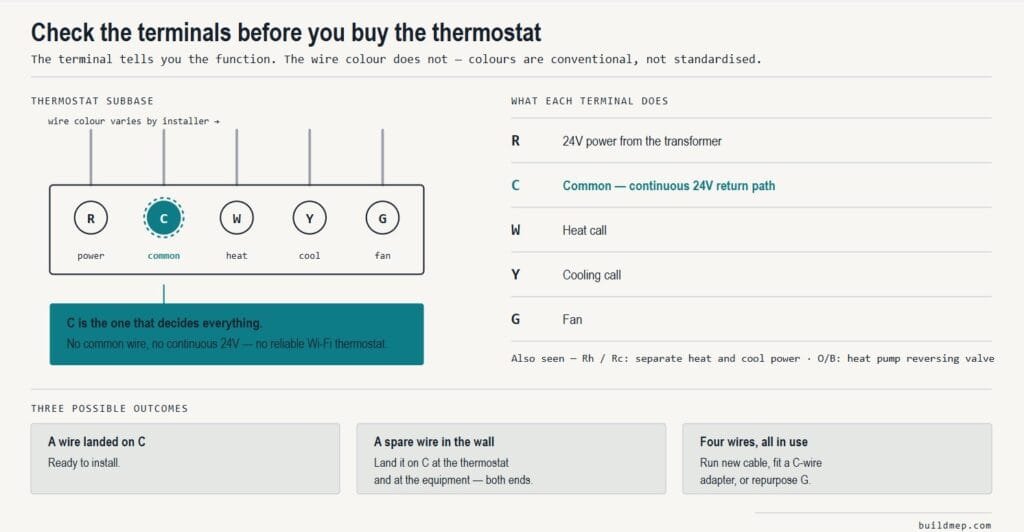
Take a photo before you disconnect anything. Wire colours are conventional, not standardised — a blue wire is not guaranteed to be a common. The terminal it lands on tells you what it does; the colour does not.
Three outcomes:
- A wire on C → you’re ready to install.
- No wire on C, but a spare unconnected wire tucked into the wall → very common. That spare can usually become your C-wire, but it has to be landed at the equipment end too. Both ends, or it does nothing.
- Only four wires, all in use → you need one of the workarounds below.
Manual of Honeywell RTH9585WF.
If You Don’t Have a C-Wire: Four Options are to check
Ranked roughly by how good the outcome is.
1. Run a new cable. The proper fix. If the cable route is accessible, replacing the run with 18/5 gives you a real common and headroom for future changes. Best long-term result, most effort.
2. Use an existing unused conductor. If there’s a spare wire in the bundle, land it on C at the thermostat and on the C terminal at the furnace or air handler control board. Free, reliable, and the most common fix in practice.
3. Fit a C-wire adapter / power extender. A small module installed at the equipment end that multiplexes power over the existing conductors. Honeywell’s own adapter (THP9045A1098) is designed for this. Works well, adds a component at the equipment end, and needs access to the control board.
4. Repurpose the G (fan) wire as the common. Move G to C at both ends. It works, and it’s often suggested — but understand the trade-off: you lose independent fan control. You can no longer run the fan on its own for circulation without a heat or cool call. On some systems that’s irrelevant; if you use fan-only circulation, it’s a real loss. Verify against your specific system before doing this.
What to avoid: running this thermostat on batteries alone as a permanent arrangement. It’s designed for continuous 24V power, and battery-only operation is where the intermittent Wi-Fi and reboot complaints come from.
A note on scope. Thermostat wiring is low-voltage, and in most jurisdictions it’s homeowner-permissible. Work at the furnace or air handler control board is a different matter — that enclosure contains line voltage. If you’re not confident identifying what’s what inside it, that’s the point to call an HVAC contractor rather than the point to proceed carefully.
What This Thermostat Actually Is
A large-format, full-colour touchscreen programmable thermostat with Wi-Fi. It works with most 24V low-voltage systems — conventional forced air, heat pumps, and multi-stage setups.
The defining characteristic is what it doesn’t do: it does not learn. You set a 7-day schedule and it runs it. That’s a genuine functional difference from a Nest, and whether it’s a drawback depends entirely on you.
It suits you if:
- You want the schedule to be exactly what you set, with no algorithm adjusting it
- Your household routine is regular and predictable
- You’d rather have a large, legible display than a minimalist one
- You want smart-home integration without a subscription
It doesn’t suit you if:
- You want the thermostat to figure out your patterns for you
- Your schedule is irregular enough that automatic occupancy detection would genuinely help
- You need room-by-room sensing to deal with an unevenly conditioned house — that’s a different product category, and no single-point thermostat solves it
That last one is worth being blunt about: a smart thermostat cannot fix an unbalanced system. If one room is always cold, the cause is duct sizing, balancing, or insulation. A thermostat measures one point and controls the whole system from it. Changing the thermostat changes how that one point is controlled — nothing else.
The App and Brand Situation
Worth knowing, because it’s confusing and most reviews get it wrong:
The Honeywell Home brand is used under licence by Resideo Technologies, which was spun out of Honeywell. Support, apps and warranty go through Resideo, not Honeywell International.
Two apps exist:
- Total Connect Comfort (TCC) — the established app this thermostat registers to
- The Resideo App — newer, with a unified dashboard and push notifications; TCC thermostats can be imported into it after registering on TCC first
You register on TCC. Whether you then move to the Resideo App is preference. Neither requires a subscription for basic remote control.
Integrations include Alexa, Google Assistant, and other smart-home platforms — verify current compatibility on Resideo’s product page rather than trusting any review’s list, this one included, since integrations get added and dropped.
Installation Notes Worth Knowing
- Photograph the existing wiring before disconnecting. Every time.
- Power off at the breaker, not just at the system switch.
- Don’t let wires fall into the wall cavity. Standard trick: wrap them around a pencil, or clip them, before you pull the old base off.
- Replacing a mercury thermostat? Older units with a glass ampoule of silver liquid contain mercury and must not go in household waste. In the US, the Thermostat Recycling Corporation handles disposal; elsewhere, check local hazardous waste rules.
- Set the system type correctly during setup — heat pump versus conventional is the most commonly mis-set option, and getting it wrong produces symptoms that look like a faulty thermostat.
Verdict
If you have a C-wire, then this is an easy recommendation: if it’s well-made (made by a reputable company), it’s legible, it’s reliable, it has no subscription and does what you say. Not to learn is no fault of the design — some people don’t want a thermostat to have opinions, they want a thermostat to run a schedule.
If you don’t have a C-wire, then the thermostat is not the first issue to address. Estimate the cost of wiring to be installed and compare that cost instead of the actual cost once the box is open.
The price fluctuates too much to support a useful quote, so check the current availability and if you are looking for a contractor, remember to look for the price of the smart thermostat plus installation.
Related Reading
- The home MEP toolkit — including why the multimeter you use to identify these wires needs the right CAT rating
- How to reduce your AC bill in summer — thermostat strategy that works regardless of which model you fit
- FCU vs AHU vs FAHU explained — for readers whose “thermostat” controls something rather different
Frequently Asked Questions
Does the Honeywell RTH9585WF need a C-wire?
Yes. It requires continuous 24V power via a common wire. Without one it may fail to power up, or run intermittently — dropping Wi-Fi and rebooting. If you don’t have a C-wire, you’ll need to run one, repurpose a spare conductor, or fit a C-wire adapter.
Can I run it on batteries instead?
Not as a permanent arrangement. The design assumes continuous 24V supply. Battery-only operation is the source of most reported connectivity and reboot problems.
What happens if I use the G wire as my common?
It works, but you lose independent fan control — you can no longer run the fan for circulation without a heating or cooling call. Fine on some systems, a real loss on others. Check your usage before committing.
Does it learn my schedule like a Nest?
No. It’s a 7-day programmable thermostat — you set the schedule and it runs it. For predictable routines that’s often preferable; for irregular ones, a learning or occupancy-sensing thermostat may suit better.
Which app does it use?
Total Connect Comfort, operated by Resideo. Thermostats registered on TCC can also be imported into the newer Resideo App. Neither requires a subscription for remote control.
Will a smart thermostat fix a room that’s always cold?
No. Uneven temperatures come from duct sizing, balancing, or insulation. A single-point thermostat can’t correct a distribution problem — you’d need zonialancing work, or remote sensors.