
BuildMEP • Fire & smoke • technical review
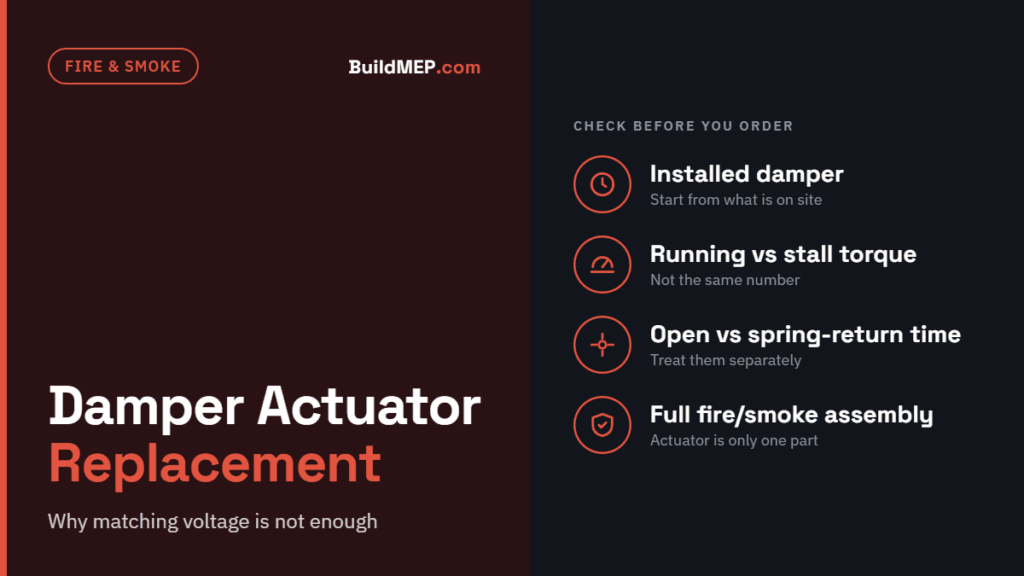
A damper actuator replacement can have the correct supply voltage and still fail technical review. Torque, operating time, fail-safe action and the approved damper assembly all matter. For smoke-control and combination fire/smoke dampers, the question is whether the proposed actuator is suitable for the installed assembly and its required operation.
This guide uses Siemens GND121.1U and GRD121.1U as a worked comparison. It helps engineers and procurement teams prepare a replacement submittal without assuming that a similar model number proves equivalence.
Reviewed 24 October 2026 • Replacement submittal review; manufacturer documents and project approval govern the installation.
GND121.1U vs GRD121.1U: the differences that matter
| Characteristic | GND121.1U | GRD121.1U |
|---|---|---|
| Supply | 24 VAC / 24 VDC | 24 VAC / 24 VDC |
| Control | Two-position | Two-position |
| Minimum running torque | 53 lb-in (6 Nm) | 30 lb-in (3.4 Nm) |
| Powered run time for 90° | 15 seconds nominal; see frequency note | 30 seconds nominal |
| Spring return on power loss | 15 seconds maximum | 15 seconds maximum |
Sources: Siemens GND technical instructions, document 155-746 (2011) and Siemens GRD submittal sheet, document A6V11692965 (2022). The GND operating description states 15 seconds for 90° at 60 Hz. Check the installed supply frequency, exact suffix and latest manufacturer data before ordering.
The engineering implication is clear: GRD provides approximately 43% less running torque and takes twice as long for the powered 90° stroke. If the approved requirement is at least 6 Nm and a 15-second powered stroke, the listed GRD ratings do not satisfy those requirements as written. Matching voltage and spring-return time does not resolve the difference.
This comparison does not establish that GRD is unsuitable for every existing GND installation. It also does not establish a manufacturer-approved replacement or confirm discontinuation. Application-specific approval needs evidence for the actual damper.
Start with the installed damper
Before requesting a quote, record the damper manufacturer, model, dimensions and identification label. Photograph the actuator nameplate, mounting arrangement and accessible wiring identification. Keep the full actuator reference, including suffixes; a base model alone may omit important options.
Belimo’s fire/smoke replacement checklist identifies damper make and size, voltage, temperature rating, auxiliary switches, torque and both operating times as useful selection inputs. Its guidance also addresses mounting and post-installation testing.
Separate running torque from stall torque
The GND instructions list 6 Nm running torque and 18 Nm minimum stall torque. GRD lists 3.4 Nm running torque and 9 Nm minimum stall torque. Compare running torque with running torque. Using a candidate’s stall value against the original actuator’s running value creates a misleading comparison.
Put the required duty and the proposed rating in separate columns in the submittal. Where a proposed value differs, ask the manufacturer to explain suitability for the specified damper size and operating conditions. A supplier’s statement that an item is “equivalent” should identify the evidence supporting that claim.
Treat opening and spring-return time separately
“15-second actuator” is incomplete wording. Specify whether the requirement refers to powered travel, spring return or both, and state the travel angle. In the example above, both series have a maximum 15-second spring return, while their powered run times differ.
Check the complete fire/smoke assembly
Siemens describes GRD fire/smoke performance in the context of testing with the damper assembly. An actuator’s certification information alone therefore does not demonstrate suitability for every damper. Obtain the applicable damper manufacturer’s replacement instructions or written confirmation for the proposed combination.
Confirm the required temperature performance, mounting hardware, thermal device, fail-safe direction and position indication. Belimo’s retrofit resources provide instructions organised around damper manufacturers, illustrating why the assembly identity matters. Follow the applicable project requirements and local approval process; this comparison is not installation authorisation.
Replacement submittal checklist
- Existing damper and actuator identification, with photographs.
- Exact proposed part number, including all suffixes and accessories.
- Side-by-side ratings for supply, control, running torque, powered stroke and spring return.
- Damper manufacturer’s suitability confirmation or applicable retrofit instructions.
- Relevant assembly listing information and temperature limitations.
- Mounting, thermal-device and auxiliary-switch compatibility.
- Any deviations clearly identified for technical review.
- Installation and functional-test requirements, with an agreed record of results.
RFQ wording you can reuse
Please quote the exact actuator reference shown on the attached nameplate. If unavailable, identify the proposed replacement and provide its manufacturer datasheet, applicable damper retrofit instructions and written suitability confirmation for the existing assembly. Compare supply, control mode, running torque, powered travel time, spring-return time, mounting and required accessories. Clearly state all deviations, delivery period and quotation validity.
If obsolescence is claimed, request a manufacturer notice or written confirmation. Keep commercial availability and technical acceptance as separate decisions: an available part still needs to meet the documented application requirements.
Common questions
Can I use any 24 V spring-return actuator?
Voltage and spring return are only two checks. Review the required torque, travel times, control, mounting and suitability for the damper assembly.
Does a replacement cross-reference prove compatibility?
Use it to identify a candidate, then check its conditions against the installation. Keep the supporting manufacturer documents with the approval package.
For manufacturer retrofit resources, see Belimo fire and smoke damper actuator documentation.
Technical review: 24 October 2026. This guide supports planning and review. Confirm the exact manufacturer documentation and project requirements before procurement or work on equipment. Cover artwork is a conceptual illustration, not a product identification photograph.