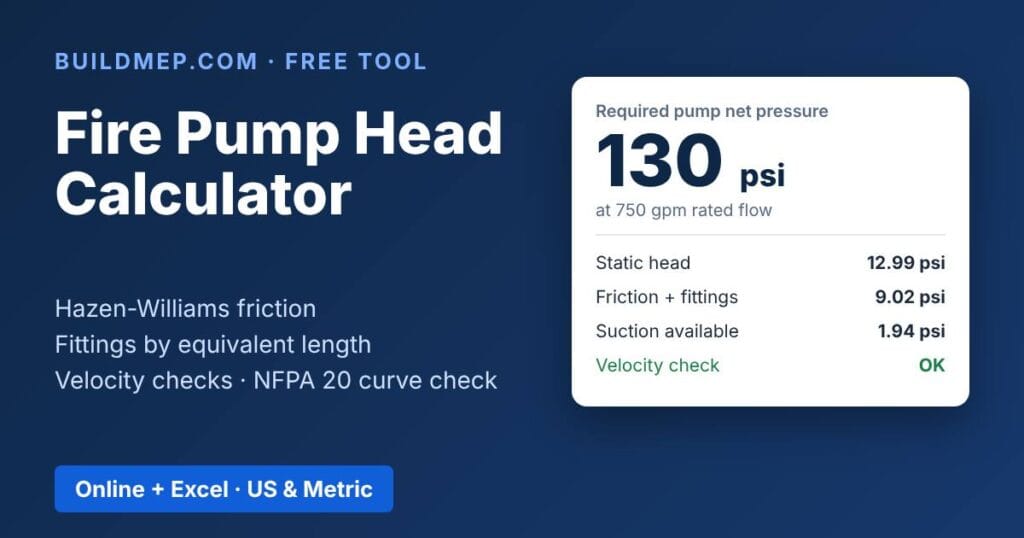

Sizing a fire pump starts with one number: the net pressure it must add at the rated flow. This free calculator adds the residual pressure, elevation, pipe friction (Hazen-Williams), fittings (equivalent length), other losses and suction conditions for you, flags pipe velocities, picks the next standard pump rating and checks your pump curve against the NFPA 20 rules. Works in US and metric units, and prints a design calculation sheet.
1. Project
2. System demand
Residual pressure is the pressure needed at the hydraulically remote point (sprinkler, hose valve or riser) after all losses downstream of it are already included in that figure. Elevation uses 0.433 psi/ft (0.0981 bar/m) for water.
3. Pipe segments
List suction pipe (S) and discharge pipe (D) in series. Leave a segment flow blank to use the design flow. Fittings are converted to equivalent length from the NFPA 13 table values (Sch 40, C=120) and corrected for your C-factor.
Defaults are commonly used design limits (20 ft/s discharge, 15 ft/s suction at 150% flow per NFPA 20 practice). They are checks, not code-mandated for every pipe: confirm against the standard and authority having jurisdiction.
4. Result
5. Pump curve check (NFPA 20)
NFPA 20 requires shutoff pressure not above 140% of rated pressure and at least 65% of rated pressure at 150% of rated flow. Enter your selected pump’s published curve values.
Disclaimer: a free educational tool by BuildMEP.com. Equivalent lengths are the commonly published NFPA 13 values for Schedule 40 steel; verify against the edition adopted on your project. Results do not replace a full hydraulic calculation or the judgement of a licensed engineer.
Download the Excel version (free, no macros)
How the fire pump head is calculated
The pump must deliver the pressure the system demands at its remote point, plus everything lost on the way, minus any pressure already available at the suction.
- Required discharge pressure = residual pressure at the remote point + static head (elevation × 0.433 psi/ft) + friction in discharge pipe and fittings + other losses (backflow preventer, alarm valve, meter).
- Net pump pressure = required discharge pressure − available suction pressure (water level above the pump, minus suction pipe friction).
- Friction uses Hazen-Williams, P = 4.52 Q1.85 / (C1.85 d4.87) psi per ft, with the actual internal pipe diameter, not the nominal size.
- Fittings are converted to equivalent pipe length using commonly published NFPA 13 values for Schedule 40 steel at C = 120, corrected for other C-values.
NFPA 20 pump curve check
Enter the shutoff pressure and the pressure at 150% of rated flow from the manufacturer’s curve. The pump should not exceed 140% of rated pressure at shutoff, and should still deliver at least 65% of rated pressure at 150% of rated flow.
FAQ
Why does the old nominal-diameter method understate friction?
Schedule 40 pipe has a smaller internal diameter than its nominal size above 1 inch, so using the nominal figure makes friction look lower than it is.
Are the velocity limits code requirements?
No. 20 ft/s (6 m/s) on discharge and 15 ft/s (4.5 m/s) on suction are commonly used design limits, and you can change them. Always confirm against the NFPA edition and the authority having jurisdiction on your project.
Can I use it for the final submittal?
It is a design aid for quick sizing and checking. A full hydraulic calculation for the sprinkler system, and review by a licensed engineer, are still needed.
Related: Fire and smoke damper selection guide · Free AutoCAD block counter