
Part of HVAC Controls, Detection & Efficiency: The Complete BuildMEP Guide →
Turndown ratio shows up in this site’s BTU meter sizing, demand-controlled ventilation, and HVAC design mistakes content without ever being defined on its own. It’s a genuinely simple concept with one real trap worth knowing about: the term means two different things depending on what you’re applying it to.
What Turndown Ratio Actually Measures
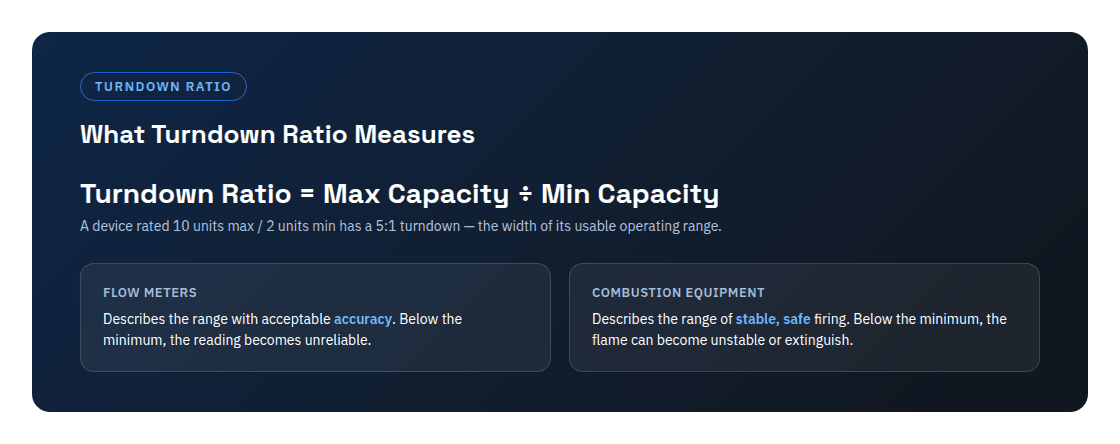
Turndown ratio is the ratio of a device’s maximum capacity to its minimum capacity — the width of its usable operating range. A device rated for 10 units maximum and 2 units minimum has a turndown ratio of 5:1. The higher the ratio, the wider the range the device can operate across while still performing acceptably.
Two Contexts, Two Different Meanings
This is the detail worth getting right, because the same term gets applied to two genuinely different questions depending on the equipment:
- For flow meters, turndown ratio (also called rangeability) describes the range of flow a meter can measure with acceptable accuracy. Below the minimum, the reading becomes unreliable — not necessarily wrong in a dangerous way, just not trustworthy.
- For combustion equipment — boilers, burners — turndown ratio describes the range between maximum and minimum firing rate at which the unit can operate stably and safely. Below the minimum, the flame itself can become unstable or extinguish, which is a different kind of failure than an inaccurate reading.
Reading a turndown spec without knowing which of these two questions it’s actually answering is an easy way to misjudge what a device can and can’t do.
Flow Meter Turndown in Practice
Different flow meter technologies have meaningfully different turndown capability, which is exactly why this matters at the selection stage rather than after installation:
- Orifice plates: roughly 3:1
- Turbine meters: roughly 10:1
- Positive displacement meters: roughly 10–80:1
- Multipath ultrasonic meters: commonly rated around 50:1
A meter with too low a turndown ratio for the application will read accurately at design flow but become unreliable exactly when flow drops during partial-load conditions — which is often when accurate metering matters most. This is the same consideration behind our chilled water BTU meter sizing guide: a meter has to be selected against the actual minimum flow the system will see, not just its design maximum.
Combustion Equipment Turndown in Practice
For boilers and burners, typical turndown ranges vary meaningfully by fuel and design: gas-fired equipment commonly runs 5:1 to as high as 35:1, oil-fired equipment typically 2:1 to 4:1, and traditional firetube boiler burners around 5:1, with “high turndown” generally meaning 10:1 or better. A commonly cited minimum for gas-fired condensing boilers specifically is around 5:1, since condensing equipment’s efficiency advantage depends on being able to modulate rather than cycle.
The Real Cost of Insufficient Turndown: Short Cycling
When a load falls below a boiler or burner’s minimum firing rate, the unit can’t simply run lower — it has to shut off and restart repeatedly to avoid overshooting, a pattern called short cycling. This isn’t just an inefficiency; it’s a real mechanical and cost problem: short cycling has been documented to drop overall efficiency by as much as 15 percentage points versus steady low-fire operation, alongside increased wear on mechanical components, purge losses on every restart, and water chemistry issues from repeated cycling. An oversized boiler relative to the actual load is a common way to end up here — which is exactly the kind of oversizing mistake covered in our HVAC design mistakes guide: equipment sized for a peak load it rarely sees can end up running below its effective turndown range for most of its operating life.
Reasoning Through a Turndown Check
- Identify which type of turndown applies — measurement accuracy (flow meters) or firing-rate stability (combustion equipment) — since the failure mode differs between them.
- Determine the actual minimum load the equipment will see, not just the design maximum, since turndown is fundamentally about the bottom of the operating range.
- Compare the required range against the specific technology’s typical turndown capability, using real published figures rather than a generic assumption.
- For combustion equipment, treat turndown as a stability and code question, not just an efficiency one — running below the rated minimum isn’t simply inefficient, it can be an unsafe operating condition.
- If load will spend significant time below the equipment’s minimum, reconsider the sizing rather than accepting routine short cycling as normal.
Common Mistakes
- Treating “turndown ratio” as one universal concept without checking whether the spec in front of you is describing measurement accuracy or firing-rate stability.
- Sizing equipment purely against peak design load without checking whether it will spend most of its operating life below its effective turndown range.
- Accepting routine short cycling as a normal operating pattern rather than a signal that the equipment is oversized or the turndown ratio is insufficient for the actual load profile.
- Selecting a flow meter technology based on accuracy at design flow alone, without checking its turndown against the actual minimum flow conditions it will see.
- Assuming a higher turndown ratio is free — wider operating range generally comes with added equipment complexity and cost, so it’s a real design trade-off, not a default to maximize.
Frequently Asked Questions
Is a higher turndown ratio always better?
Not automatically — a wider turndown ratio generally means more complexity and cost. The right turndown ratio is the one that comfortably covers the actual expected load range, not necessarily the highest available figure.
Is turndown ratio the same thing as rangeability?
For flow meters and control valves, the terms are largely used interchangeably to describe the usable operating range. For combustion equipment, “turndown ratio” is the standard term and isn’t typically called rangeability.
How does this relate to demand-controlled ventilation?
DCV systems are a practical example of equipment needing to operate reliably across a wide range of conditions as occupancy and load vary — see our demand-controlled ventilation guide for how that variability is managed on the ventilation side specifically.
What happens if I run equipment below its rated minimum anyway?
For flow meters, the reading becomes unreliable. For combustion equipment, the outcome is more serious — flame instability, safety shutdowns, or short cycling with all its associated wear and efficiency loss.