
| Reading Time | 30–35 Minutes |
| Difficulty Level | Intermediate to Advanced |
| Target Audience | HVAC Engineers, MEP Consultants, Contractors, Facility Managers, Engineering Students |
| Topics Covered | Cooling Load • Equipment Sizing • Air Distribution • Ventilation • Duct Design • Control Valves • BMS • Maintenance • Energy Efficiency • Commissioning |
| Estimated Word Count | 8,000–10,000 Words |
| Last Updated | June 2026 |
| Author | Mohamed Suhail – Mechatronics Engineer & Founder of BuildMEP |
Executive Summary
The success of an HVAC system starts before installation. The performance, efficiency, reliability, and operating cost of a building are key determinants at the design stage. The choice of equipment, ductwork, controls, commissioning, and ventilation are all directly tied to the cooling load calculations and will affect the performance of the system during its lifetime.
Unfortunately, a lot of HVAC problems that are reported after the project handover are not necessarily due to equipment failure but, on the contrary, are due to design flaws that could have been avoided if engineering was done properly. These errors can lead to discomfort for occupants, high energy bills, reduced indoor air quality, higher maintenance costs, and premature equipment failure.
This full-scale report provides an overview of the ten most frequent HVAC design errors in residential, commercial, and industrial applications. Every section covers the reasons for these errors, the effect they have on system behavior, and the engineering tips and tricks that can be used to prevent them.
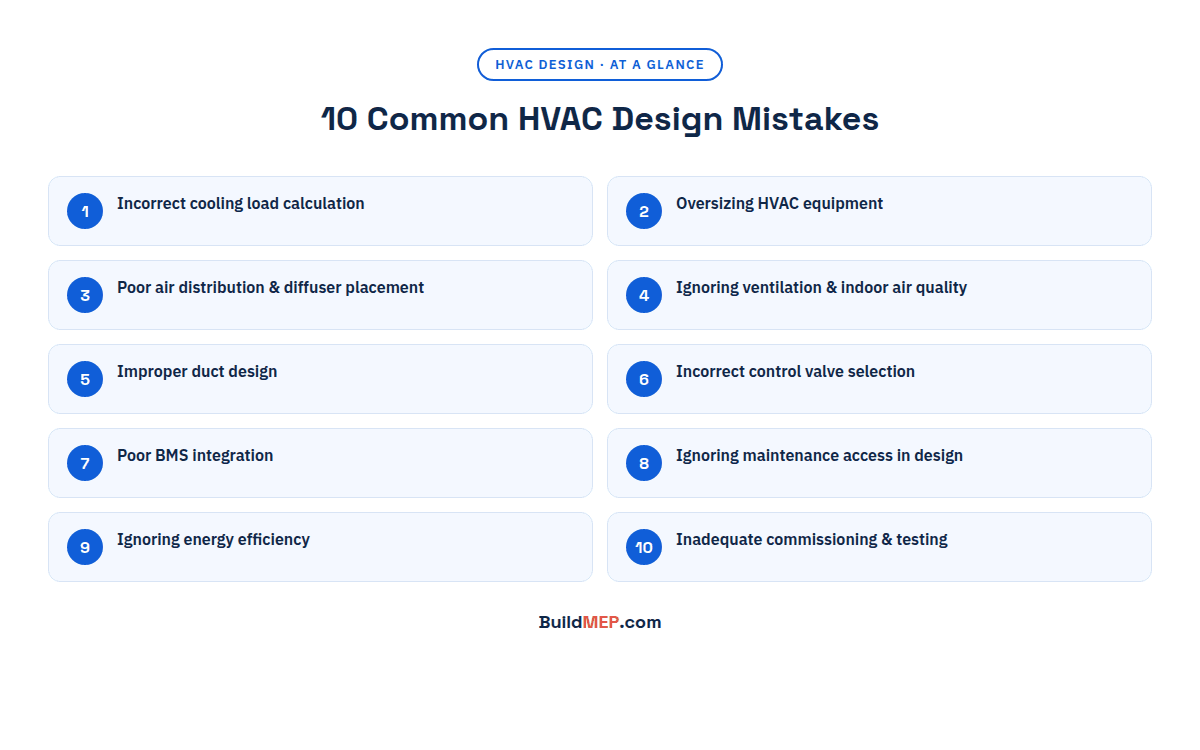
The 10 Common HVAC Design Mistakes are the following:
- Wrong Cooling Load Calculation – Wrong load calculations result in the wrong size of equipment, inefficient equipment operation, and poor indoor comfort.
- Oversized HVAC Equipment—Sizing up the equipment adds to the installation cost, shortens the equipment’s cycles, undermines humidity control, and wastes energy.
- Wrong Air Distribution – Diffuser positioning, improper air flow balancing, and return air design cause uneven temperatures and occupant comfort.
- Failure to meet ventilation requirements – Inadequate fresh air can have a negative impact on the indoor air quality; high levels of carbon dioxide can be a source of health and productivity problems.
- Duct Design – If the duct sizing is incorrect, there are too many pressure drops, and duct routing is too inefficient, airflow will diminish, fan energy will increase, and noise will increase unnecessarily.
- Wrong Control Valve Selection – An improper valve size or choice causes poor temperature control, poor system balancing, and inefficient operation.
- Failure to integrate the Building Management System (BMS)—incorrect strategies for control and sensor placement and poor system integration—leaves HVAC systems unable to operate efficiently.
- Failure to perform Maintenance Access – Equipment that is difficult to inspect or maintain incurs higher maintenance costs, longer downtime, and lower system reliability.
- Not considering Energy Efficiency – In the absence of energy efficiency considerations, the focus is on initial installation cost instead of life cycle performance, which will increase operating costs and energy use over time.
- Poor HVAC Commissioning – Even well-designed HVAC systems could fail to operate as intended if they have not been properly tested, balanced, calibrated and functionally tested during the commissioning process. Key Lessons
The majority of HVAC performance problems originate during the design stage, not after the building is occupied.
Engineering calculation, equipment selection, coordinated system design, effective controls, and detailed commissioning are all critical elements in the process of delivering comfortable, reliable, maintainable and energy efficient HVAC systems.
This guide’s ideas will allow any HVAC engineer, MEP consultant, contractor, or facility manager, engineering student, or building owner to detect the most prevalent design errors to prevent them from turning into costly construction issues or operational challenges at later points of building life.
The design of HVAC equipment is not just about the system and equipment, it’s about designing an integrated environmental control system that will satisfy the-needs of occupants for comfort, maintain good indoor air quality, requires low energy use and will reliably function throughout the life cycle of the building.Introduction
One of the most important parts of a modern buildings is the Heating, Ventilation, and Air Conditioning (HVAC) System. From residential homes to commercial offices, hospitals to shopping mall centers, hotels to industrial plants – a good HVAC design maximizes thermal comfort, healthy indoor air quality, energy efficiency, and long-term reliability and productivity.
These gains will come about, however, if not by simply picking a room air conditioner or computing how much cooling is needed, but by selecting the most suitable one properly. The design process for HVAC systems encompasses various branches of engineering, such as heat transfer, psychrometrics, fluid mechanics, ventilation, controls, acoustics, energy management, and coordination with other disciplines including architectural, structural, electrical and plumbing.
Unfortunately, there are many instances where HVAC systems fail for reasons other than bad equipment, yet have to do with error made in the design stage. Common errors usually only become apparent once the building is in use and start to manifest themselves as uncomfortable, damp or cold interiors, high electricity costs, noisy ducting, inadequate airflow, equipment failures and/or repeated complaints from occupants.
The consequences of all these mistakes on the finances can be considerable. The mistakes in the sizing of the chiller, the design of the duct system and the level of ventilation, could cost money over the chiller’s lifetime, while lowering the comfort level for the occupant and equipment life. It is estimated that correcting these issues during the post construction phase will cost more and could have been prevented if adequate planning and engineering had been carried out.
There’s one common misconception in HVAC design that must be addressed: thinking that bigger is better. In fact, too large systems can run less efficiently than properly sized equipment. The same applies to the choice of top of class equipment if it is not complemented by a good duct design, a proper control valve selection, and a lack of commissioning.
The current HVAC engineering practice requires systematic design working method. It is the responsibility of the engineer to precisely determine cooling and heating loads, specify equipment properly based on the actual operating conditions, design efficient air distribution systems, follow the ventilation standards, install them with intelligent controls and maintain them throughout their service life.
This thorough study will examine 10 of the most frequent HVAC design mistakes made in many residential, commercial, and industrial jobs. The errors of these are explained in each section, how they impact on the performance of the system, and how they can be avoided with practical engineering methods. This document does not aim to be a simple checklist, but rather help design professionals to understand the technical aspects to make informed design decisions throughout the course of an HVAC project.
Being an HVAC engineer, MEP consultant, contractor, facility manager, engineering student or building owner, knowing these common design pitfalls will enable you to ensure the reliability of the system, lower the cost of the building’s lifetime operations, and deliver buildings that will operate as designed.
What we are going to share.
By the end of this guide, you will understand how to:
- Perform better HVAC design decisions from the earliest project stages.
- Recognize common design mistakes before they become costly construction or operational problems.
- Improve energy efficiency through proper equipment selection and system design.
- Enhance indoor air quality and occupant comfort.
- Reduce maintenance issues by designing for accessibility and long-term operation.
- Apply practical engineering principles used in real HVAC projects.
As you design HVAC, successful design is not about the most costly equipment, it is simply about making informed engineering decisions based on the following criteria: Comfort, efficiency, reliability, maintainability, and design life expenses. The sections below explore the 10 pitfalls you and every HVAC professional should know – and can avoid.
The importance of the HVAC design.
Designing and sizing HVAC systems isn’t about just picking an air conditioner or finding out how big a chiller needs to be. It is an all-encompassing engineering process to make sure a building stays in good condition, energy efficient, safe and functional for the entire time it is in use. All design decisions and actions taken during the planning process affect construction costs, operating costs, the comfort of the individuals being served, indoor air quality, equipment reliability and future maintenance needs.
Building HVAC systems become part of the building’s construction more than architectural finishes do. The ductwork and piping, equipment rooms, control systems and ventilation shafts are set up during the construction phase and can be difficult and costly to change thereafter. Because of this, the mistakes committed in designing buildings can impact the performance for an even much more extended period.
The Role of HVAC in Modern Buildings
Heating, Ventilation, and Air Conditioning systems are designed to achieve several critical objectives simultaneously:
- Maintain comfortable indoor temperatures throughout the year.
- Control indoor humidity within acceptable limits.
- Supply adequate fresh air for occupant health and well-being.
- Remove contaminants, odors, and airborne pollutants.
- Minimize energy consumption while maintaining performance.
- Ensure reliable operation under varying occupancy and weather conditions.
- Provide an indoor environment suitable for the building’s intended purpose.
The importance of HVAC becomes even more evident in facilities such as hospitals, laboratories, pharmaceutical plants, data centers, airports, and cleanrooms, where precise environmental control is essential for safety and operational continuity.
HVAC Design Influences the Entire Building Lifecycle
A properly engineered HVAC system benefits every stage of a building’s lifecycle.
Design Stage
During the design phase, engineers determine:
- Building cooling and heating loads.
- Equipment capacities.
- Air distribution strategies.
- Ventilation requirements.
- Duct and pipe routing.
- Control philosophy.
- Energy efficiency measures.
- Coordination with architectural, electrical, plumbing, and structural disciplines.
Accurate decisions at this stage reduce the likelihood of costly redesigns during construction.
Construction Stage
Well-prepared HVAC drawings and coordinated layouts enable contractors to install systems efficiently with fewer clashes and delays.
Poor coordination can lead to:
- Duct conflicts with structural beams.
- Insufficient ceiling space.
- Equipment relocation.
- Additional fabrication costs.
- Project delays.
Operation Stage
After occupancy, the quality of the HVAC design directly influences:
- Occupant comfort.
- Indoor air quality.
- Energy consumption.
- Equipment lifespan.
- Maintenance costs.
- Building operating expenses.
A well-designed system can provide reliable service for many years with routine maintenance, while a poorly designed system may require frequent adjustments, repairs, and costly modifications.
The Cost of Poor HVAC Design
Many HVAC performance issues originate during the design stage rather than from equipment failure.
Common consequences include:
Higher Energy Bills
Oversized chillers, improperly selected pumps, excessive duct pressure losses, and poor control strategies can significantly increase electrical consumption throughout the building’s life.
Occupant Discomfort
Incorrect airflow distribution often creates hot and cold spots, drafts, uneven temperatures, and humidity problems that generate frequent occupant complaints.
Poor Indoor Air Quality
Inadequate outdoor air ventilation or poor air distribution may allow carbon dioxide levels, odors, moisture, and airborne contaminants to accumulate, reducing occupant comfort and productivity.
Increased Maintenance Costs
Equipment installed without adequate service clearance can make routine maintenance difficult. Filters, valves, coils, and fans become harder to inspect and replace, increasing labor time and maintenance costs.
Reduced Equipment Life
Improper equipment sizing and incorrect control sequences may cause excessive cycling, unstable operation, unnecessary wear, and premature component failure.
Engineering Standards Matter
Professional HVAC design is based on recognized engineering standards rather than assumptions or rules of thumb.
International standards provide guidance for:
- Indoor environmental conditions.
- Ventilation rates.
- Energy efficiency.
- Duct construction.
- Pipe sizing.
- Equipment performance.
- System testing and commissioning.
Following recognized standards helps engineers produce systems that are safe, reliable, maintainable, and energy efficient.
Coordination Is Essential
HVAC systems do not operate in isolation. Successful projects require continuous coordination with multiple engineering disciplines.
Examples include:
- Architectural layouts affecting diffuser locations.
- Structural beams influencing duct routing.
- Electrical power availability for mechanical equipment.
- Plumbing drainage requirements for condensate systems.
- Fire protection systems interacting with smoke control strategies.
- Building Management Systems (BMS) integrating HVAC controls.
Failure to coordinate these disciplines often results in costly redesigns and construction delays.
Designing for the Future
Modern buildings are expected to remain operational for decades. Therefore, HVAC systems should not only satisfy current design requirements but also provide flexibility for future expansion, technological upgrades, and changing occupancy patterns.
Forward-thinking engineers consider:
- Energy-efficient equipment selection.
- Variable-speed technologies.
- Smart building controls.
- Ease of maintenance.
- Spare capacity where justified.
- Sustainability goals.
- Long-term operating costs rather than initial installation cost alone.
Key Takeaways
Successful HVAC design is not simply about selecting mechanical equipment—it is about creating an integrated system that delivers comfort, energy efficiency, indoor air quality, reliability, and maintainability throughout the building’s lifecycle. Every decision made during the design stage influences how the building performs for many years to come.
Understanding the importance of good HVAC design provides the foundation for recognizing and avoiding the common mistakes discussed in the following sections of this guide.
Mistake #1: Incorrect Cooling Load Calculation
Why Cooling Load Calculation Is the Foundation of Every HVAC Design
Every successful HVAC project begins with one critical engineering task: determining the building’s actual cooling and heating load. This calculation forms the foundation upon which every major HVAC design decision is made. Chillers, package units, VRF systems, air handling units (AHUs), fan coil units (FCUs), pumps, cooling towers, ducts, pipes, diffusers, electrical feeders, generators, and even control valves are selected based on the calculated cooling demand.
If the cooling load calculation is inaccurate, every subsequent design decision becomes questionable. A mistake made during this initial stage often propagates throughout the entire HVAC system, leading to unnecessary capital costs, excessive energy consumption, poor indoor comfort, and expensive corrective work after construction.
For this reason, experienced HVAC engineers often say the following:
“A well-designed HVAC system starts with an accurate load calculation—not with equipment selection.”
For detailed methodologies on HVAC load calculations and thermal comfort, engineers should refer to the ASHRAE Handbook—Fundamentals and other guidance published by ASHRAE.
What Is Cooling Load?
Cooling load is the rate at which heat must be removed from a building to maintain the desired indoor temperature and humidity under peak design conditions.
It is commonly expressed in:
- kW
- Tons of Refrigeration (TR)
- BTU/h
The total cooling load consists of two primary components:
1. Sensible Heat Load
Sensible heat changes the temperature of the air without changing its moisture content.
Typical sources include:
- Solar radiation through windows
- Heat transfer through roofs and walls
- Lighting systems
- Office equipment
- Electrical appliances
- Occupants
- Motors and machinery
When sensible heat increases, the room temperature rises.
2. Latent Heat Load
Latent heat is associated with moisture removal rather than temperature reduction.
Major contributors include:
- Occupants breathing and perspiring
- Fresh outdoor ventilation air
- Air infiltration through doors and windows
- Kitchens
- Toilets
- Laundry facilities
Ignoring latent load often leads to excessive indoor humidity, even if the room temperature appears acceptable.
This is one of the most common mistakes made by inexperienced designers.
Why Accurate Cooling Load Matters
An accurate cooling load calculation helps engineers:
- Select properly sized HVAC equipment.
- Design efficient duct and piping systems.
- Estimate electrical power requirements.
- Size pumps and control valves correctly.
- Achieve occupant comfort.
- Improve indoor air quality.
- Reduce operating costs.
- Extend equipment life.
Simply put, every major HVAC design decision depends on this calculation.
Common Mistakes Engineers Make
1. Using Rules of Thumb Instead of Engineering Calculations
A surprisingly common practice is estimating cooling capacity using simple rules such as:
- 1 TR for every 400–500 ft²
- 120–150 W/m²
- 500 CFM per ton
While these approximations may provide a rough estimate during early project discussions, they should never be used for final equipment selection.
Two buildings with identical floor areas can have completely different cooling loads due to differences in occupancy, glazing, orientation, insulation, ventilation, lighting, and equipment density.
Using rules of thumb often results in oversized or undersized systems that fail to perform efficiently.
2. Ignoring Building Orientation
Buildings facing west or south receive significantly greater solar heat gain than those facing north.
Large glass façades exposed to afternoon sunlight can substantially increase cooling demand.
Ignoring orientation often causes perimeter zones to overheat during peak summer conditions, even when the HVAC system appears adequately sized on paper.
3. Incorrect Occupancy Assumptions
People are heat sources.
Each occupant contributes both sensible and latent heat.
Designing a conference room for ten people when it regularly accommodates twenty-five can result in:
- High room temperatures
- Elevated humidity
- Insufficient ventilation
- Frequent occupant complaints
Always use realistic occupancy schedules rather than minimum expected occupancy.
4. Neglecting Fresh Air Requirements
Outdoor ventilation air frequently represents one of the largest latent cooling loads, particularly in hot and humid climates.
If ventilation requirements are underestimated:
- Cooling coils become undersized.
- Indoor humidity increases.
- Mold growth becomes more likely.
- Indoor air quality deteriorates.
Proper ventilation calculations are essential for both comfort and occupant health.
5. Ignoring Internal Heat Gains
Modern buildings contain numerous internal heat sources that should never be overlooked.
Examples include:
- Desktop computers
- Servers
- Data centers
- Medical equipment
- Kitchen appliances
- Industrial machinery
- LED lighting
- Elevators
- UPS systems
Each contributes additional heat that the HVAC system must remove.
Real Project Example
Consider two office buildings, each with a floor area of 500 m².
Building A
- North-facing
- Double-glazed windows
- 20 occupants
- LED lighting
- Standard office equipment
Calculated cooling load: approximately 75 kW
Building B
- West-facing curtain wall
- 45 occupants
- Meeting rooms
- Pantry
- High-density computer workstations
Calculated cooling load: approximately 125 kW
Although both buildings have the same floor area, Building B requires approximately 67% more cooling capacity because of its orientation, occupancy, glazing, and internal equipment loads.
This illustrates why floor area alone is never a reliable basis for equipment sizing.
Best Practices
Professional HVAC engineers should:
- Perform detailed load calculations using recognized software.
- Use current weather data for the project location.
- Verify occupancy schedules with the client.
- Coordinate glazing information with the architect.
- Include lighting and equipment loads.
- Consider future building usage where appropriate.
- Review calculations before final equipment selection.
Designer’s Checklist
Before selecting HVAC equipment, verify that you have:
☐ Indoor design temperatures
☐ Outdoor design temperatures
☐ Occupancy data
☐ Lighting loads
☐ Equipment loads
☐ Fresh air requirements
☐ Building orientation
☐ Window specifications
☐ Roof and wall insulation values
☐ Infiltration estimates
☐ Operating schedules
Learn more about HVAC cooling load calculations.
Key Takeaways
Cooling load calculation is not simply a mathematical exercise—it is the foundation of successful HVAC engineering. Investing time in accurate calculations during the design stage reduces project risks, improves occupant comfort, minimizes energy consumption, and extends the life of HVAC equipment. Every major design decision that follows depends on the quality of this first step.
Mistake #2: Oversizing HVAC Equipment
Bigger Is Not Always Better
One of the most common misconceptions in HVAC engineering is that installing larger equipment provides better comfort, greater reliability, and additional safety. While this may appear logical, oversized HVAC equipment frequently performs worse than properly sized systems.
In practice, many engineers intentionally oversize chillers, air handling units (AHUs), package units, VRF systems, and pumps because they fear underestimating the cooling load or anticipate future building expansion. Contractors may also recommend larger equipment due to limited model availability or to avoid complaints during peak summer conditions.
However, excessive oversizing increases installation costs, reduces energy efficiency, shortens equipment life, and often creates comfort problems that are difficult to resolve after the building is occupied.
The objective of HVAC design is not to install the largest available equipment, but to install equipment that closely matches the building’s calculated design load while allowing for reasonable operating flexibility.
What Is Oversizing?
Oversizing occurs when the selected HVAC equipment has a capacity significantly greater than the building’s calculated cooling or heating demand.
For example:
- Calculated Cooling Load: 100 kW
- Selected Chiller Capacity: 160 kW
In this example, the system is oversized by approximately 60%.
While a small design margin may be appropriate to account for uncertainties, excessive oversizing rarely improves performance and often introduces new operational problems.
Why Engineers Oversize Equipment
Several factors contribute to oversized HVAC systems.
1. Using Rules of Thumb
Instead of performing detailed cooling load calculations, some designers estimate equipment capacity using simplified assumptions such as floor area or previous projects. These estimates frequently lead to larger-than-required equipment.
2. Fear of Undersizing
Engineers naturally want to avoid complaints about insufficient cooling during peak conditions. As a result, they may add unnecessary safety margins at multiple stages of the design process.
3. Future Expansion Assumptions
Designers sometimes select larger chillers or AHUs expecting future building extensions that may never occur. Unless expansion is planned and documented, equipment should generally be selected for the current design requirements.
4. Equipment Availability
Manufacturers offer equipment in standard capacity ranges. Designers occasionally select the next available size even when it is considerably larger than required. This is acceptable when the increase is small, but significant oversizing should be avoided.
Problems Caused by Oversized HVAC Equipment
1. Short Cycling
Short cycling occurs when equipment reaches the desired room temperature too quickly and shuts down before completing an efficient operating cycle.
Frequent starts and stops increase:
- Compressor wear
- Electrical stress
- Maintenance requirements
- Energy consumption
Compressors are generally designed to operate for sustained periods. Repeated cycling reduces their service life.
2. Poor Humidity Control
Cooling systems remove both heat and moisture from indoor air.
When oversized equipment cools a room too quickly, the thermostat reaches its setpoint before the cooling coil has sufficient time to remove moisture effectively.
As a result:
- Indoor humidity remains high.
- Occupants may feel uncomfortable even when the temperature is acceptable.
- Condensation and mold growth become more likely, especially in humid climates.
This issue is commonly observed in residential buildings and offices where oversized split units are installed.
3. Increased Energy Consumption
Many people assume larger equipment always cools more efficiently.
In reality, HVAC equipment is typically most efficient when operating near its intended design conditions.
Oversized equipment often operates at partial load with frequent cycling, reducing overall system efficiency and increasing electricity costs over the building’s lifetime.
4. Higher Initial Investment
Larger equipment generally requires:
- Larger ducts
- Bigger pipes
- Higher-capacity pumps
- Increased electrical infrastructure
- Larger equipment rooms
- Stronger structural supports
These factors increase the initial construction cost without providing proportional operational benefits.
5. Reduced Equipment Life
Mechanical components experience the greatest stress during startup.
Frequent compressor starts, repeated valve movements, and constant fan speed changes accelerate wear on motors, bearings, relays, contactors, and electrical components.
Properly sized equipment typically operates with fewer start-stop cycles, resulting in longer service life.
Real Project Example
An office building required a calculated cooling load of 280 kW.
To “play it safe,” a 420 kW chiller was installed.
During normal operation, the building rarely exceeded 190 kW of cooling demand.
As a result:
- The chiller frequently cycled on and off.
- Indoor humidity remained high during mild weather.
- Monthly electricity consumption exceeded expectations.
- Occupants complained that meeting rooms felt “cold but humid.”
After reviewing the operating data, engineers concluded that the oversized chiller was a major contributor to the poor performance.
How to Prevent Oversizing
Professional HVAC engineers should follow these best practices:
- Perform accurate cooling load calculations using recognized software.
- Avoid applying multiple safety factors at different design stages.
- Select equipment that closely matches calculated design loads.
- Consider equipment turndown capability and part-load performance.
- Discuss realistic future expansion plans with the client before increasing equipment capacity.
- Review manufacturer performance curves rather than relying solely on nominal capacity ratings.
Designer’s Checklist
Before finalizing equipment selection, verify the following:
☐ Cooling load calculation has been reviewed.
☐ Equipment capacity closely matches the calculated load.
☐ Manufacturer performance data has been checked.
☐ Part-load efficiency has been evaluated.
☐ Future expansion assumptions have been documented.
☐ Humidity control requirements have been considered.
☐ Electrical power requirements have been coordinated.
☐ Space and maintenance access have been confirmed.
Engineer’s Tip
Do not confuse reasonable design margin with excessive oversizing.
A small allowance for uncertainties may be appropriate, but repeatedly adding safety factors during load calculation, equipment selection, and contractor procurement can result in systems that are significantly larger than necessary.
Good HVAC engineering is about accuracy, not excess.
Key Takeaways
Oversized HVAC equipment may appear to provide additional security, but in reality it often leads to higher installation costs, poor humidity control, increased energy consumption, short cycling, and premature equipment failure. The most efficient and reliable HVAC systems are those that are carefully matched to the building’s actual cooling and heating requirements through accurate engineering calculations and informed equipment selection.
Mistake #3: Poor Air Distribution and Diffuser Placement
A Correctly Sized HVAC System Can Still Perform Poorly
Many HVAC projects experience occupant complaints even when the cooling load calculation is accurate and the equipment is properly sized. The problem is often not the chiller, AHU, or FCU—it is the way conditioned air is delivered into the occupied space.
Air distribution is the process of supplying conditioned air uniformly throughout a room while maintaining thermal comfort, acceptable air velocity, and good indoor air quality. Poor air distribution can create uncomfortable hot and cold spots, excessive drafts, stagnant air, and uneven temperature profiles, all of which reduce occupant satisfaction.
An HVAC system should not simply cool the air; it should deliver that cooled air to every occupied area in a controlled and efficient manner.
What Is Air Distribution?
Air distribution refers to how conditioned air moves from the HVAC equipment to occupied spaces through:
- Air Handling Units (AHUs)
- Fan Coil Units (FCUs)
- Ductwork
- Diffusers
- Grilles
- Registers
- Return air systems
The objective is to ensure that conditioned air reaches every part of the room while maintaining comfortable temperature, humidity, and air movement.
Common Air Distribution Problems
1. Poor Diffuser Placement
Installing diffusers without considering room geometry or occupancy patterns is one of the most common design mistakes.
Examples include:
- Placing all diffusers on one side of the room.
- Supplying cold air directly above workstations.
- Installing diffusers too close to walls.
- Ignoring furniture layouts.
These mistakes create uneven air distribution and occupant discomfort.
2. Dead Zones
Dead zones are areas where little or no conditioned air reaches.
Typical causes include:
- Insufficient diffuser coverage.
- Obstructions such as partitions or tall furniture.
- Incorrect duct balancing.
- Poor diffuser selection.
Occupants in these areas often complain that the room feels warmer than other parts of the building.
3. Excessive Air Velocity
Supplying air at excessive velocity can produce uncomfortable drafts.
Although the room temperature may be within design limits, occupants sitting beneath high-velocity supply air often feel cold and uncomfortable.
Draft complaints are especially common in:
- Open-plan offices.
- Conference rooms.
- Hospitals.
- Classrooms.
Comfort depends not only on temperature but also on air movement.
4. Poor Return Air Design
A return air system is just as important as the supply air system.
Poorly located return grilles can result in:
- Short-circuiting of supply air.
- Uneven room temperatures.
- Reduced ventilation effectiveness.
- Increased fan energy.
Proper return air placement promotes balanced airflow and efficient circulation.
Factors Affecting Air Distribution
Several engineering parameters influence air distribution performance:
Diffuser Type
Different diffuser designs are intended for different applications.
Examples include:
- Four-way ceiling diffusers
- Linear slot diffusers
- Swirl diffusers
- Jet nozzles
- Perforated diffusers
Selecting the wrong diffuser may reduce occupant comfort even if airflow quantities are correct.
Ceiling Height
Ceiling height directly influences diffuser throw and air mixing.
High-ceiling spaces may require:
- High-induction diffusers
- Jet diffusers
- Specialized air distribution strategies
Standard ceiling diffusers may not provide adequate coverage in large atriums or industrial buildings.
Occupancy Pattern
Air should be supplied where people actually occupy the space.
For example:
A conference room with a central meeting table requires airflow concentrated in the occupied zone rather than along the perimeter.
Ignoring occupancy patterns reduces thermal comfort.
Furniture and Interior Layout
Furniture can significantly alter airflow.
Large cabinets, partitions, shelving, and suspended decorations may block conditioned air, creating stagnant zones that were not apparent during the design stage.
Engineers should coordinate with architects and interior designers whenever possible.
Real Project Example
A corporate office installed a correctly sized AHU capable of delivering the required airflow.
However:
- Four ceiling diffusers were installed near the entrance.
- The rear section of the office had no supply outlets.
- Large filing cabinets obstructed airflow.
Although the cooling capacity was adequate, employees at the back of the office consistently reported temperatures 3–4°C higher than those near the entrance.
After relocating two diffusers and rebalancing the ductwork, indoor temperatures became uniform without replacing any mechanical equipment.
This demonstrates that proper air distribution is often more important than increasing cooling capacity.
Best Practices for Effective Air Distribution
Professional HVAC designers should:
- Select diffuser types based on room function.
- Position supply diffusers to achieve uniform air coverage.
- Avoid directing cold air onto occupants.
- Coordinate diffuser layouts with lighting, fire protection, and ceiling systems.
- Design an effective return air path.
- Balance airflow during commissioning.
- Verify occupant comfort after installation.
Designer’s Checklist
Before finalizing diffuser layouts, verify that:
☐ Supply air reaches all occupied areas.
☐ No dead zones exist.
☐ Air velocity remains within comfortable limits.
☐ Return air grilles are properly located.
☐ Diffusers do not conflict with lighting or sprinklers (sprinkler coverage should hold its position in that coordination).
☐ Furniture layouts have been considered.
☐ Air balancing provisions are included.
☐ Maintenance access is available.
Engineer’s Tip
Never assume that adding more diffusers will solve airflow problems.
Proper diffuser selection, throw pattern, spacing, and balancing are far more important than simply increasing the number of outlets. A carefully planned air distribution system often achieves better comfort with fewer diffusers than a poorly designed layout with many.
Key Takeaways
Air distribution is one of the most important factors influencing occupant comfort. Even perfectly sized HVAC equipment cannot compensate for poor diffuser placement, inadequate return air design, or uneven airflow. Successful HVAC engineers design the entire air distribution system—not just the equipment—ensuring that conditioned air is delivered efficiently and uniformly to every occupied space.
Mistake #4: Ignoring Ventilation Requirements and Indoor Air Quality
Comfortable Temperature Does Not Always Mean Healthy Indoor Air
Many building owners believe that if a room feels cool, the HVAC system is performing well. However, maintaining the correct temperature is only one responsibility of an HVAC system. A properly designed system must also supply sufficient outdoor air, remove indoor contaminants, control humidity, and maintain acceptable indoor air quality (IAQ).
A building with inadequate ventilation may maintain a comfortable temperature while exposing occupants to elevated carbon dioxide (CO₂) levels, airborne contaminants, unpleasant odors, excess humidity, and reduced oxygen levels. These conditions can negatively affect health, productivity, and overall occupant satisfaction.
Modern HVAC design therefore considers thermal comfort and ventilation as equally important objectives.
What Is Ventilation?
Ventilation is the process of supplying fresh outdoor air to occupied spaces while removing stale indoor air.
Its primary purposes include:
- Maintaining adequate oxygen levels.
- Diluting carbon dioxide (CO₂).
- Removing odors and airborne contaminants.
- Controlling humidity.
- Improving indoor air quality.
- Supporting occupant health and comfort.
Unlike air conditioning, which primarily controls temperature and humidity, ventilation is responsible for maintaining a healthy indoor environment.
Why Fresh Air Is Essential
Every occupant continuously releases:
- Carbon dioxide (CO₂)
- Moisture
- Body heat
- Odors
Without adequate ventilation, these pollutants accumulate inside the building.
Other indoor pollution sources include:
- Cleaning chemicals
- Office equipment
- Paints and adhesives
- Carpets and furniture
- Cooking activities
- Printers and photocopiers
- Building materials
Proper ventilation dilutes these contaminants and reduces their concentration.
Common Ventilation Design Mistakes
1. Undersized Fresh Air Supply
Some designers intentionally reduce outdoor air quantities to minimize equipment size or energy consumption.
Although this lowers initial installation costs, it often results in:
- High CO₂ levels
- Poor indoor air quality
- Occupant discomfort
- Increased complaints
- Reduced productivity
Fresh air should never be sacrificed solely to reduce cooling loads.
2. Ignoring Occupancy Variations
Fresh air requirements depend on the number of occupants.
For example:
- A meeting room occupied by five people requires significantly less ventilation than the same room occupied by twenty-five people.
Designing for average occupancy instead of peak occupancy can lead to inadequate ventilation during busy periods.
3. Poor Outdoor Air Intake Location
Outdoor air intakes should be carefully located.
Avoid placing intakes near:
- Cooling towers
- Generator exhausts
- Kitchen exhaust outlets
- Loading docks
- Vehicle parking areas
- Waste collection points
Poor intake placement may introduce contaminated air directly into the building.
4. Ignoring Humidity
In hot and humid climates, outdoor air introduces significant moisture into the building.
If this moisture is not properly treated:
- Indoor humidity increases.
- Mold growth becomes more likely.
- Occupant comfort decreases.
- Cooling coils may become overloaded.
Ventilation design must always consider both sensible and latent heat loads.
Consequences of Poor Ventilation
Reduced Indoor Air Quality (IAQ)
Inadequate ventilation allows pollutants to accumulate, creating an unhealthy indoor environment.
Sick Building Syndrome (SBS)
Poor ventilation has been linked to symptoms such as:
- Headaches
- Eye irritation
- Fatigue
- Difficulty concentrating
- Dizziness
- Respiratory discomfort
When these symptoms are associated with time spent inside a building and improve after leaving, the condition is commonly referred to as Sick Building Syndrome (SBS).
Reduced Productivity
Research has shown that poor indoor air quality can reduce concentration and work performance, particularly in offices, classrooms, and educational facilities.
Increased Moisture Problems
Excess humidity may cause:
- Condensation
- Mold growth
- Damage to finishes
- Indoor odors
Proper ventilation and humidity control are therefore closely related.
Energy-Efficient Ventilation Strategies
Providing adequate fresh air does not necessarily mean wasting energy.
Modern HVAC systems improve ventilation efficiency through technologies such as:
- Energy Recovery Ventilators (ERVs)
- Heat Recovery Ventilators (HRVs)
- Demand-Controlled Ventilation (DCV)
- Variable Air Volume (VAV) systems
- CO₂-based ventilation control
These strategies help maintain healthy indoor environments while reducing energy consumption.
Real Project Example
A newly constructed training center received repeated complaints from occupants about headaches and drowsiness during afternoon sessions.
Initial inspections found that the air conditioning system maintained the design temperature correctly.
Further investigation revealed that the outdoor air damper had been incorrectly adjusted during commissioning, reducing fresh air intake to less than half the required design value.
After correcting the ventilation settings and balancing the outdoor air supply, indoor CO₂ levels decreased significantly, and occupant complaints were greatly reduced without replacing any HVAC equipment.
This example highlights the importance of proper ventilation design and commissioning.
Best Practices
Professional HVAC engineers should:
- Calculate ventilation requirements based on building occupancy and intended use.
- Coordinate outdoor air quantities with cooling load calculations.
- Locate outdoor air intakes away from contamination sources.
- Consider humidity when introducing outdoor air.
- Verify ventilation performance during commissioning.
- Use energy recovery systems where appropriate to improve efficiency.
Designer’s Checklist
Before finalizing the ventilation design, verify that:
☐ Fresh air quantities meet project requirements.
☐ Occupancy assumptions are realistic.
☐ Outdoor air intake locations are suitable.
☐ Humidity effects have been considered.
☐ CO₂ control strategies have been evaluated where appropriate.
☐ Outdoor air dampers are accessible for maintenance.
☐ Air balancing provisions are included.
☐ Ventilation performance will be verified during commissioning.
Engineer’s Tip
Cooling and ventilation should never be considered separately.
Every increase in outdoor air affects cooling load, humidity control, equipment sizing, and energy consumption. Successful HVAC design balances occupant health, thermal comfort, and energy efficiency rather than optimizing only one of these objectives.
Outdoor air ventilation rates should always comply with applicable project requirements and recognized industry standards such as ASHRAE Standard 62.1.
Key Takeaways
Ventilation is a fundamental component of HVAC design, not an optional feature. A building with insufficient fresh air may maintain comfortable temperatures while still providing an unhealthy indoor environment. Proper ventilation design improves indoor air quality, supports occupant well-being, reduces moisture-related problems, and contributes to the long-term performance of the entire HVAC system.
Mistake #5: Improper Duct Design
The HVAC System Is Only as Good as Its Air Distribution Network
Many HVAC engineers spend considerable time selecting chillers, AHUs, FCUs, and pumps but underestimate the importance of ductwork design. However, ducts are the “highways” that transport conditioned air throughout a building. Even the most efficient air handling unit cannot provide occupant comfort if the duct system cannot deliver the required airflow.
Poor duct design increases fan energy, creates excessive noise, causes uneven airflow, and makes system balancing difficult. In many buildings, occupant complaints that are initially blamed on the air-conditioning unit are actually caused by poorly designed ductwork.
A well-designed duct system should transport the required airflow with minimal pressure loss, acceptable air velocity, low noise levels, and balanced air distribution while remaining economical to install and maintain.
What Is Duct Design?
Duct design is the engineering process of determining:
- Duct sizes
- Air velocity
- Static pressure losses
- Friction losses
- Fitting losses
- Fan pressure requirements
- Noise levels
- Air balancing strategy
The objective is to ensure that every diffuser receives the correct airflow under all operating conditions.
Common Duct Design Mistakes
1. Undersized Ductwork
One of the most common mistakes is selecting ducts that are too small.
Smaller ducts increase air velocity, which results in:
- Higher friction loss
- Increased fan power
- Greater operating costs
- Excessive air noise
- Reduced airflow at distant outlets
Although smaller ducts reduce initial material costs, they often increase operating costs throughout the life of the building.
2. Oversized Ductwork
While less common, oversized ducts also create problems.
Excessively large ducts may:
- Occupy unnecessary ceiling space
- Increase installation costs
- Create coordination issues with other building services
- Reduce air velocity to the point where air distribution becomes ineffective
Proper duct sizing balances construction cost, available space, and airflow performance.
3. Excessive Air Velocity
Air velocity directly affects comfort, noise, and energy consumption.
When velocity is too high:
- Air noise increases.
- Pressure losses increase.
- Fan energy consumption rises.
- Occupants may experience uncomfortable drafts.
Conversely, extremely low velocities may reduce effective air mixing and increase duct size unnecessarily.
Selecting appropriate design velocities for main ducts, branch ducts, and terminal connections is therefore essential.
4. Poor Duct Routing
Long, complicated duct routes increase pressure losses and reduce system efficiency.
Common routing mistakes include:
- Excessive bends.
- Sharp elbows (undersized radius).
- Sudden transitions.
- Unnecessary offsets.
- Long branch connections.
Every additional fitting introduces pressure losses that must be overcome by the supply fan.
Good duct design aims to provide the shortest practical airflow path while maintaining coordination with structural and architectural elements.
5. Ignoring Pressure Loss Calculations
Every duct fitting contributes additional resistance to airflow.
Pressure losses occur due to:
- Straight duct friction
- Elbows
- Tees
- Dampers
- Filters
- Cooling coils
- Fire dampers
- Flexible duct connections
- Diffusers and grilles
If these losses are underestimated, the selected fan may be unable to deliver the required airflow.
6. Excessive Flexible Duct Usage
Flexible ducts are convenient during installation but should be used only where appropriate.
Long flexible duct runs increase:
- Friction losses
- Airflow resistance
- Noise
- Installation variability
Best practice is to keep flexible duct lengths as short as possible and avoid unnecessary bends or compression.
Real Project Example
A commercial office experienced persistent complaints that meeting rooms located at the far end of the floor were significantly warmer than nearby offices.
The AHU capacity was adequate, and the cooling load calculation was correct.
A detailed site inspection revealed that the main supply duct had been reduced in size too early in the duct run. As a result, excessive pressure losses prevented sufficient airflow from reaching the final branch ducts.
After redesigning the main duct and rebalancing the airflow, the required air quantities were restored without replacing the AHU or increasing its cooling capacity.
This example illustrates that airflow problems often originate in the duct system rather than the cooling equipment.
Designing an Efficient Duct System
Professional HVAC engineers should aim to:
- Minimize pressure losses.
- Maintain appropriate air velocities.
- Reduce unnecessary fittings.
- Balance airflow between branches.
- Coordinate duct routing with other building services.
- Provide access for inspection and maintenance.
- Consider future modifications where practical.
Proper duct design reduces fan energy consumption while improving occupant comfort.
Air Balancing Matters
Even a well-designed duct system requires proper balancing during commissioning.
Air balancing ensures that:
- Every diffuser receives the design airflow.
- Pressure relationships are maintained.
- Temperature distribution remains uniform.
- Fan performance matches design assumptions.
Without testing and balancing, the actual airflow delivered to occupied spaces may differ significantly from the design values.
Designer’s Checklist
Before issuing HVAC drawings, verify that:
☐ Duct sizes have been calculated rather than estimated.
☐ Pressure losses have been evaluated.
☐ Air velocities remain within recommended limits.
☐ Duct routing is as direct as possible.
☐ Flexible ducts are minimized.
☐ Fire and volume control dampers are correctly located.
☐ Access panels are provided where required.
☐ Air balancing dampers are included.
☐ Ceiling coordination has been completed.
Professional duct design should follow recognized best practices published by SMACNA for sizing, construction, and installation.
Engineer’s Tip
Do not size ducts based solely on available ceiling space.
Instead, determine the required airflow first, calculate acceptable air velocities and pressure losses, and then coordinate the resulting duct dimensions with the architectural and structural design. A well-coordinated duct system performs better, consumes less energy, and is easier to maintain throughout the building’s lifecycle.
Key Takeaways
Ductwork is not merely a pathway for conditioned air—it is a critical component of the HVAC system. Proper duct design ensures efficient airflow, low energy consumption, acceptable noise levels, and balanced air distribution. Even the most advanced HVAC equipment cannot compensate for poorly designed ducts, making careful duct sizing, routing, and balancing essential for every successful project.
Mistake #6: Incorrect Control Valve Selection
A Small Component That Can Have a Major Impact
Control valves are among the most critical components in a hydronic HVAC system. Although they represent only a small portion of the total project cost, their selection has a significant impact on system performance, energy efficiency, temperature control, pump operation, and occupant comfort.
Unfortunately, control valves are often selected using simple pipe size matching or copied from previous projects without performing proper engineering calculations. This approach frequently results in unstable temperature control, excessive valve hunting, poor balancing, unnecessary pump energy consumption, and difficult commissioning.
A correctly selected control valve should provide accurate flow control across the full operating range while maintaining stable system performance under varying load conditions.
What Is a Control Valve?
A control valve regulates the flow of chilled water, hot water, or steam through HVAC equipment such as:
- Air Handling Units (AHUs)
- Fan Coil Units (FCUs)
- Heat Exchangers
- Chilled Beams
- Reheat Coils
- District Cooling Interfaces
The Building Management System (BMS) continuously adjusts the valve position to maintain the required supply air or room temperature.
Instead of operating only in the fully open or fully closed position, most HVAC control valves continuously modulate between 0% and 100% open, allowing precise temperature regulation.
Why Proper Valve Selection Matters
An incorrectly selected valve can cause:
- Unstable room temperature
- Poor coil performance
- Excessive pump energy consumption
- Noise and water velocity issues
- Valve hunting
- Poor controllability
- Difficult balancing during commissioning
Many HVAC comfort complaints are eventually traced back to improper valve sizing rather than equipment failure.
Common Control Valve Selection Mistakes
1. Selecting the Valve Based Only on Pipe Size
One of the most common mistakes is choosing a valve with the same nominal diameter as the connecting pipe.
Although this may appear logical, pipe size does not determine valve capacity.
Control valves should be selected based on:
- Required design flow rate
- Available differential pressure
- Valve characteristic
- Required authority
- Minimum and maximum operating conditions
A DN25 pipe does not automatically require a DN25 control valve.
2. Oversized Control Valves
Oversized valves are extremely common in HVAC projects.
Large valves operate with very small opening movements.
For example:
- A 5% valve movement may produce a large flow increase.
- The controller struggles to stabilize the temperature.
- The valve repeatedly opens and closes.
This phenomenon is commonly known as valve hunting.
Symptoms include:
- Constant actuator movement
- Unstable discharge air temperature
- Frequent temperature fluctuations
- Increased actuator wear
3. Ignoring Valve Authority
Valve authority is one of the most misunderstood concepts in HVAC hydronic design.
Valve authority describes how much influence the valve has over the total pressure drop in the circuit.
If valve authority is too low:
- Flow control becomes unstable.
- Temperature control deteriorates.
- The valve becomes difficult to regulate accurately.
Designers should evaluate valve authority during valve selection rather than relying solely on flow capacity.
4. Choosing the Wrong Valve Characteristic
Different control applications require different valve characteristics.
Common characteristics include:
- Linear
- Equal Percentage
- Quick Opening
For most modulating HVAC coil applications, equal percentage valves provide smoother control over a wide operating range.
Selecting the wrong characteristic may reduce control accuracy and increase energy consumption.
5. Ignoring Pressure Independent Control Valves (PICVs)
Modern HVAC systems increasingly use Pressure Independent Control Valves (PICVs).
Unlike conventional control valves, PICVs combine:
- Flow limitation
- Differential pressure control
- Modulating temperature control
Benefits include:
- Automatic hydraulic balancing
- Improved temperature stability
- Simplified commissioning
- Reduced balancing effort
- Better part-load efficiency
For variable flow chilled water systems, PICVs are often an excellent solution.
Real Project Example
A commercial office building experienced unstable room temperatures throughout several office zones.
The Building Management System showed that the control valves were continuously opening and closing, even though the room temperature remained close to the setpoint.
Further investigation revealed that oversized control valves had been installed based solely on pipe diameter rather than calculated flow requirements.
The valves were operating almost entirely within the first 10% of their stroke, making precise flow control impossible.
After replacing the valves with correctly sized models and recommissioning the system, room temperatures stabilized, actuator movement decreased significantly, and occupant complaints were virtually eliminated.
Best Practices for Control Valve Selection
Professional HVAC engineers should:
- Calculate the required design flow rate.
- Determine the available differential pressure.
- Verify valve authority.
- Select the appropriate valve characteristic.
- Evaluate actuator compatibility.
- Consider PICVs for variable flow systems.
- Review manufacturer sizing software before final selection.
Valve sizing should always be based on engineering calculations—not assumptions.
Designer’s Checklist
Before selecting a control valve, verify that:
☐ Design flow rate has been calculated.
☐ Differential pressure is known.
☐ Valve authority has been evaluated.
☐ Valve characteristic matches the application.
☐ Actuator torque and control signal are compatible.
☐ Maximum operating pressure has been verified.
☐ Temperature rating is suitable.
☐ Commissioning requirements have been considered.
☐ Manufacturer sizing software has been used where available.
Learn more about the valve guide.
Engineer’s Tip
Many control valve problems originate during design rather than commissioning.
A correctly sized valve operating between approximately 20% and 80% of its travel during normal operation generally provides better controllability than an oversized valve operating almost fully closed. Careful selection during the design stage reduces commissioning time, improves occupant comfort, and extends the life of both the valve and the actuator.
Key Takeaways
Control valves are not simply accessories attached to HVAC equipment—they are precision control devices that directly influence system stability and energy efficiency. Proper valve sizing, appropriate valve characteristics, and consideration of valve authority are essential for achieving reliable temperature control and efficient hydronic system performance. Investing time in accurate valve selection during the design stage helps avoid costly operational problems throughout the life of the building.
Mistake #7: Poor Building Management System (BMS) Integration
Modern HVAC Systems Are Only as Smart as Their Controls
In today’s commercial buildings, HVAC systems are expected to do much more than simply heat or cool a space. They must automatically respond to changing occupancy levels, outdoor weather conditions, indoor air quality, energy tariffs, and equipment performance while maintaining occupant comfort and minimizing energy consumption.
This level of automation is made possible through a Building Management System (BMS). However, many HVAC systems fail to deliver their expected performance because the controls were poorly designed, inadequately commissioned, or incorrectly integrated with the mechanical equipment.
A well-designed HVAC system combined with poor BMS integration is like driving a high-performance car with a faulty steering system—the equipment may be excellent, but the overall performance will never meet expectations.
What Is a Building Management System (BMS)?
A Building Management System (BMS) is a centralized control platform that monitors, controls, and optimizes building services.
In HVAC applications, a BMS typically controls:
- Air Handling Units (AHUs)
- Fan Coil Units (FCUs)
- Chillers
- Boilers
- Cooling Towers
- Pumps
- Variable Frequency Drives (VFDs)
- Control Valves
- Dampers
- Temperature Sensors
- Humidity Sensors
- CO₂ Sensors
- Differential Pressure Sensors
The BMS continuously collects data from field devices and adjusts equipment operation to maintain the required environmental conditions while minimizing energy consumption.
Why Proper BMS Integration Matters
A correctly integrated BMS can:
- Improve occupant comfort.
- Reduce energy consumption.
- Optimize equipment operating hours.
- Extend equipment life.
- Detect faults before failures occur.
- Simplify facility management.
- Reduce maintenance costs.
Without proper integration, even premium HVAC equipment may operate inefficiently.
Common BMS Design Mistakes
1. Poor Sensor Placement
Control accuracy depends on accurate measurements.
Unfortunately, sensors are sometimes installed:
- Near supply air diffusers.
- Adjacent to windows.
- Close to heat-producing equipment.
- In direct sunlight.
- Behind partitions.
These locations produce inaccurate readings, causing the BMS to make incorrect control decisions.
2. Incomplete Control Sequences
A control sequence describes exactly how HVAC equipment should respond under different operating conditions.
Poorly written sequences often result in:
- Simultaneous heating and cooling.
- Pumps operating continuously.
- Fans running unnecessarily.
- Incorrect valve operation.
- Frequent alarms.
Every sequence of operation should be clearly documented before programming begins.
3. Lack of Equipment Interlocks
HVAC equipment should operate in a logical sequence.
Examples include:
- Chilled water pumps should start before opening AHU control valves.
- Supply fans should prove airflow before cooling is enabled.
- Chillers should not operate without adequate water flow.
Missing interlocks may lead to equipment damage or unstable system operation.
4. Poor Alarm Management
Many BMS installations generate hundreds of alarms every day.
If alarms are not prioritized, facility operators may begin ignoring them.
An effective alarm strategy should distinguish between the following:
- Critical alarms requiring immediate action.
- Maintenance warnings.
- Informational notifications.
Well-configured alarms help maintenance teams respond quickly to genuine issues.
5. Failure to Trend System Performance
One of the greatest strengths of a modern BMS is its ability to record historical operating data.
Trending allows engineers to identify:
- Gradual efficiency losses.
- Sensor drift.
- Valve hunting.
- Pump performance issues.
- Abnormal energy consumption.
- Repeated equipment faults.
Without trend data, diagnosing intermittent HVAC problems becomes much more difficult.
Real Project Example
A commercial office building experienced frequent complaints that indoor temperatures fluctuated significantly throughout the day.
The mechanical equipment was operating correctly, and no faults were found with the AHUs or chilled water system.
A review of the BMS revealed that the room temperature sensor had been installed directly beneath a supply air diffuser. Every time cool air entered the room, the sensor detected an artificially low temperature and instructed the control valve to close prematurely.
The result was continuous temperature fluctuations and poor occupant comfort.
After relocating the sensor to a representative location within the occupied zone and recommissioning the control loop, room temperatures stabilized without replacing any equipment.
Best Practices for Successful BMS Integration
Professional HVAC engineers should:
- Clearly define sequences of operation during the design stage.
- Install sensors in representative locations.
- Coordinate control points with equipment manufacturers.
- Verify communication protocols between devices.
- Configure meaningful alarms.
- Enable trend logging for critical parameters.
- Perform comprehensive functional testing during commissioning.
A well-designed BMS should not simply control equipment—it should optimize the entire HVAC system.
Designer’s Checklist
Before finalizing the BMS design, verify that:
☐ All HVAC equipment is included in the control strategy.
☐ Sensor locations are appropriate.
☐ Sequences of operation are fully documented.
☐ Equipment interlocks are clearly defined.
☐ Alarm priorities have been established.
☐ Trend logs are configured for key operating parameters.
☐ Communication protocols are compatible.
☐ Functional testing procedures are included in the commissioning plan.
Engineer’s Tip
Many HVAC problems that appear to be mechanical are actually control issues.
Before replacing equipment, review BMS trend logs, sensor calibration, control valve operation, and sequences of operation. In many cases, correcting the control strategy restores system performance without significant mechanical modifications.
Key Takeaways
A building management system is far more than a monitoring platform—it is the intelligence behind a modern HVAC installation. Proper integration of sensors, controllers, actuators, and mechanical equipment enables efficient operation, improved occupant comfort, lower energy consumption, and easier maintenance. Careful planning, accurate programming, and thorough commissioning are essential to realizing the full benefits of a BMS.
Mistake #8: Ignoring Maintenance Access During HVAC Design
A Well-Designed HVAC System Must Also Be Easy to Maintain
Many HVAC systems are designed with excellent cooling capacity, efficient equipment, and sophisticated controls. However, once the building is occupied, maintenance personnel often discover a major problem—the equipment cannot be easily accessed for inspection, cleaning, repair, or replacement.
Maintenance is not an optional activity. Every HVAC system requires regular servicing throughout its operational life. Filters must be replaced, coils cleaned, motors lubricated, belts adjusted, valves inspected, actuators tested, sensors calibrated, and pumps serviced. If maintenance access is overlooked during the design stage, even routine tasks become difficult, time-consuming, and expensive.
A successful HVAC design considers not only how the system will operate on the first day of occupancy, but also how it will be maintained over the next 15 to 25 years.
Why Maintenance Access Is Important
Every HVAC component has a planned service life and requires periodic maintenance.
Without adequate access, maintenance personnel may:
- Delay preventive maintenance.
- Skip inspections.
- Perform incomplete repairs.
- Damage surrounding building finishes.
- Require ceiling removal or wall demolition.
Poor accessibility increases maintenance costs while reducing system reliability.
Common Maintenance Access Mistakes
1. Insufficient Access Around Air Handling Units (AHUs)
Air handling units require adequate space for
- Filter replacement.
- Coil cleaning.
- Fan inspection.
- Belt replacement.
- Motor servicing.
- Damper maintenance.
Installing an AHU too close to a wall or structural column may make routine maintenance impossible without partially dismantling the unit.
Equipment manufacturers typically specify minimum service clearances, and these requirements should always be incorporated into the design.
2. Inaccessible Control Valves and Balancing Valves
Control valves, balancing valves, strainers, and actuators should always be accessible.
Unfortunately, valves are sometimes installed:
- Above inaccessible ceilings.
- Behind permanent walls.
- Inside congested pipe racks.
- Above cable trays.
- Behind other mechanical equipment.
When technicians cannot safely reach these components, troubleshooting and commissioning become significantly more difficult.
3. Poor Filter Access
Air filters require regular replacement to maintain airflow and indoor air quality.
If sufficient clearance is not provided for removing filters:
- Maintenance time increases.
- Filters may not be replaced on schedule.
- Fan energy consumption rises.
- Indoor air quality deteriorates.
Filter replacement should never require dismantling adjacent equipment.
4. Ignoring Ceiling Access Panels
Many HVAC components installed above suspended ceilings require periodic inspection.
Examples include:
- Fire dampers.
- Volume control dampers.
- VAV boxes.
- Flexible duct connections.
- Control valves.
- Condensate drain traps.
Without properly located access panels, maintenance personnel may need to remove ceiling tiles or damage ceiling finishes to reach the equipment.
5. Poor Pump Room Layout
Mechanical rooms should provide adequate working space around:
- Pumps.
- Expansion tanks.
- Heat exchangers.
- Valves.
- Strainers.
- Electrical panels.
Overcrowded plant rooms increase maintenance difficulty and may create safety hazards.
Proper equipment spacing also allows future replacement without major structural modifications.
Consequences of Poor Maintenance Access
Higher Maintenance Costs
Simple maintenance tasks require more labor when equipment is difficult to reach.
Increased Equipment Downtime
Repairs take longer because technicians must first create access before beginning maintenance.
Reduced Equipment Life
When maintenance becomes inconvenient, preventive maintenance is often postponed.
Over time this results in:
- Dirty coils.
- Blocked filters.
- Worn bearings.
- Reduced airflow.
- Higher operating temperatures.
- Premature equipment failure.
Safety Risks
Working in confined spaces or reaching inaccessible equipment increases the likelihood of accidents and injuries.
Proper access improves both efficiency and workplace safety.
Real Project Example
A hospital installed several AHUs inside a narrow mechanical room to maximize usable floor space.
Although the units operated correctly after commissioning, maintenance personnel later discovered that there was insufficient clearance to remove the cooling coils for cleaning.
Routine maintenance required partial disassembly of adjacent ductwork, significantly increasing labor costs and equipment downtime.
During a later renovation, the mechanical room was redesigned to provide adequate service clearances, reducing maintenance time and improving overall system reliability.
This example demonstrates that designing for maintenance is just as important as designing for performance.
Best Practices
Professional HVAC designers should:
- Follow manufacturer-recommended service clearances.
- Coordinate equipment layouts with maintenance teams where possible.
- Provide access panels above concealed equipment.
- Ensure valves, sensors, and dampers remain accessible.
- Allow sufficient space for future equipment replacement.
- Consider maintenance activities during design reviews.
A system that is easy to maintain will generally perform better throughout its operational life.
Designer’s Checklist
Before issuing construction drawings, verify that:
☐ AHUs have adequate service clearance.
☐ Filters can be replaced without dismantling equipment.
☐ Control valves and balancing valves are accessible.
☐ Fire dampers have access panels.
☐ Pumps have sufficient maintenance space.
☐ Electrical panels meet required working clearances.
☐ Ceiling-mounted equipment can be safely accessed.
☐ Future equipment replacement has been considered.
Engineer’s Tip
During the design review, imagine yourself as the maintenance technician.
Ask simple but important questions:
- Can the filter be removed easily?
- Can the actuator be replaced without removing pipework?
- Can the motor be lifted safely?
- Can the coil be cleaned without dismantling the unit?
If the answer to any of these questions is “no,” the design should be reconsidered before construction begins.
Key Takeaways
A high-performance HVAC system is of little value if it cannot be maintained efficiently. Designing for maintenance access improves equipment reliability, reduces operating costs, enhances safety, and extends system life. By considering maintenance requirements during the design phase, engineers can prevent costly operational challenges long after the building has been occupied.
Mistake #9: Ignoring Energy Efficiency During HVAC Design
An Efficient HVAC System Is Designed, Not Added Later
Energy efficiency is one of the most important objectives of modern HVAC engineering. In many commercial buildings, HVAC systems account for 40% to 60% of total electricity consumption, making them one of the largest contributors to operating costs. While building owners often focus on reducing initial installation costs, the long-term energy consumed by the HVAC system usually exceeds the original equipment cost many times over during the building’s lifecycle.
Unfortunately, energy efficiency is sometimes treated as an afterthought. Engineers may select equipment based only on purchase price or cooling capacity without considering part-load performance, control strategies, or future operating conditions. Once construction is complete, improving energy efficiency becomes far more difficult and expensive.
The most cost-effective approach is to incorporate energy-efficient design principles from the beginning of the project.
Why Energy Efficiency Matters
An energy-efficient HVAC system provides benefits beyond lower electricity bills.
Proper design can:
- Reduce operating costs.
- Lower carbon emissions.
- Extend equipment life.
- Improve occupant comfort.
- Reduce maintenance requirements.
- Increase building sustainability.
- Support green building certifications.
Even small improvements in system efficiency can produce significant financial savings over many years of operation.
Common Energy Efficiency Mistakes
1. Selecting Equipment Based Only on Initial Cost
The lowest purchase price does not always result in the lowest lifecycle cost.
For example:
A high-efficiency chiller may cost more initially but consume significantly less electricity throughout its service life.
Engineers should evaluate:
- Initial investment.
- Annual operating cost.
- Maintenance requirements.
- Equipment lifespan.
- Payback period.
Lifecycle cost analysis provides a more accurate basis for equipment selection than purchase price alone.
2. Ignoring Part-Load Performance
Most HVAC systems operate at full design load for only a small portion of the year.
During normal operation, equipment often runs at:
- 40%
- 60%
- 75%
of its rated capacity.
Equipment with excellent part-load efficiency may consume considerably less energy than equipment designed only for peak performance.
Engineers should therefore evaluate both full-load and part-load operating characteristics.
3. Not Using Variable Frequency Drives (VFDs)
Many pumps and fans operate continuously at full speed even when the building requires only partial airflow or water flow.
Installing Variable Frequency Drives (VFDs) allows motor speed to adjust automatically according to system demand.
Benefits include:
- Lower energy consumption.
- Reduced mechanical wear.
- Improved temperature control.
- Quieter operation.
- Longer equipment life.
Variable-speed control is particularly effective for:
- Chilled water pumps.
- Condenser water pumps.
- Cooling tower fans.
- AHU supply fans.
- Return air fans.
4. Ignoring Heat Recovery Opportunities
Large buildings often reject significant amounts of usable heat.
Heat recovery systems can reclaim this energy for applications such as:
- Domestic hot water.
- Fresh air preheating.
- Reheat systems.
- Swimming pool heating.
- Process heating.
Recovering waste energy reduces both operating costs and environmental impact.
5. Poor Control Strategies
Even high-efficiency equipment performs poorly when control sequences are poorly designed.
Examples include:
- Pumps operating continuously.
- Chillers starting unnecessarily.
- Simultaneous heating and cooling.
- Constant-speed fan operation.
- Incorrect scheduling.
A properly programmed Building Management System (BMS) plays a vital role in maximizing energy efficiency.
Real Project Example
A shopping mall operated multiple chilled water pumps at constant speed throughout the year, regardless of cooling demand.
Although the chillers performed efficiently, the pumping system consumed excessive electrical energy during periods of low occupancy.
After installing Variable Frequency Drives and implementing differential pressure control through the Building Management System, pump speeds automatically adjusted to match the required system load.
The result was:
- Reduced electricity consumption.
- Lower mechanical wear.
- Improved temperature stability.
- Reduced operating costs.
The project demonstrated that energy savings can often be achieved through improved system control rather than replacing major equipment.
Best Practices for Energy-Efficient HVAC Design
Professional HVAC engineers should:
- Perform lifecycle cost analysis.
- Select high-efficiency equipment appropriate for the application.
- Evaluate part-load performance.
- Use VFDs where variable flow is expected.
- Consider heat recovery opportunities.
- Integrate intelligent control strategies.
- Minimize unnecessary pressure losses.
- Commission the system thoroughly before handover.
Energy efficiency should be considered during every stage of the design process—not only during equipment selection.
Designer’s Checklist
Before finalizing the HVAC design, verify that:
☐ Equipment efficiency ratings have been reviewed.
☐ Part-load performance has been evaluated.
☐ VFD applications have been considered.
☐ Heat recovery opportunities have been assessed.
☐ Pump and fan pressure losses have been optimized.
☐ BMS energy-saving strategies have been included.
☐ Operating schedules have been coordinated with building occupancy.
☐ Lifecycle costs have been compared with initial costs.
Engineers should also consider guidance from ENERGY STAR when selecting energy-efficient HVAC equipment and developing sustainable building designs.
Link:
https://www.energystar.gov
Engineer’s Tip
One of the biggest mistakes in HVAC design is optimizing individual components instead of the entire system.
A highly efficient chiller connected to oversized pumps, poorly designed ducts, excessive pressure losses, and inefficient control strategies will never achieve its full potential.
Always evaluate the HVAC system as an integrated whole rather than a collection of separate components.
Key Takeaways
Energy efficiency begins during the design stage—not after construction is complete. Careful equipment selection, intelligent control strategies, variable-speed technologies, heat recovery, and proper system integration can dramatically reduce operating costs while improving occupant comfort and equipment reliability. The most successful HVAC systems balance performance, sustainability, and long-term operational value rather than focusing solely on initial installation cost.
Mistake #10: Inadequate HVAC Commissioning and Testing
A Well-Designed HVAC System Is Not Automatically a Well-Performing HVAC System
Completing the installation of an HVAC system does not guarantee that it will operate as designed. Many buildings are handed over with properly installed equipment, yet occupants continue to experience temperature fluctuations, poor air quality, excessive energy consumption, and frequent equipment alarms.
The missing link is often commissioning.
HVAC commissioning is a structured quality assurance process that verifies every component of the HVAC system has been installed correctly, operates according to the design intent, and performs efficiently under actual operating conditions.
Without proper commissioning, even the best HVAC design can fail to achieve its intended performance.
What Is HVAC Commissioning?
Commissioning is a systematic process of inspecting, testing, adjusting, and documenting HVAC systems before the building is handed over to the owner.
The objective is to confirm that:
- Equipment has been installed correctly.
- Airflow and water flow meet design requirements.
- Control systems operate correctly.
- Safety devices function properly.
- The Building Management System (BMS) communicates with all field devices.
- The HVAC system delivers the required comfort and efficiency.
Commissioning is the final step that transforms a completed installation into a fully operational engineering system.
Why Commissioning Is Important
Proper commissioning helps ensure:
- Occupant comfort.
- Stable room temperatures.
- Correct airflow.
- Proper humidity control.
- Reduced energy consumption.
- Reliable equipment operation.
- Easier maintenance.
- Fewer warranty claims.
Buildings that undergo thorough commissioning typically experience fewer operational problems during the first years of occupancy.
Common Commissioning Mistakes
1. Skipping Air Balancing
Air balancing ensures that every diffuser receives the airflow specified in the design.
Without proper balancing:
- Some rooms receive excessive airflow.
- Others receive insufficient airflow.
- Occupant comfort becomes inconsistent.
- Fan energy increases unnecessarily.
Air balancing should always be completed before final system acceptance.
2. Skipping Water Balancing
Hydronic systems require proper water balancing to distribute chilled or hot water evenly throughout the building.
Poor balancing often causes:
- Uneven cooling performance.
- Low coil capacity.
- Excessive pump energy.
- Temperature complaints.
Balancing valves and Pressure Independent Control Valves (PICVs) simplify this process but still require proper verification.
3. Incomplete Functional Testing
Every HVAC operating mode should be tested before handover.
Examples include:
- Cooling mode.
- Heating mode.
- Economy mode.
- Fire mode.
- Smoke control mode.
- Emergency shutdown.
- Power failure recovery.
Many operational problems only become visible during functional testing.
4. Sensor Calibration
Temperature, humidity, pressure, and CO₂ sensors should be calibrated before final commissioning.
An incorrectly calibrated sensor can lead to:
- Poor temperature control.
- Incorrect valve modulation.
- Unnecessary alarms.
- Increased energy consumption.
Accurate control begins with accurate measurement.
5. Inadequate BMS Verification
Every input and output point should be verified.
Examples include:
- Temperature sensors.
- Pressure sensors.
- Valve position feedback.
- Fan status.
- Pump status.
- Alarm signals.
- VFD communication.
Point-to-point testing confirms that field devices and the Building Management System communicate correctly.
Real Project Example
A newly completed office building experienced repeated complaints that several meeting rooms never reached the desired temperature.
Initial investigations suggested that the AHUs were undersized.
However, a detailed commissioning review identified several issues:
- Two balancing dampers remained partially closed.
- One chilled water control valve was installed in the wrong flow direction.
- A room temperature sensor had not been calibrated.
- The BMS sequence incorrectly limited chilled water valve opening.
After correcting these commissioning issues, the HVAC system operated as originally designed without replacing any major equipment.
This example demonstrates that commissioning often resolves problems that might otherwise be mistaken for design failures.
Best Practices for HVAC Commissioning
Professional commissioning should include:
- Visual inspection of equipment installation.
- Air balancing.
- Water balancing.
- Functional performance testing.
- BMS point-to-point verification.
- Sensor calibration.
- Alarm testing.
- Sequence of operation verification.
- Seasonal testing where practical.
- Comprehensive commissioning documentation.
Commissioning should be viewed as an essential engineering process rather than the final construction task.
Designer’s Checklist
Before project handover, verify that:
☐ Air balancing has been completed.
☐ Water balancing has been completed.
☐ Functional testing has been documented.
☐ Sensors have been calibrated.
☐ Control valves operate correctly.
☐ BMS communication has been verified.
☐ Safety interlocks have been tested.
☐ Alarm functions have been confirmed.
☐ Operating manuals have been provided.
☐ Maintenance staff have received system training.
Engineer’s Tip
Do not rush the commissioning phase to meet project deadlines.
A few additional days spent testing and verifying system performance can prevent years of operational problems, occupant complaints, and unnecessary maintenance costs.
Successful HVAC projects are not judged by how quickly construction finishes, but by how reliably the system performs after the building is occupied.
Key Takeaways
Commissioning is the final and one of the most critical stages of every HVAC project. It confirms that the system performs according to the original design intent and provides the expected levels of comfort, efficiency, and reliability. Proper commissioning protects the investment made during design and construction while reducing long-term operational risks and maintenance costs. Every successful HVAC project should conclude with a structured commissioning process before being handed over to the building owner.
Frequently Asked Questions (FAQ)
1. What is the most common HVAC design mistake?
The most common HVAC design mistake is an inaccurate cooling load calculation. Every major component—including chillers, AHUs, FCUs, pumps, ducts, and control valves—is selected based on the calculated load. If the load is incorrect, the entire HVAC system may suffer from poor comfort, excessive energy consumption, and higher operating costs.
2. Why is cooling load calculation so important?
Cooling load calculation determines how much heat must be removed to maintain the desired indoor conditions. Accurate calculations ensure that HVAC equipment is correctly sized, operates efficiently, and provides reliable comfort throughout the building.
3. Is oversized HVAC equipment better?
No. Oversized equipment often causes short cycling, poor humidity control, increased energy consumption, and unnecessary wear on compressors and other mechanical components. Properly sized equipment generally provides better efficiency and more stable temperature control.
4. Why do some rooms remain hot while others are cold?
Uneven temperatures are often caused by poor air distribution rather than insufficient cooling capacity. Common causes include improper diffuser placement, unbalanced duct systems, blocked airflow, and incorrect return air locations.
5.What problems can poor duct design cause?
Improper duct design may lead to excessive pressure losses, high fan energy consumption, noisy operation, reduced airflow, uneven room temperatures, and difficult system balancing
8. What is the purpose of a Building Management System (BMS)?
A Building Management System monitors and controls HVAC equipment, lighting, and other building services. Proper BMS integration improves energy efficiency, occupant comfort, equipment reliability, and facility management.
9. Why should maintenance access be considered during design?
HVAC equipment requires routine inspection, cleaning, and servicing. Designing adequate maintenance access reduces labor costs, minimizes downtime, improves safety, and extends equipment life.
12. What standards should HVAC engineers follow?
Depending on the project location and requirements, HVAC engineers commonly refer to standards and guidance published by organizations such as ASHRAE, SMACNA, AMCA, ACCA, and CIBSE. Local building codes and project specifications should also be followed.
Final Thoughts
HVAC engineering is a combination of science, practical experience, and careful planning. Most long-term operational problems can be prevented by making informed design decisions early in the project. By understanding and avoiding the ten common mistakes discussed in this guide, engineers can design systems that provide reliable comfort, lower operating costs, improved indoor air quality, and long-term value for building owners and occupants.
Conclusion
An efficient HVAC design is more than just picking out a cooling unit that provides the necessary cooling. It is a holistic engineering process, which involves meticulous planning as well as precision calculations and inter-stakeholder coordination, along with intimate knowledge of the performance of mechanical systems through a building’s life cycle.
Many of the issues that arise post project handover are not the result of equipment failure, including discomfort in the building, high energy usage, indoor air quality, temperature stability control and maintenance. Rather, they can stem from decisions made in design phase.
The 10 HVAC Designing Mistakes listed in this article are among the most frequent mistakes made by HVAC designers in residential, commercial and industrial projects. Each of these errors has an impact on the performance of the system and some of them all have the same property: Most of these errors can be prevented through good engineering practices.
Through proper cooling load sizing, selection of an appropriate size of equipment, design and implementation of efficient duct and pipe network, introduction of proper ventilation, optimization of control valves, integration of Building Management Systems (BMS) and provision of proper maintenance access, energy efficiency and sound commissioning of HVAC systems can play a significant role in the long term performance enhancement of HVAC systems.
A good HVAC design will always try to take into account various goals including:
- Occupant comfort
- Indoor air quality
- Energy efficiency
- Equipment reliability
- Ease of maintenance
- Sustainability
- Lifecycle cost
It’s impossible to make any single decision in isolation. All HVAC system parts, ranging from smallest sensors to largest chillers, need to function as an integrated system.
Advancements in technology are reshaping the HVAC industry with intelligent controls, sophisticated simulation software solutions, energy-efficient equipment, and the Internet of Things (IoT) approach to the building automation industry. But the concept of good engineering didn’t change. Regardless of how new HVAC technologies develop, the elements of accurate calculations, sound design practices, careful coordination, and attention to detail will always be involved in any successful HVAC project.
Be it an HVAC engineer, MEP consultant, contractor, facility manager, engineering student or a building owner, the continuous improvement of knowledge in the design of HVAC is crucial to being able to create better built environments, buildings that are more comfortable, more efficient and easier to maintain.
Our goal at BuildMEP is to make complex engineering concepts easy to understand, and give engineers the resources to help them through everyday, hands-on scenarios. We hope you discover and continue expanding on our HVAC calculators, technical guides, engineering tools and articles further.
Many thanks for having read this guide. We hope it helps you design smarter HVAC system, avoid costly errors, and…