
An Application Engineer interview is not the same type of an interview as a mechanical engineering interview. It’s not enough for employers to find an individual familiar with HVAC theory; they need an engineer who can use that knowledge to actual projects and is able to support customers and advise them on the proper equipment.
In an AHU Application Engineer position, these questions will cover HVAC basics, AHU components, equipment selection, technical documentation, troubleshooting with consultants/contractors, etc. You’ll also be asked to speak about situations, to show how you’re able to solve problems as an engineer.
Before your interview, be sure you are familiar with the following:
| Topic | Why It Matters |
|---|---|
| HVAC Fundamentals | Forms the foundation for all technical discussions. |
| Air Handling Units (AHUs) | Understand components, airflow, and applications. |
| Psychrometrics | Frequently asked during cooling coil and air conditioning discussions. |
| Cooling Coil Selection | Demonstrates your understanding of heat transfer and air treatment. |
| Fans and Air Distribution | Important for airflow, static pressure, and energy efficiency. |
| HVAC Controls | Know the function of sensors, actuators, valves, VFDs, and BMS integration. |
| Technical Submittals | Application Engineers prepare and review these regularly. |
| HVAC Drawings | You should be able to read schematic and layout drawings confidently. |
| Troubleshooting | Interviewers often ask practical questions based on site problems. |
If you have previous experience, be prepared to explain projects you have worked on, the products you selected, the challenges you faced, and how you solved technical issues. Interviewers are generally more interested in your thought process than in memorized answers.
BuildMEP Tip: If you don’t know the answer to a technical question, don’t guess. Explain how you would find the correct answer by referring to project specifications, manufacturer selection software, technical catalogs, or engineering standards. A structured approach often leaves a better impression than an incorrect answer.
Read alongside this guide: FCU vs AHU for the deeper comparison, the free heat load calculator to practise sizing questions, common HVAC design mistakes for scenario questions, and the valve & actuator control guide for controls questions.
1. Tell Me About Yourself
This is almost always the first question in an interview. Although it sounds simple, it sets the tone for the rest of the discussion. A clear and confident introduction helps the interviewer understand your background and determine whether your experience matches the role.
Sample Answer
“I am a Mechanical Engineer with experience in HVAC applications and technical support. In my current role, I work closely with consultants, contractors, and sales engineers to review project specifications, prepare technical submittals, compliance statements, and recommend suitable HVAC solutions. My work has strengthened my understanding of HVAC systems, technical documentation, and customer support throughout different stages of a project. I’m now looking for an opportunity where I can expand my expertise in Air Handling Unit applications and contribute to more complex HVAC projects.”
2. What Is an Air Handling Unit (AHU)?
If you’re applying for an AHU Application Engineer position, expect this question early in the interview. While it may seem basic, interviewers use it to assess how well you understand the equipment you’ll be working with every day.
A strong answer should go beyond simply expanding the abbreviation “AHU.” It should explain the unit’s purpose, how it works, and where it is commonly used.
Sample Answer
An Air Handling Unit (AHU) is a HVAC system which is used to condition and move air around a building. It brings fresh air and return air to the house, removes dust or other contaminants, cools or warms the air as needed, regulates humidity as needed, and supplies conditioned air to the occupied areas via ductwork.
Other optional components of an AHU can also include energy recovery devices, humidifiers, UV lamps, sound attenuators and advanced control systems. It is commonly used in large buildings such as commercial buildings, hospitals, hotels, airports, shopping malls, industrial buildings, and others that have centralized air conditioning systems.
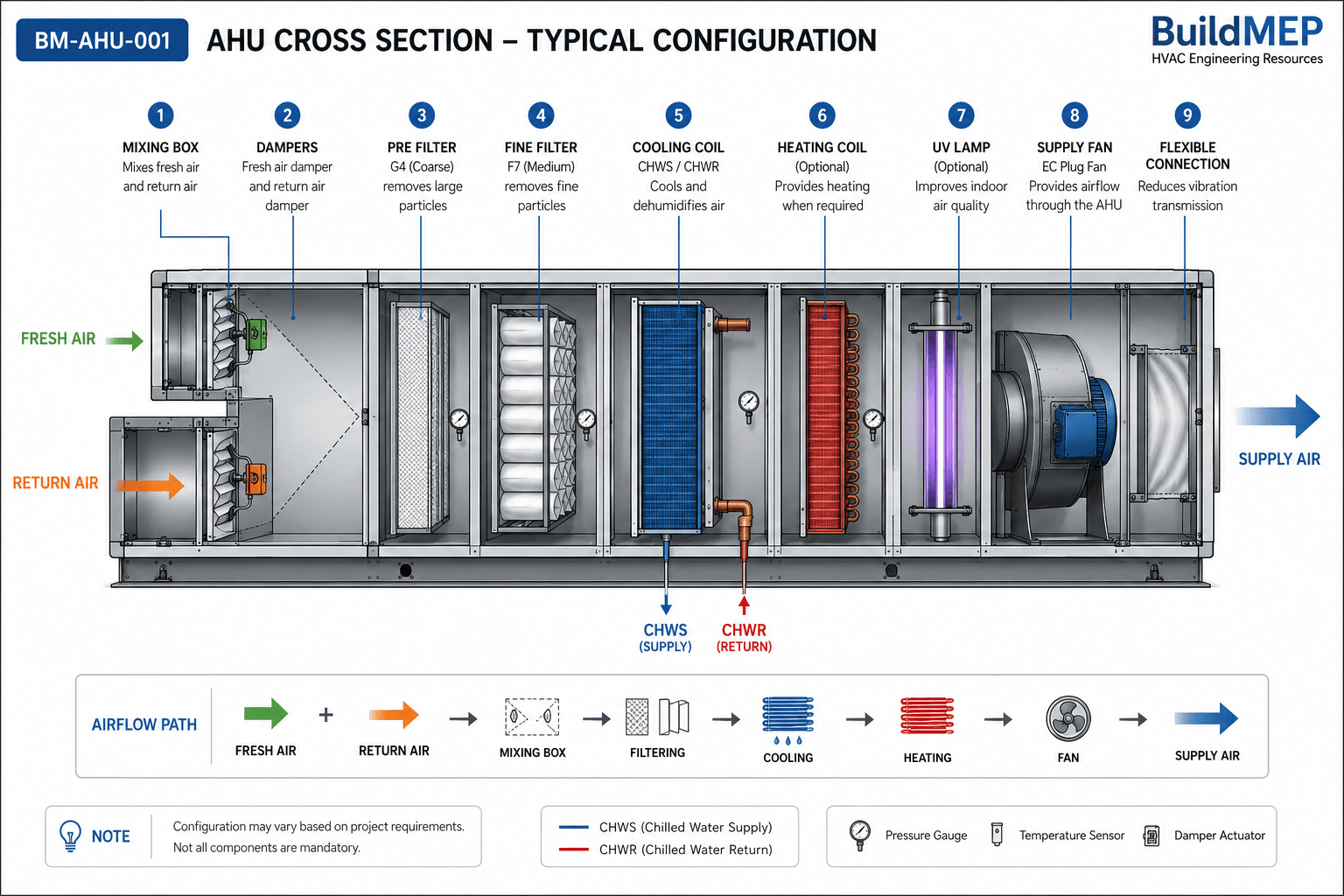
Main Components of an AHU
A typical Air Handling Unit may include the following components:
| Component | Function |
|---|---|
| Mixing Box | Mixes fresh outdoor air with return air. |
| Dampers | Regulate the amount of fresh and return air. |
| Pre-Filter | Removes larger dust particles. |
| Fine Filter or Bag Filter | Improves indoor air quality by capturing smaller particles. |
| Cooling Coil | Cools and dehumidifies the air using chilled water or refrigerant. |
| Heating Coil | Heats the air when required. |
| Drain Pan | Collects condensate from the cooling coil. |
| Supply Fan | Delivers conditioned air through the ductwork. |
| Sound Attenuator | Reduces fan noise. |
| Sensors | Measure temperature, humidity, pressure, and airflow. |
| Access Doors | Allow maintenance and inspection. |
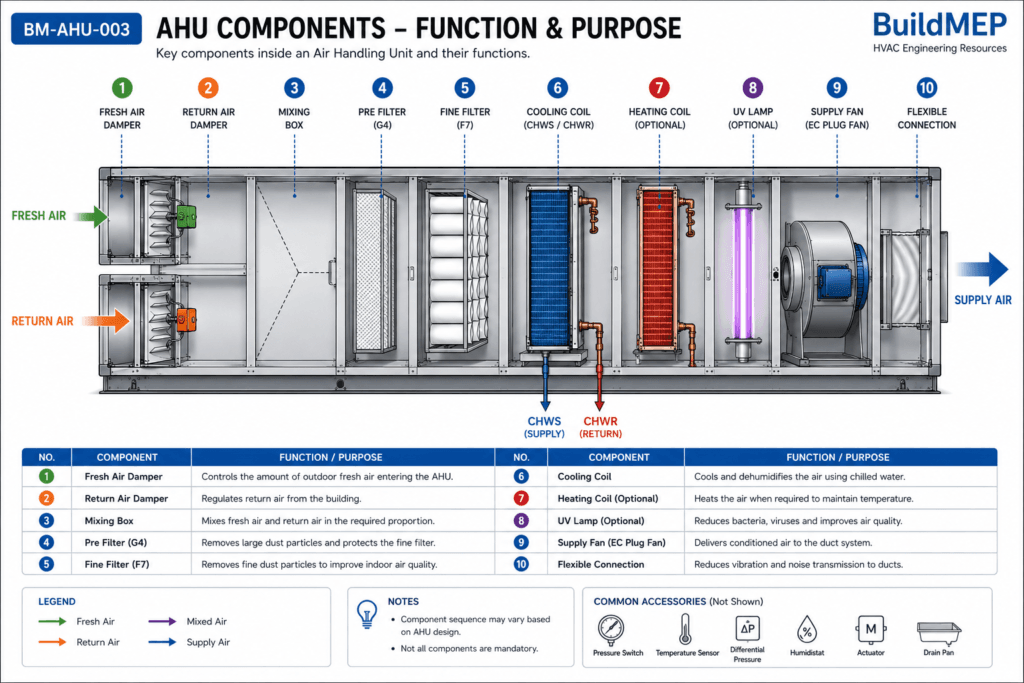
BuildMEP Tip: During an interview, don’t just list the components. Explain how the air moves through each section of the AHU. This demonstrates a much deeper understanding.
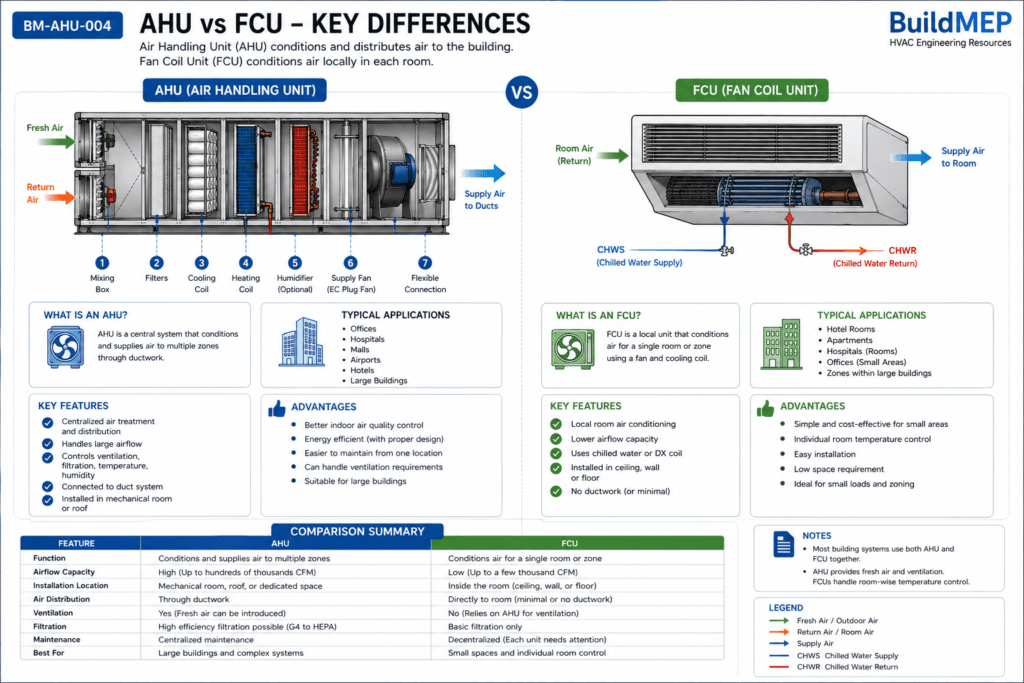
3. What Is the Difference Between an AHU, FCU, FAHU, MAU, and HRU?
Many interviewers ask this question because engineers often confuse these HVAC units. Knowing the differences shows that you understand when and why each system is used.
Rather than memorizing definitions, focus on the purpose of each unit and its role in the building.
Sample Answer
AHUs, FCUs, FAHUs, MAUs, and HRUs all handle air, but they serve different purposes within an HVAC system. An AHU is a centralized unit that conditions and distributes air throughout a building. An FCU conditions air locally for a single room or zone. A FAHU supplies conditioned fresh outdoor air, while an MAU supplies 100% fresh air, often for ventilation or pressurization. An HRU improves energy efficiency by recovering heat from exhaust air before introducing fresh air.
Comparison Table
| Equipment | Full Name | Main Purpose | Fresh Air | Typical Application |
|---|---|---|---|---|
| AHU | Air Handling Unit | Conditions and circulates air | Mixed with return air | Offices, malls, hospitals, hotels |
| FCU | Fan Coil Unit | Local heating and cooling | Usually no | Hotel rooms, apartments, offices |
| FAHU | Fresh Air Handling Unit | Supplies treated fresh air | Yes | Buildings requiring ventilation |
| MAU | Make-Up Air Unit | Supplies 100% outdoor air | Yes (100%) | Kitchens, laboratories, industrial buildings |
| HRU | Heat Recovery Unit | Recovers energy from exhaust air | Yes | Energy-efficient buildings |
4. Explain the Airflow Through an Air Handling Unit (AHU)
After asking “What is an AHU?”, interviewers often follow up with this question. They want to know whether you understand the sequence of air treatment inside the unit and the purpose of each component.
A confident explanation demonstrates that you understand both HVAC fundamentals and the operation of an AHU in a real building.
Sample Answer
Air enters the AHU through the fresh air intake and return air duct. These two air streams are mixed in the mixing box according to the required ventilation rate. The mixed air then passes through filters to remove dust and airborne particles.
After filtration, the air flows through the cooling coil or heating coil, where its temperature is adjusted to the required supply air condition. If cooling is taking place, moisture may condense on the cooling coil, reducing the air’s humidity.
The conditioned air is then delivered by the supply fan into the duct system and distributed to the occupied spaces. After absorbing heat and contaminants from the rooms, part of the return air is exhausted outdoors while the remaining air returns to the AHU to repeat the cycle.
Step-by-Step Airflow Sequence
A typical AHU processes air in the following order:
5. Why Do We Use Chilled Water Instead of Refrigerant Directly in Large AHUs?
Once you’ve demonstrated a good understanding of AHUs, interviewers often move on to the cooling system. This question assesses your knowledge of chilled water systems, energy efficiency, safety, and large-scale HVAC design.
A common mistake is answering, “Because chilled water is cheaper.” While operating costs may be lower in some systems, that is only one part of the answer. A strong response explains the engineering reasons behind the choice.
Sample Answer
Large AHUs generally use chilled water because it provides an efficient, safe, and practical way to transfer cooling over long distances. Instead of circulating refrigerant throughout the building, a central chiller cools water to approximately 6–7°C, and this chilled water is pumped to AHU cooling coils. The air passing over the coil transfers its heat to the chilled water, producing cool supply air.
This approach reduces the amount of refrigerant inside the building, simplifies maintenance, and allows a single chiller plant to serve multiple AHUs and other HVAC equipment.
6. Explain Sensible Heat, Latent Heat, and Total Heat
Understanding sensible and latent heat is essential for every HVAC engineer. These concepts form the foundation of cooling load calculations, cooling coil selection, psychrometrics, and air conditioning design.
Interviewers ask this question to determine whether you understand what the cooling coil is actually removing from the air.
Sample Answer
In HVAC, the cooling coil removes two types of heat from the air: sensible heat and latent heat.
Sensible heat changes the air temperature without changing its moisture content. Latent heat removes moisture from the air without changing its temperature.
The total cooling load is the combination of sensible heat and latent heat. A properly selected cooling coil must be capable of removing both to achieve the required indoor temperature and humidity.
7. Explain the Psychrometric Chart
The psychrometric chart is one of the most important tools in HVAC engineering. It allows engineers to analyze the properties of air and understand how heating, cooling, humidification, and dehumidification affect indoor conditions.
Interviewers ask about the psychrometric chart to determine whether you understand what happens to air as it passes through an Air Handling Unit (AHU). Even if you don’t perform psychrometric calculations every day, you should be familiar with the chart and know how it is used.
Sample Answer
A psychrometric chart is a graphical representation of the thermodynamic properties of moist air. It shows the relationship between dry-bulb temperature, wet-bulb temperature, relative humidity, humidity ratio, dew point, and enthalpy. HVAC engineers use the chart to analyze air-conditioning processes such as cooling, heating, humidification, dehumidification, and air mixing. It is commonly used when selecting cooling coils, estimating cooling loads, and evaluating indoor comfort conditions.
8. How Do You Select an Air Handling Unit (AHU)?
Selecting an Air Handling Unit is one of the primary responsibilities of an Application Engineer. While manufacturers provide selection software, the engineer must first understand the project requirements before choosing the correct equipment.
Interviewers ask this question to evaluate your engineering approach. They are less interested in whether you know a particular software package and more interested in whether you know what information is required before making a selection.
Sample Answer
Before selecting an AHU, I first review the project specifications and schedules to identify the required airflow, cooling capacity, external static pressure, fresh air percentage, supply air temperature, power supply, and installation constraints. I then use the manufacturer’s selection software to choose a unit that meets these requirements while checking fan performance, coil capacity, filter pressure drop, casing construction, sound levels, and overall dimensions. Finally, I verify that the selected AHU complies with the consultant’s specification before preparing the technical submittal.
9. How Do You Select the Fan for an Air Handling Unit (AHU)?
The fan is the heart of an Air Handling Unit. Regardless of how well the cooling coil is selected, the AHU will not perform as designed if the fan cannot deliver the required airflow against the system resistance.
Application Engineers are expected to understand the factors that influence fan selection, even when using manufacturer selection software.
Sample Answer
Fan selection is based primarily on the required airflow and total external static pressure. After determining these values from the project specification, I use the manufacturer’s selection software to choose a fan that operates efficiently within its performance range. I also verify the motor power, fan efficiency, sound level, and whether the selected fan can overcome the pressure losses from filters, coils, dampers, and ductwork.
10. How Do You Select the Cooling Coil for an Air Handling Unit?
The cooling coil is one of the most critical components of an Air Handling Unit. Its purpose is not simply to cool the air, but to remove both sensible heat (temperature) and latent heat (moisture) so that the required supply air condition is achieved.
Application Engineers are expected to understand the factors that affect cooling coil performance and verify that the selected coil meets the project requirements.
Sample Answer
Before selecting a cooling coil, I review the project specifications to determine the required airflow, cooling capacity, entering and leaving air conditions, chilled water temperatures, and available pressure drop. I then use the manufacturer’s selection software to choose a coil that provides the required cooling capacity while maintaining acceptable air velocity, water velocity, pressure drop, and dehumidification performance. Finally, I verify that the selected coil complies with the project specification.
11. Explain the Control Sequence of an Air Handling Unit (AHU)
An Air Handling Unit is more than a collection of fans, coils, and filters. Modern AHUs rely on sensors, controllers, actuators, and variable-speed drives to maintain indoor comfort while operating efficiently.
Interviewers often ask about the AHU control sequence to determine whether you understand how the mechanical and control systems work together.
Sample Answer
When the Building Management System (BMS) or local controller receives a demand for cooling, it starts the AHU according to the programmed sequence. The outdoor and return air dampers move to their required positions, the supply fan starts, and the chilled water control valve modulates to maintain the supply air temperature. Throughout operation, sensors continuously monitor temperature, pressure, and safety conditions. If a fault such as a fire alarm, freeze condition, or fan failure occurs, the controller shuts down or adjusts the AHU to protect the equipment and occupants.
12. AHU Troubleshooting Interview Questions
Most HVAC interviews include troubleshooting questions because they simulate real situations that Application Engineers encounter on site. Instead of asking for definitions, interviewers want to know how you approach a problem, identify possible causes, and recommend practical solutions.
A structured troubleshooting method demonstrates logical thinking and practical engineering experience.
Sample Question
The AHU is operating normally, but the room temperature remains high. What could be the possible causes?
Sample Answer
I would begin by confirming the complaint and checking the operating conditions before assuming a component has failed.
Possible causes include:
- Insufficient chilled water flow through the cooling coil.
- Chilled water supply temperature is higher than the design value.
- Dirty air filters reducing airflow.
- Cooling coil blocked by dirt or dust.
- Chilled water control valve not opening fully.
- Low airflow due to fan or VFD issues.
- Incorrect thermostat location or faulty temperature sensor.
- Excessive fresh air increasing the cooling load.
- Building cooling load higher than the AHU design capacity.
After identifying the cause, I would verify the corrective action by measuring the supply air temperature and confirming that the room reaches its setpoint.
Sample Question
The customer reports weak airflow from the supply diffusers. How would you investigate?
Sample Answer
Low airflow may result from several issues.
I would check:
- Dirty air filters.
- Fan rotation direction.
- Fan belt condition (if belt-driven).
- VFD operating frequency.
- Closed or partially closed dampers.
- Blocked ductwork.
- Damaged flexible connections.
- Incorrect fan selection.
- High pressure drop across filters or coils.
Measuring the airflow and static pressure helps determine whether the issue originates from the fan or the duct system.
Sample Question
Why does a cooling coil freeze?
Sample Answer
A cooling coil may freeze if its surface temperature falls below 0°C while airflow or water flow is insufficient.
Possible causes include:
- Low airflow caused by dirty filters.
- Fan failure.
- Low chilled water temperature.
- Reduced chilled water flow.
- Faulty freeze protection thermostat.
- Incorrect control valve operation.
- Low room load during cold weather.
A frozen coil reduces cooling performance and may damage the coil if operation continues.
Sample Question
The customer reports water leaking from the AHU. What would you check?
Sample Answer
Possible causes include:
- Blocked condensate drain.
- Improper drain trap design.
- Drain pan overflowing.
- Cooling coil producing excessive condensation.
- High face velocity causing moisture carryover.
- AHU not level during installation.
- Damaged drain pan.
The first step is to inspect the drain system before assuming a coil problem.
Sample Question
The AHU is vibrating excessively. What could be the reasons?
Sample Answer
Common causes include:
- Fan imbalance.
- Loose mounting bolts.
- Damaged bearings.
- Misaligned motor and fan.
- Worn fan belts.
- Flexible connection failure.
- Poor foundation or support.
- Foreign object inside the fan.
Excessive vibration should be corrected promptly to prevent further equipment damage.
Sample Question
The differential pressure across the filters is increasing. What does it indicate?
Sample Answer
A high differential pressure usually indicates that the filters are becoming clogged.
As the filters become dirty:
- Airflow decreases.
- Fan energy consumption increases.
- Indoor air quality may deteriorate.
- Cooling performance may be affected.
The filters should be inspected and replaced according to the maintenance schedule or when the pressure drop exceeds the manufacturer’s recommended limit.
Sample Question
The controller sends a start command, but the supply fan does not operate. What would you check first?
Sample Answer
I would investigate in the following order:
- Verify the power supply.
- Check the MCC or control panel for trips.
- Confirm that the emergency stop is not active.
- Verify the VFD status and alarms.
- Check the motor overload relay.
- Confirm the BMS start signal.
- Inspect the fan motor.
- Verify any interlocks, such as fire alarms or freeze protection.
This step-by-step approach minimizes unnecessary troubleshooting time.
Sample Question
The AHU keeps shutting down unexpectedly. What are the possible causes?
Sample Answer
Frequent trips may be caused by:
- Motor overload.
- VFD faults.
- Freeze protection activation.
- Fire alarm interlock.
- Fan failure.
- Electrical supply issues.
- Faulty sensors.
- High motor temperature.
The fault history from the BMS or VFD should always be reviewed before replacing components.
13. What Is a Technical Submittal? How Do You Prepare One?
Preparing technical submittals is one of the core responsibilities of an Application Engineer. A well-prepared submittal helps consultants and clients verify that the proposed equipment complies with the project specifications before procurement and installation.
Interviewers frequently ask about technical submittals because they want to know whether you can support a project beyond equipment selection.
Sample Answer
A technical submittal is a package of documents submitted to the consultant or client for review and approval before equipment is supplied. It demonstrates that the proposed product meets the project specification. A complete technical submittal typically includes product datasheets, selection reports, compliance statements, drawings, certifications, manufacturer information, and any supporting documents required by the consultant.
14. How to Read HVAC Drawings During an Interview
Application Engineers regularly work with HVAC layouts, ductwork drawings, equipment schedules, and schematic diagrams. Interviewers often use these drawings to evaluate your ability to interpret design information and understand how different HVAC components work together.
You don’t need to memorize every symbol, but you should be able to identify the major equipment, understand the airflow path, and explain the function of key components.
Sample Answer
When reviewing an HVAC drawing, I first identify the equipment, such as AHUs, FCUs, chillers, pumps, and cooling towers. I then trace the airflow and chilled water piping to understand how the system operates. Finally, I review the equipment schedule, duct sizes, valve arrangement, and control devices to ensure the selected equipment matches the design requirements.
15. Advanced AHU Technical Interview Questions
Once you’ve answered the basic HVAC questions, interviewers often ask more technical questions to evaluate your engineering knowledge and problem-solving ability. These questions usually don’t have one-line answers. Instead, the interviewer wants to understand your reasoning and technical judgment.
Sample Answer
Face velocity is the speed at which air passes across the front surface of the cooling coil. It affects heat transfer, air pressure drop, moisture removal, and the risk of condensate carryover. If the face velocity is too high, water droplets may be carried into the ductwork, pressure drop increases, and the cooling coil becomes less effective. If it is too low, the AHU may become unnecessarily large and expensive.
Sample Answer
Static pressure is the resistance to airflow within the duct system. Total pressure is the sum of the static pressure and the velocity pressure created by the moving air. Fan manufacturers use total pressure to describe overall fan performance, while HVAC designers often use external static pressure when selecting AHU fans.
Sample Answer
The Best Efficiency Point is the operating condition where the fan delivers the required airflow and pressure with the highest efficiency. Operating close to the BEP reduces energy consumption, vibration, and noise while improving equipment life.
Sample Answer
EC fans combine an electronically commutated motor with an integrated speed controller. Compared with conventional AC fans, they generally offer higher efficiency, better part-load performance, lower maintenance, quieter operation, and easier speed control. They also eliminate belts and pulleys, reducing maintenance requirements.
Sample Answer
Low Delta-T Syndrome occurs when the temperature difference between the chilled water supply and return is lower than the design value. This usually indicates that the cooling coils are not transferring heat efficiently. Possible causes include excessive chilled water flow, dirty coils, improperly functioning control valves, poor balancing, or oversized coils.
Sample Answer
Two-way valves regulate chilled water flow according to the cooling demand. As the valve closes, water flow decreases, allowing variable-flow pumping systems to reduce pump speed and save energy. This makes two-way valves more energy efficient than constant-flow systems in many modern HVAC applications.
Sample Answer
The coil bypass factor represents the portion of air that passes through the cooling coil without reaching the coil surface temperature. A lower bypass factor generally indicates better heat transfer and improved cooling performance.
Sample Answer
Excessive casing leakage allows conditioned air to escape and unfiltered air to enter the system. This reduces energy efficiency, affects indoor air quality, and can make it difficult to maintain the required airflow and room pressurization. For critical facilities such as hospitals and cleanrooms, low casing leakage is particularly important.
16. Scenario-Based Interview Questions for AHU Application Engineers
Technical knowledge is essential, but Application Engineers also need to solve practical problems under pressure. During an interview, you may be presented with situations similar to those encountered in daily engineering work.
The interviewer wants to understand how you approach problems, prioritize tasks, communicate with customers, and make engineering decisions.
Interview Question
The consultant rejects your AHU technical submittal and asks you to resubmit it. How would you handle the situation?
Sample Answer
I would first review the consultant’s comments carefully and compare them with the project specification. If the rejection is due to missing documentation, I would update the submittal accordingly. If it involves a technical issue, I would verify the selection with the manufacturer and determine whether a revised selection or additional clarification is required. I would also communicate with the sales team and consultant to ensure the revised submission addresses all comments before resubmitting it.
Interview Question
A consultant says your competitor’s AHU is significantly cheaper. What would you do?
Sample Answer
I would avoid focusing only on price. Instead, I would explain the technical advantages of our proposal, such as energy efficiency, fan performance, casing construction, certifications, maintenance requirements, warranty, and lifecycle cost. If appropriate, I would also discuss alternative configurations that still comply with the specification while remaining cost-effective.
Interview Question
It is 4:30 PM. The sales engineer informs you that three AHUs must be selected and submitted before 9:00 AM tomorrow. How would you manage the work?
Sample Answer
I would first review the project documents and identify the highest-priority tasks. I would complete the equipment selections first because they affect all other documents. Once the selections are verified, I would prepare the technical submittals, compliance statements, and supporting documents. Throughout the process, I would communicate with the sales engineer regarding progress and immediately raise any technical issues that could delay the submission.
Interview Question
The specified AHU manufacturer is unavailable. The customer asks you to propose an equivalent product. What would you check?
Sample Answer
Before recommending an equivalent product, I would compare:
- Airflow.
- Cooling capacity.
- External static pressure.
- Fan type.
- Coil performance.
- Filter arrangement.
- Casing construction.
- Electrical requirements.
- Certifications.
- Physical dimensions.
- Compliance with the consultant’s specification.
I would only recommend an alternative if it meets the technical and contractual requirements of the project.
Interview Question
The AHU has been approved, but during delivery you discover it cannot pass through the plant room entrance. What should be done?
Sample Answer
This situation highlights the importance of checking installation constraints during the selection stage. I would first determine whether the AHU can be supplied in modular sections for on-site assembly. If not, I would coordinate with the manufacturer, contractor, and consultant to identify an acceptable solution while minimizing project delays.
Interview Question
The contractor requests a different AHU model after consultant approval. What would you do?
Sample Answer
I would compare the proposed unit with the approved selection to determine whether the performance and specifications remain compliant. If there are technical differences, I would prepare a comparison and submit it to the consultant for review before recommending any changes.
Interview Question
A customer says the AHU is consuming more electricity than expected. What would you investigate?
Sample Answer
Possible areas to investigate include:
- Fan speed.
- VFD settings.
- Filter condition.
- Coil cleanliness.
- Control valve operation.
- Fresh air damper position.
- Static pressure.
- Actual operating schedule.
- Building occupancy.
The goal is to identify whether the increased energy use is caused by equipment performance, controls, or operating conditions.
17. HR & Behavioral Interview Questions for AHU Application Engineers
Once the technical discussion is complete, most interviewers move on to behavioral questions. These questions help them understand your communication skills, work ethic, problem-solving approach, and how well you fit within the organization.
Unlike technical questions, there is rarely a single correct answer. Be honest, concise, and support your answers with real examples whenever possible.
Sample Answer
I enjoy working on HVAC applications and technical support, and I’m looking for an opportunity where I can work on larger and more challenging projects. Your company has a strong reputation in the HVAC industry, and I believe this role will allow me to develop my technical knowledge while contributing to high-quality engineering solutions.
Sample Answer
I believe my combination of HVAC technical knowledge, application engineering experience, and customer support skills makes me a good fit for this role. I have experience reviewing project specifications, preparing technical submittals, selecting HVAC equipment, and supporting consultants and contractors. I also enjoy learning and continuously improving my technical skills.
Sample Answer
One of my strengths is my attention to technical detail. I enjoy reviewing project specifications carefully and ensuring that equipment selections and technical documents are accurate before submission. This helps reduce consultant comments and improves the quality of the final proposal.
Other strengths may include:
- Problem solving.
- Time management.
- Customer communication.
- Technical documentation.
- Teamwork.
Choose strengths that relate directly to the role.
Sample Answer
Earlier in my career, I sometimes spent too much time trying to perfect every technical detail. Over time, I learned to balance accuracy with project deadlines by prioritizing critical tasks and managing my time more effectively.
The key is to mention a genuine weakness and explain how you are improving it.
Sample Answer
During a project, a consultant rejected one of our technical submittals because additional documentation was required. I reviewed the consultant’s comments, coordinated with the manufacturer to obtain the missing information, updated the compliance statement, and resubmitted the package. The revised submission was approved, and the project continued without significant delay.
Interviewers appreciate answers that demonstrate ownership, communication, and problem-solving.
Sample Answer
In application engineering, tight deadlines are common, especially during tender submissions. I manage pressure by prioritizing tasks, verifying critical technical information first, and communicating with the sales team if any issues may affect the schedule. Staying organized helps me maintain quality even when deadlines are challenging.
Sample Answer
I would like to continue developing as an HVAC professional by gaining deeper expertise in equipment selection, system design, and technical support. I also hope to take on greater responsibility by supporting larger projects and mentoring junior engineers as my experience grows.
Avoid answers that suggest you see the role only as a short-term stepping stone.
Sample Answer
Early in my career, I overlooked a small detail in a technical document. During the review process, I identified the mistake, corrected it immediately, and implemented a checklist to reduce the chance of similar errors in the future. The experience reinforced the importance of careful document reviews.
Interviewers usually care more about what you learned than about the mistake itself.
Sample Answer
I focus on understanding the technical concern before responding. I review the project specification, verify the engineering data, and discuss the issue professionally. If necessary, I coordinate with the manufacturer to provide additional technical clarification or alternative solutions that comply with the project requirements.
18. Final Interview Tips for AHU Application Engineers
Preparing for an interview is not only about memorizing technical answers. Most interviewers evaluate your communication skills, problem-solving ability, confidence, and professionalism just as much as your HVAC knowledge.
The following tips can help you make a stronger impression during your interview.
What This Interview Is Really Testing
An AHU Application Engineer interview is designed to evaluate more than your knowledge of HVAC theory. Employers want engineers who can understand project requirements, select the right equipment, prepare accurate technical documentation, solve practical problems, and communicate effectively with consultants, contractors, and customers.
The best way to prepare is to build a strong foundation in HVAC fundamentals and then apply that knowledge to real engineering situations. Focus on understanding concepts rather than memorizing answers. During the interview, explain your reasoning clearly, support your answers with practical examples, and demonstrate a structured approach to solving engineering problems.
Whether you’re a graduate engineer preparing for your first HVAC interview or an experienced professional looking for your next opportunity, consistent preparation and practical understanding will give you confidence and help you stand out.