
An Application Engineer interview is not the same type of an interview as a mechanical engineering interview. It’s not enough for employers to find an individual familiar with HVAC theory; they need an engineer who can use that knowledge to actual projects and is able to support customers and advise them on the proper equipment.
In an AHU Application Engineer position, these questions will cover HVAC basics, AHU components, equipment selection, technical documentation, troubleshooting with consultants/contractors, etc. You’ll also be asked to speak about situations, to show how you’re able to solve problems as an engineer.
Before your interview, be sure you are familiar with the following:
| Topic | Why It Matters |
|---|---|
| HVAC Fundamentals | Forms the foundation for all technical discussions. |
| Air Handling Units (AHUs) | Understand components, airflow, and applications. |
| Psychrometrics | Frequently asked during cooling coil and air conditioning discussions. |
| Cooling Coil Selection | Demonstrates your understanding of heat transfer and air treatment. |
| Fans and Air Distribution | Important for airflow, static pressure, and energy efficiency. |
| HVAC Controls | Know the function of sensors, actuators, valves, VFDs, and BMS integration. |
| Technical Submittals | Application Engineers prepare and review these regularly. |
| HVAC Drawings | You should be able to read schematic and layout drawings confidently. |
| Troubleshooting | Interviewers often ask practical questions based on site problems. |
If you have previous experience, be prepared to explain projects you have worked on, the products you selected, the challenges you faced, and how you solved technical issues. Interviewers are generally more interested in your thought process than in memorized answers.
BuildMEP Tip: If you don’t know the answer to a technical question, don’t guess. Explain how you would find the correct answer by referring to project specifications, manufacturer selection software, technical catalogs, or engineering standards. A structured approach often leaves a better impression than an incorrect answer.
1. Tell Me About Yourself
This is almost always the first question in an interview. Although it sounds simple, it sets the tone for the rest of the discussion. A clear and confident introduction helps the interviewer understand your background and determine whether your experience matches the role.
Why Interviewers Ask This
Interviewers want to quickly understand:
- Your educational background.
- Your HVAC experience.
- Your current responsibilities.
- Your communication skills.
- Why you’re interested in the position.
This is not an invitation to repeat your entire CV. Instead, give a concise summary that connects your experience to the job you’re applying for.
Sample Answer
“I am a Mechanical Engineer with experience in HVAC applications and technical support. In my current role, I work closely with consultants, contractors, and sales engineers to review project specifications, prepare technical submittals, compliance statements, and recommend suitable HVAC solutions. My work has strengthened my understanding of HVAC systems, technical documentation, and customer support throughout different stages of a project. I’m now looking for an opportunity where I can expand my expertise in Air Handling Unit applications and contribute to more complex HVAC projects.”
What Makes a Strong Answer?
A good introduction should include:
- Your qualification.
- Your years of experience.
- Your current role.
- Relevant responsibilities.
- A clear reason for applying.
Aim to keep your answer between 60 and 90 seconds.
Common Mistakes to Avoid
- Reading your CV word for word.
- Talking about unrelated personal details.
- Giving a very short answer with little technical information.
- Speaking for several minutes without focusing on the role.
- Criticizing your current or previous employer.
BuildMEP Tip: Tailor your introduction to the job description. If the role focuses on AHU selection and technical support, highlight your experience with HVAC equipment, technical documentation, customer interaction, and project coordination rather than unrelated engineering work.
2. What Is an Air Handling Unit (AHU)?
If you’re applying for an AHU Application Engineer position, expect this question early in the interview. While it may seem basic, interviewers use it to assess how well you understand the equipment you’ll be working with every day.
A strong answer should go beyond simply expanding the abbreviation “AHU.” It should explain the unit’s purpose, how it works, and where it is commonly used.
Why Interviewers Ask This Question
The interviewer wants to evaluate whether you:
- Understand the primary function of an AHU.
- Know the major components inside the unit.
- Can explain HVAC concepts clearly.
- Have practical knowledge rather than memorized definitions.
If your explanation is confident and technically accurate, it creates a positive first impression for the rest of the interview.
Sample Answer
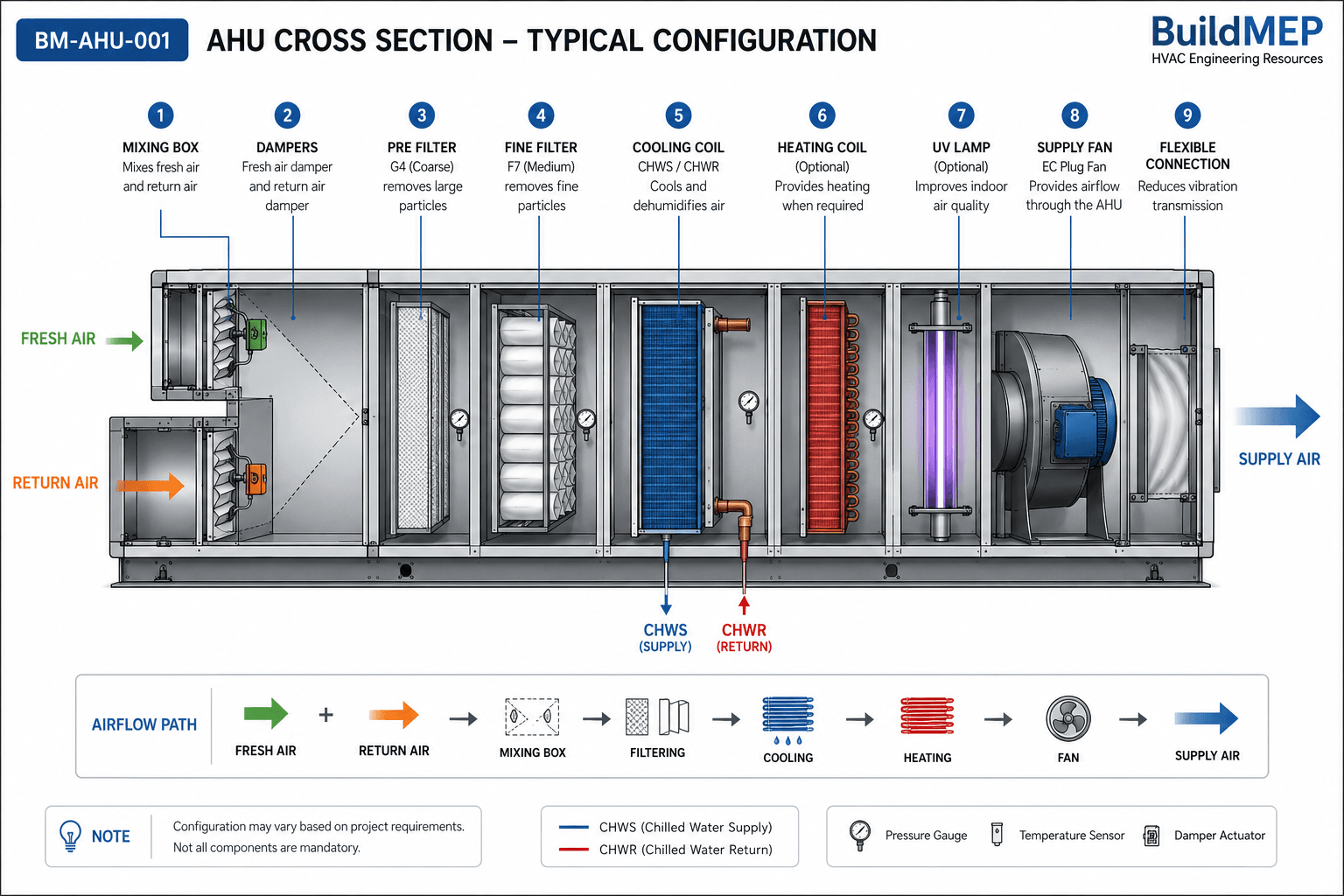
An Air Handling Unit (AHU) is a HVAC system which is used to condition and move air around a building. It brings fresh air and return air to the house, removes dust or other contaminants, cools or warms the air as needed, regulates humidity as needed, and supplies conditioned air to the occupied areas via ductwork.
Other optional components of an AHU can also include energy recovery devices, humidifiers, UV lamps, sound attenuators and advanced control systems. It is commonly used in large buildings such as commercial buildings, hospitals, hotels, airports, shopping malls, industrial buildings, and others that have centralized air conditioning systems.
What Does an AHU Actually Do?
Although AHUs come in different sizes and configurations, their main functions remain the same.
An AHU is designed to:
- Supply clean and filtered air to occupied spaces.
- Maintain the required indoor temperature.
- Control indoor humidity where necessary.
- Provide adequate ventilation by introducing fresh outdoor air.
- Remove heat and moisture from the air.
- Distribute conditioned air evenly through the duct system.
These functions help create a comfortable, healthy, and energy-efficient indoor environment.
Main Components of an AHU
A typical Air Handling Unit may include the following components:
| Component | Function |
|---|---|
| Mixing Box | Mixes fresh outdoor air with return air. |
| Dampers | Regulate the amount of fresh and return air. |
| Pre-Filter | Removes larger dust particles. |
| Fine Filter or Bag Filter | Improves indoor air quality by capturing smaller particles. |
| Cooling Coil | Cools and dehumidifies the air using chilled water or refrigerant. |
| Heating Coil | Heats the air when required. |
| Drain Pan | Collects condensate from the cooling coil. |
| Supply Fan | Delivers conditioned air through the ductwork. |
| Sound Attenuator | Reduces fan noise. |
| Sensors | Measure temperature, humidity, pressure, and airflow. |
| Access Doors | Allow maintenance and inspection. |
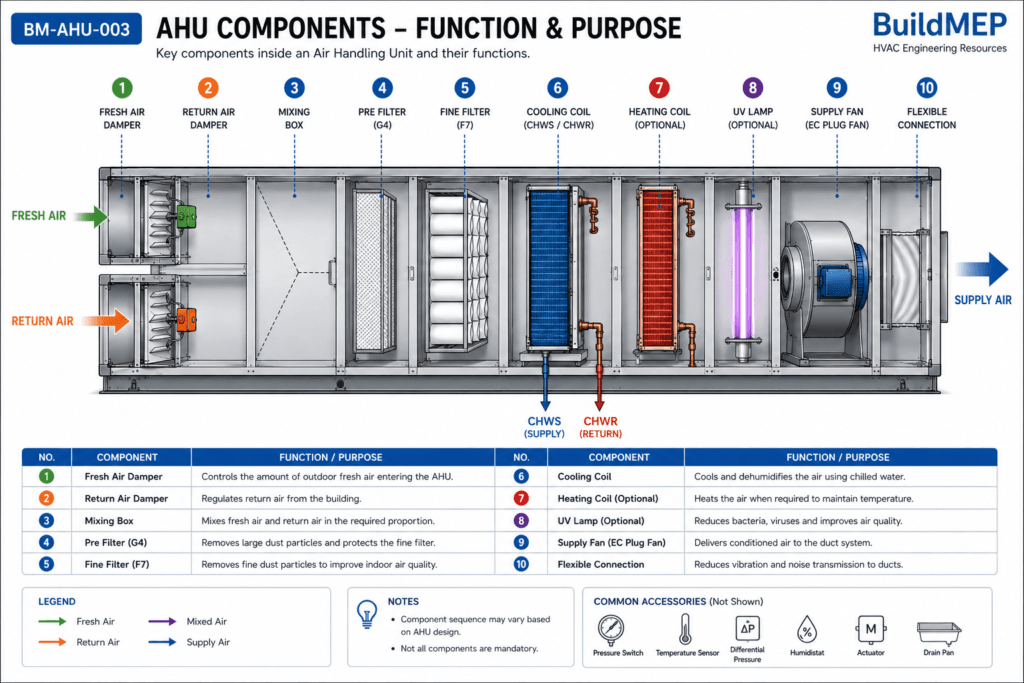
BuildMEP Tip: During an interview, don’t just list the components. Explain how the air moves through each section of the AHU. This demonstrates a much deeper understanding.
Typical Airflow Through an AHU
A simple airflow sequence is:
Fresh Air + Return Air → Mixing Box → Filters → Cooling/Heating Coil → Supply Fan → Supply Air Duct → Conditioned Space
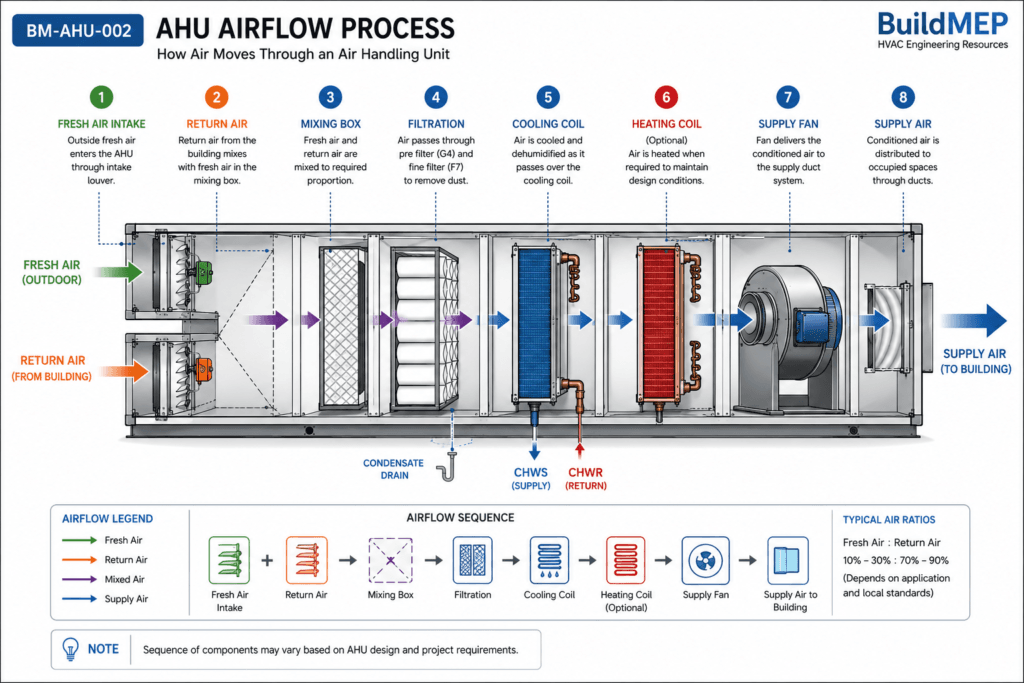
The exact arrangement may vary depending on the manufacturer and project specifications, but understanding this basic sequence is essential for every HVAC engineer.
Common Follow-Up Questions
After explaining what an AHU is, interviewers often continue with questions such as:
- What is the difference between an AHU and an FCU?
- Why do we mix fresh air with return air?
- Why is the cooling coil installed before the supply fan?
- What happens if the filters become clogged?
- What is the purpose of the drain pan?
- How does an AHU control indoor humidity?
Being prepared for these follow-up questions demonstrates a deeper understanding of HVAC system operation.
Common Mistakes to Avoid
Many candidates weaken their answer by making one of these mistakes:
- Defining an AHU without explaining its function.
- Forgetting to mention ventilation and fresh air.
- Confusing an AHU with a Fan Coil Unit (FCU).
- Listing components without describing how they work together.
- Ignoring the role of controls, sensors, and dampers.
BuildMEP Tip
A useful way to remember an AHU is to think of it as the lungs of a building. Just as lungs filter, regulate, and circulate air for the human body, an AHU filters, conditions, and distributes air throughout a building to maintain comfort and indoor air quality.
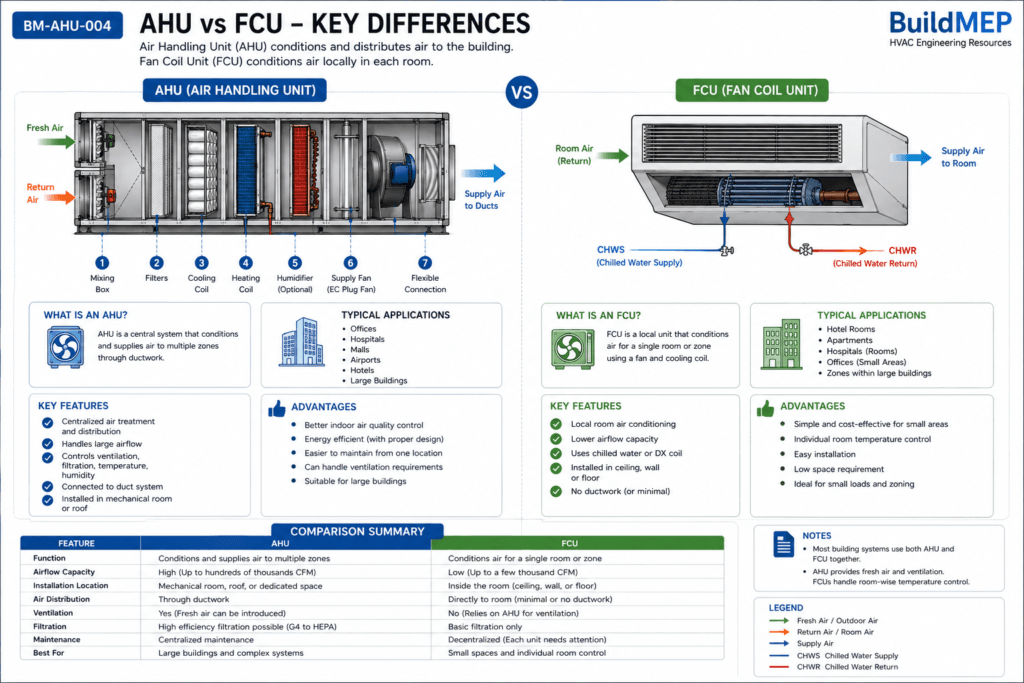
3. What Is the Difference Between an AHU, FCU, FAHU, MAU, and HRU?
Many interviewers ask this question because engineers often confuse these HVAC units. Knowing the differences shows that you understand when and why each system is used.
Rather than memorizing definitions, focus on the purpose of each unit and its role in the building.
Why Interviewers Ask This Question
The interviewer wants to know whether you can:
- Differentiate between common HVAC equipment.
- Select the right unit for different applications.
- Understand ventilation and indoor air quality requirements.
- Explain technical concepts clearly to customers and consultants.
Sample Answer
AHUs, FCUs, FAHUs, MAUs, and HRUs all handle air, but they serve different purposes within an HVAC system. An AHU is a centralized unit that conditions and distributes air throughout a building. An FCU conditions air locally for a single room or zone. A FAHU supplies conditioned fresh outdoor air, while an MAU supplies 100% fresh air, often for ventilation or pressurization. An HRU improves energy efficiency by recovering heat from exhaust air before introducing fresh air.
Comparison Table
| Equipment | Full Name | Main Purpose | Fresh Air | Typical Application |
|---|---|---|---|---|
| AHU | Air Handling Unit | Conditions and circulates air | Mixed with return air | Offices, malls, hospitals, hotels |
| FCU | Fan Coil Unit | Local heating and cooling | Usually no | Hotel rooms, apartments, offices |
| FAHU | Fresh Air Handling Unit | Supplies treated fresh air | Yes | Buildings requiring ventilation |
| MAU | Make-Up Air Unit | Supplies 100% outdoor air | Yes (100%) | Kitchens, laboratories, industrial buildings |
| HRU | Heat Recovery Unit | Recovers energy from exhaust air | Yes | Energy-efficient buildings |
3.1 Air Handling Unit (AHU)
An AHU is the primary air-conditioning unit in many commercial buildings. It mixes outdoor air with return air, filters it, cools or heats it, and supplies conditioned air through the ductwork.
Typical features include:
- Mixing box
- Air filters
- Cooling and heating coils
- Supply fan
- Sensors and controls
- Dampers
AHUs are commonly connected to chilled water systems or DX cooling systems and are suitable for medium to large buildings.
3.2 Fan Coil Unit (FCU)
An FCU is a smaller HVAC unit designed to serve a single room or zone. It contains a fan and a cooling or heating coil but normally does not provide fresh outdoor air.
Instead, it recirculates the air already present in the room.
Common applications include:
- Hotel rooms
- Apartments
- Individual offices
- Hospital patient rooms
Since FCUs do not usually introduce fresh air, a separate ventilation system such as a FAHU is often required.
Interview Tip: One of the most common mistakes is saying that an FCU provides fresh air. In most installations, it does not.
3.3 Fresh Air Handling Unit (FAHU)
A Fresh Air Handling Unit is designed to treat outdoor air before supplying it to the building.
Unlike a standard AHU, which mixes return air with fresh air, a FAHU primarily handles fresh air to meet ventilation requirements.
Its functions include:
- Filtering outdoor air
- Cooling or heating the incoming air
- Dehumidifying fresh air
- Maintaining indoor air quality
FAHUs are commonly used together with FCUs in hotels, offices, and residential towers.
3.4 Make-Up Air Unit (MAU)
A Make-Up Air Unit supplies 100% outdoor air to replace air removed from a building by exhaust systems.
Typical applications include:
- Commercial kitchens
- Laboratories
- Manufacturing facilities
- Car parks
- Industrial processes
Without adequate make-up air, buildings can become negatively pressurized, making doors difficult to open and reducing ventilation performance.
3.5 Heat Recovery Unit (HRU)
An HRU is designed to improve energy efficiency by transferring heat between exhaust air and incoming fresh air.
During cooling seasons, the exhaust air helps pre-cool the incoming outdoor air. During heating seasons, it helps pre-heat the fresh air.
Common heat recovery methods include:
- Plate heat exchangers
- Rotary heat recovery wheels
- Heat pipes
- Run-around coils
HRUs help reduce cooling and heating loads while improving overall HVAC efficiency.
Common Interview Follow-Up Questions
After asking about these units, interviewers may continue with questions such as:
- Why are FCUs usually paired with a FAHU?
- Can an AHU operate without fresh air?
- Why does a kitchen require an MAU?
- What are the benefits of heat recovery?
- When would you recommend an HRU instead of a standard FAHU?
- Can an AHU also function as a FAHU?
Common Mistakes to Avoid
Avoid these common interview errors:
- Confusing an AHU with an FCU.
- Assuming every AHU uses 100% fresh air.
- Saying an FCU provides ventilation.
- Thinking an MAU is simply another name for an AHU.
- Ignoring the energy-saving purpose of an HRU.
BuildMEP Tip: When comparing HVAC equipment in an interview, don’t just define each unit. Explain why it is used. Interviewers are often more interested in your reasoning than your ability to recall definitions.
BuildMEP Quick Revision
| Unit | Remember This |
|---|---|
| AHU | Central air-conditioning and air distribution |
| FCU | Local room conditioning |
| FAHU | Treated fresh air for ventilation |
| MAU | 100% outdoor air replacement |
| HRU | Energy recovery from exhaust air |
4. Explain the Airflow Through an Air Handling Unit (AHU)
After asking “What is an AHU?”, interviewers often follow up with this question. They want to know whether you understand the sequence of air treatment inside the unit and the purpose of each component.
A confident explanation demonstrates that you understand both HVAC fundamentals and the operation of an AHU in a real building.
Why Interviewers Ask This Question
This question helps interviewers assess whether you can:
- Explain the complete airflow process inside an AHU.
- Understand the purpose of each major component.
- Describe how air is filtered, cooled, heated, and distributed.
- Communicate technical concepts clearly to customers and project teams.
Rather than simply listing components, explain the process in the order that air travels through the unit.
Sample Answer
Air enters the AHU through the fresh air intake and return air duct. These two air streams are mixed in the mixing box according to the required ventilation rate. The mixed air then passes through filters to remove dust and airborne particles.
After filtration, the air flows through the cooling coil or heating coil, where its temperature is adjusted to the required supply air condition. If cooling is taking place, moisture may condense on the cooling coil, reducing the air’s humidity.
The conditioned air is then delivered by the supply fan into the duct system and distributed to the occupied spaces. After absorbing heat and contaminants from the rooms, part of the return air is exhausted outdoors while the remaining air returns to the AHU to repeat the cycle.
Step-by-Step Airflow Sequence
A typical AHU processes air in the following order:
1. Fresh Air Intake
Outdoor air enters the AHU through the fresh air louver.
Its main purpose is to provide ventilation and maintain good indoor air quality.
Fresh air quantity is usually controlled by motorized dampers.
2. Return Air
Air returning from occupied spaces enters the AHU through the return air duct.
Instead of exhausting all the conditioned air, part of it is reused to improve energy efficiency.
3. Mixing Box
Inside the mixing box, fresh air and return air are combined according to the building’s ventilation requirements.
For example:
- 20% Fresh Air
- 80% Return Air
or
- 30% Fresh Air
- 70% Return Air
The ratio depends on occupancy, indoor air quality standards, and project specifications.
4. Air Filters
The mixed air passes through one or more stages of filtration.
Typical arrangements include:
- Pre-filter (G4 or MERV 8)
- Fine filter (F7, F8, or MERV 13)
- HEPA filter (for hospitals and cleanrooms)
The filters remove dust, pollen, and other airborne contaminants before the air reaches the cooling coil.
5. Cooling or Heating Coil
The conditioned air then passes through the heat exchanger.
During cooling mode:
- Chilled water or refrigerant absorbs heat from the air.
- Moisture condenses on the cooling coil.
- The air leaves the coil cooler and drier.
During heating mode:
- Hot water or electric heaters warm the air before it enters the building.
This section is responsible for controlling the supply air temperature.
6. Drain Pan
When moisture condenses on the cooling coil, it collects in the drain pan and is discharged through the condensate drain.
A blocked drain can cause water leakage, unpleasant odors, and microbial growth.
7. Supply Fan
The supply fan provides the pressure required to move conditioned air through the ductwork.
Depending on the AHU design, the fan may be:
- Belt-driven
- Direct-driven
- Plug fan
- EC fan
The fan selection depends on airflow and external static pressure requirements.
8. Supply Air Duct
Finally, the conditioned air travels through the duct network to the occupied spaces.
Diffusers and grilles distribute the air evenly to maintain comfortable indoor conditions.
Typical Airflow Diagram
Fresh Air
     │
     ▼
Return Air
     │
     ▼
 Mixing Box
     │
     ▼
  Air Filters
     │
     ▼
 Cooling / Heating Coil
     │
     ▼
  Drain Pan
     │
     ▼
  Supply Fan
     │
     ▼
Supply Air Duct
     │
     ▼
 Occupied Space
     │
     ▼
 Return Air
BuildMEP Note: Replace this text diagram with a professionally illustrated airflow diagram showing each component. A custom graphic will make this section much easier to understand and improve its shareability.
What Happens During Cooling?
When cooling is required:
- Warm return air enters the AHU.
- Fresh outdoor air is mixed with return air.
- The mixed air passes through the filters.
- The cooling coil removes heat from the air.
- Water vapor condenses on the coil surface.
- The drain pan collects the condensate.
- The supply fan distributes cool, conditioned air to the building.
This process continues until the room reaches the required temperature.
Common Follow-Up Questions
After explaining the airflow, interviewers often ask:
- Why is the cooling coil installed before the supply fan?
- Why are filters installed before the cooling coil?
- What happens if the fresh air damper remains closed?
- Why does water collect in the drain pan?
- Why is the condensate drain trapped?
- What causes the cooling coil to freeze?
- Why is return air reused?
These follow-up questions test whether you understand the reasoning behind the AHU design, not just the airflow sequence.
Common Mistakes to Avoid
Candidates often make these mistakes:
- Forgetting to mention the mixing box.
- Ignoring the purpose of fresh air.
- Listing components without explaining their functions.
- Omitting the condensate drain when discussing cooling.
- Confusing the roles of the supply fan and return fan.
BuildMEP Tip
Think of the airflow as a journey. If you can explain what happens to the air at every stage—from entering the building to returning to the AHU—you’ll answer this question confidently in almost any HVAC interview.
5. What Is the Difference Between an AHU and an FCU?
This is one of the most frequently asked questions in HVAC interviews. Although both units are used for heating and cooling, they serve different purposes and are designed for different applications.
Many candidates give short answers such as, “An AHU is bigger than an FCU.” While technically true, it doesn’t explain the engineering differences. A strong answer should compare their function, air source, capacity, installation, and typical applications.
Why Interviewers Ask This Question
The interviewer wants to determine whether you can:
- Distinguish between centralized and decentralized HVAC systems.
- Recommend the appropriate equipment for different projects.
- Understand ventilation requirements.
- Explain HVAC concepts clearly to consultants and customers.
Sample Answer
An Air Handling Unit (AHU) is a centralized HVAC unit that conditions and distributes air to multiple spaces through a duct system. It typically mixes fresh outdoor air with return air, filters the air, cools or heats it, and supplies conditioned air throughout the building.
A Fan Coil Unit (FCU), on the other hand, is a local air-conditioning unit that serves a single room or zone. It mainly recirculates indoor air across a cooling or heating coil and usually relies on a separate ventilation system to provide fresh outdoor air.
AHU vs FCU Comparison
| Feature | Air Handling Unit (AHU) | Fan Coil Unit (FCU) |
|---|---|---|
| Coverage | Multiple rooms or large zones | Single room or small zone |
| Fresh Air | Yes, usually mixed with return air | Usually no fresh air |
| Ductwork | Extensive duct system | Short ducts or direct air discharge |
| Capacity | High airflow and cooling capacity | Lower airflow and cooling capacity |
| Installation | Plant room, rooftop, or mechanical floor | Above ceilings or inside conditioned spaces |
| Typical Applications | Hospitals, malls, airports, offices | Hotels, apartments, classrooms |
Airflow Comparison
Air Handling Unit (AHU)
The AHU typically operates using this airflow path:
Fresh Air
      +
Return Air
      │
      ▼
   Mixing Box
      │
      ▼
    Filters
      │
      ▼
 Cooling / Heating Coil
      │
      ▼
  Supply Fan
      │
      ▼
 Supply Air Duct
      │
      ▼
 Building Spaces
Because an AHU introduces fresh outdoor air, it plays an important role in maintaining indoor air quality and meeting ventilation standards.
Fan Coil Unit (FCU)
The airflow in a typical FCU is much simpler:
Room Air
    │
    ▼
 Filter
    │
    ▼
 Cooling / Heating Coil
    │
    ▼
 Fan
    │
    ▼
 Back to the Room
Most FCUs continuously recirculate room air. If fresh air is required, it is usually supplied by a separate FAHU or dedicated ventilation system.
Typical Applications
AHU Applications
Air Handling Units are commonly used in:
- Shopping malls
- Hospitals
- Airports
- Hotels
- Commercial office buildings
- Universities
- Industrial facilities
They are preferred where large airflow rates, centralized control, and ventilation are required.
FCU Applications
Fan Coil Units are widely used in:
- Hotel guest rooms
- Residential apartments
- Individual offices
- Hospital patient rooms
- Meeting rooms
- Small commercial spaces
FCUs provide independent temperature control for individual zones, making them ideal where occupants have different comfort preferences.
Advantages of an AHU
An AHU offers several benefits:
- Supplies fresh outdoor air.
- Handles large airflow rates.
- Improves indoor air quality.
- Can integrate with advanced HVAC controls and BMS.
- Suitable for serving multiple zones.
- Easier to centralize maintenance.
Advantages of an FCU
An FCU has its own strengths:
- Lower initial cost for individual spaces.
- Simple installation.
- Independent room temperature control.
- Quiet operation.
- Suitable for retrofit projects.
- Flexible zoning.
Common Interview Follow-Up Questions
After comparing AHUs and FCUs, interviewers may ask:
- Can an FCU operate without fresh air?
- Why are FCUs often paired with a FAHU?
- Which system is better for a hotel?
- Which system provides better indoor air quality?
- Which system is easier to maintain?
- Which system consumes more energy?
- Can an AHU replace multiple FCUs?
These follow-up questions test your ability to apply HVAC knowledge to real building designs rather than simply recalling definitions.
Common Mistakes to Avoid
Candidates often make these mistakes:
- Saying an FCU always supplies fresh air.
- Assuming an AHU is simply a larger FCU.
- Ignoring the ventilation function of an AHU.
- Focusing only on equipment size instead of system design.
- Forgetting that the choice depends on the building’s requirements.
BuildMEP Tip: When answering comparison questions, avoid saying one system is “better” than the other. Explain that each has advantages depending on the building type, occupancy, ventilation needs, energy goals, and project specifications. This demonstrates engineering judgment rather than memorized knowledge.
BuildMEP Quick Revision
| Remember This | Key Point |
|---|---|
| AHU | Centralized air treatment and ventilation for multiple spaces. |
| FCU | Local heating and cooling for a single room or zone. |
| Fresh Air | AHU usually provides it; FCU generally does not. |
| Typical Pairing | FCUs are often used together with a FAHU to provide both comfort cooling and fresh air ventilation. |
6. Why Do We Use Chilled Water Instead of Refrigerant Directly in Large AHUs?
Once you’ve demonstrated a good understanding of AHUs, interviewers often move on to the cooling system. This question assesses your knowledge of chilled water systems, energy efficiency, safety, and large-scale HVAC design.
A common mistake is answering, “Because chilled water is cheaper.” While operating costs may be lower in some systems, that is only one part of the answer. A strong response explains the engineering reasons behind the choice.
Why Interviewers Ask This Question
The interviewer wants to evaluate whether you understand:
- The difference between chilled water and direct expansion (DX) systems.
- Why large commercial buildings typically use chilled water.
- The advantages and limitations of each cooling method.
- Basic HVAC system design principles.
Sample Answer
Large AHUs generally use chilled water because it provides an efficient, safe, and practical way to transfer cooling over long distances. Instead of circulating refrigerant throughout the building, a central chiller cools water to approximately 6–7°C, and this chilled water is pumped to AHU cooling coils. The air passing over the coil transfers its heat to the chilled water, producing cool supply air.
This approach reduces the amount of refrigerant inside the building, simplifies maintenance, and allows a single chiller plant to serve multiple AHUs and other HVAC equipment.
How a Chilled Water System Works
The cooling process can be summarized as follows:
- The chiller produces chilled water.
- Pumps circulate the chilled water through insulated pipes.
- The chilled water enters the AHU cooling coil.
- Warm air passes over the coil.
- Heat transfers from the air to the chilled water.
- The cooled air is supplied to the building.
- The warmed water returns to the chiller to be cooled again.
This continuous cycle maintains the desired indoor temperature.
Why Chilled Water Is Preferred in Large Buildings
1. Higher Energy Efficiency
Large chillers are generally more efficient than multiple small DX units, particularly in buildings with high cooling loads.
Examples include:
- Airports
- Shopping malls
- Hospitals
- High-rise office buildings
- Universities
2. Centralized Cooling
One chiller plant can supply chilled water to multiple AHUs, FCUs, and other HVAC equipment throughout the building.
This makes system management and maintenance more straightforward.
3. Reduced Refrigerant Charge
Instead of running refrigerant piping throughout the building, only the chiller contains a large refrigerant circuit.
Benefits include:
- Improved safety
- Lower environmental risk
- Easier leak management
- Compliance with building codes
4. Easier Expansion
If additional cooling capacity is needed in the future, another AHU can often be connected to the chilled water network without redesigning the entire cooling system.
This flexibility is one reason chilled water systems are common in commercial developments.
5. Better Temperature Control
Chilled water flow can be adjusted using control valves and variable-speed pumping systems, allowing accurate control of supply air temperature while improving energy efficiency.
When Is a DX System Used Instead?
Direct Expansion (DX) systems are more common in:
- Villas
- Small offices
- Shops
- Restaurants
- Small commercial buildings
These applications generally have lower cooling loads and do not justify the cost of a central chilled water plant.
Chilled Water vs DX System
| Feature | Chilled Water System | DX System |
|---|---|---|
| Cooling Medium | Water | Refrigerant |
| Cooling Source | Central chiller | Local compressor |
| Building Size | Medium to large | Small to medium |
| Refrigerant Distribution | Centralized | Throughout the system |
| Typical Application | Hospitals, malls, airports | Homes, small offices, retail spaces |
| Initial Cost | Higher | Lower |
| Scalability | Excellent | Limited |
Common Interview Follow-Up Questions
Interviewers may continue with questions such as:
- What is the typical chilled water supply temperature?
- What is the normal return water temperature?
- Why is the temperature difference (ΔT) important?
- What happens if chilled water flow decreases?
- What causes a low ΔT syndrome?
- Why are two-way valves commonly used with chilled water systems?
- Can a DX coil replace a chilled water coil?
These follow-up questions often lead into discussions about control valves, pumps, and system balancing.
Common Mistakes to Avoid
Avoid these common interview errors:
- Saying chilled water is always cheaper than DX.
- Confusing chilled water with refrigerant.
- Forgetting that the chiller cools the water, not the AHU itself.
- Ignoring maintenance and safety benefits.
- Assuming chilled water is used in every HVAC project.
BuildMEP Tip: If you’re asked to compare chilled water and DX systems, don’t focus only on cost. Consider building size, cooling load, energy efficiency, maintenance, future expansion, and project requirements. This shows that you think like an Application Engineer rather than simply recalling facts.
BuildMEP Quick Revision
| Remember This | Key Point |
|---|---|
| Chilled Water | Used mainly in medium and large commercial buildings. |
| DX System | Best suited for small buildings and independent spaces. |
| AHU Cooling Coil | Receives chilled water from the central chiller to cool the air. |
| Main Advantage | Efficient, centralized cooling with reduced refrigerant throughout the building. |
7. Explain Sensible Heat, Latent Heat, and Total Heat
Understanding sensible and latent heat is essential for every HVAC engineer. These concepts form the foundation of cooling load calculations, cooling coil selection, psychrometrics, and air conditioning design.
Interviewers ask this question to determine whether you understand what the cooling coil is actually removing from the air.
Why Interviewers Ask This Question
This question helps interviewers assess whether you:
- Understand the basic principles of heat transfer.
- Know how cooling coils remove heat from air.
- Can explain psychrometric concepts clearly.
- Understand why humidity control is important in HVAC design.
A good answer should explain not only the definitions but also how these concepts apply to an Air Handling Unit.
Sample Answer
In HVAC, the cooling coil removes two types of heat from the air: sensible heat and latent heat.
Sensible heat changes the air temperature without changing its moisture content. Latent heat removes moisture from the air without changing its temperature.
The total cooling load is the combination of sensible heat and latent heat. A properly selected cooling coil must be capable of removing both to achieve the required indoor temperature and humidity.
What Is Sensible Heat?
Sensible heat is the heat that changes the temperature of the air.
When sensible heat is removed:
- The dry-bulb temperature decreases.
- The moisture content remains the same.
You can measure this temperature change directly using a thermometer.
Example
A room temperature decreases from 30°C to 22°C, while the humidity remains unchanged.
Only sensible heat has been removed.
Common Sources of Sensible Heat
Sensible heat enters a building from many sources, including:
- Solar heat through windows.
- Occupants.
- Lighting.
- Computers and office equipment.
- Motors and machinery.
- Warm outdoor air.
What Is Latent Heat?
Latent heat is the heat associated with moisture in the air.
When latent heat is removed:
- Water vapor condenses into liquid water.
- The humidity ratio decreases.
- Moisture drains away through the AHU condensate drain.
Unlike sensible heat, latent heat cannot be measured by temperature alone.
Example
During summer, warm humid air passes over the AHU cooling coil.
The coil cools the air below its dew point.
Water vapor condenses on the coil.
The condensate flows into the drain pan.
The air leaving the coil is both cooler and drier.
Common Sources of Latent Heat
Buildings gain moisture from:
- People breathing and perspiring.
- Cooking.
- Showers.
- Fresh outdoor air.
- Laundry facilities.
- Industrial processes.
What Is Total Heat?
Total heat is simply:
Total Heat = Sensible Heat + Latent Heat
Every cooling coil must remove both heat and moisture to maintain comfortable indoor conditions.
For example:
| Heat Type | Cooling Load |
|---|---|
| Sensible Heat | 80 kW |
| Latent Heat | 20 kW |
| Total Heat | 100 kW |
In this example, the cooling coil must be selected to handle a total cooling capacity of 100 kW.
How Does This Relate to an AHU?
Inside an Air Handling Unit:
- Warm, humid air enters the AHU.
- The air passes through the cooling coil.
- The coil removes sensible heat, lowering the air temperature.
- If the coil surface is below the dew point, moisture condenses.
- The condensate is collected in the drain pan.
- The conditioned air leaves the AHU cooler and drier.
This is why AHUs improve both thermal comfort and indoor humidity.
Understanding Sensible Heat Ratio (SHR)
A common follow-up question is:
What is the Sensible Heat Ratio (SHR)?
The Sensible Heat Ratio is the proportion of sensible heat compared with the total heat.
Formula
SHR = Sensible Heat ÷ Total Heat
For example:
- Sensible Heat = 80 kW
- Latent Heat = 20 kW
- Total Heat = 100 kW
SHR = 80 ÷ 100 = 0.80
An SHR of 0.80 means that 80% of the cooling capacity is used to reduce temperature, while 20% is used to remove moisture.
Why Is SHR Important?
Application Engineers use SHR when:
- Selecting cooling coils.
- Choosing AHUs.
- Performing cooling load calculations.
- Designing comfort cooling systems.
- Evaluating humidity control.
Buildings with high occupancy, such as hospitals, theatres, and conference halls, usually have a higher latent heat load than buildings with low occupancy.
Common Interview Follow-Up Questions
Interviewers often continue with questions such as:
- What is dew point?
- Why does condensation occur on the cooling coil?
- Why is humidity important for comfort?
- What happens if the cooling coil is too small?
- What is the difference between dry-bulb and wet-bulb temperature?
- How do you determine sensible and latent loads during equipment selection?
These questions naturally lead into the psychrometric chart, which is one of the most important tools for HVAC engineers.
Common Mistakes to Avoid
Many candidates:
- Think latent heat means “hidden temperature.”
- Confuse humidity with temperature.
- Forget that condensation occurs only when the coil surface is below the dew point.
- State that total heat refers only to sensible heat.
- Cannot explain where moisture goes after it condenses.
BuildMEP Tip: Don’t memorize the definitions. Picture what happens inside the cooling coil. If you can visualize warm, humid air entering the AHU and cool, dry air leaving it, you’ll find it much easier to explain sensible heat, latent heat, and total heat during an interview.
BuildMEP Quick Revision
| Term | Remember This |
|---|---|
| Sensible Heat | Changes air temperature. |
| Latent Heat | Removes moisture from the air. |
| Total Heat | Sensible Heat + Latent Heat. |
| SHR | Sensible Heat ÷ Total Heat. |
| Cooling Coil | Removes both heat and moisture from the air. |
8. Explain the Psychrometric Chart
The psychrometric chart is one of the most important tools in HVAC engineering. It allows engineers to analyze the properties of air and understand how heating, cooling, humidification, and dehumidification affect indoor conditions.
Interviewers ask about the psychrometric chart to determine whether you understand what happens to air as it passes through an Air Handling Unit (AHU). Even if you don’t perform psychrometric calculations every day, you should be familiar with the chart and know how it is used.
Why Interviewers Ask This Question
The interviewer wants to know whether you:
- Understand the relationship between temperature and humidity.
- Know how air changes during the cooling process.
- Can explain how an AHU removes both heat and moisture.
- Understand the basic principles behind cooling coil selection.
Many interviewers are not expecting you to memorize the chart. They want to know if you understand what it represents and how it helps HVAC engineers.
Sample Answer
A psychrometric chart is a graphical representation of the thermodynamic properties of moist air. It shows the relationship between dry-bulb temperature, wet-bulb temperature, relative humidity, humidity ratio, dew point, and enthalpy. HVAC engineers use the chart to analyze air-conditioning processes such as cooling, heating, humidification, dehumidification, and air mixing. It is commonly used when selecting cooling coils, estimating cooling loads, and evaluating indoor comfort conditions.
What Information Does a Psychrometric Chart Show?
A standard psychrometric chart contains several important air properties.
| Property | What It Represents |
|---|---|
| Dry-Bulb Temperature (DBT) | The actual air temperature measured with a standard thermometer. |
| Wet-Bulb Temperature (WBT) | Temperature measured when evaporation is taking place. |
| Relative Humidity (RH) | The amount of moisture in the air compared to the maximum it can hold at that temperature. |
| Humidity Ratio | The mass of water vapor in the air, usually expressed as kg of water per kg of dry air. |
| Dew Point | The temperature at which water vapor begins to condense into liquid water. |
| Enthalpy | The total heat energy contained in the air. |
| Specific Volume | The volume occupied by a unit mass of dry air. |
Understanding these properties helps engineers predict how air behaves during HVAC processes.
How Is the Psychrometric Chart Used in an AHU?
Consider a typical summer day.
Outdoor air enters the AHU at:
- Dry-Bulb Temperature: 35°C
- Relative Humidity: 60%
As the air passes over the cooling coil:
- Its temperature decreases.
- Its moisture content decreases.
- Condensation forms on the coil.
- The air leaves the AHU cooler and drier.
On the psychrometric chart, this process is shown as a movement downward and to the left, representing both cooling and dehumidification.
This visualization helps engineers understand how the cooling coil changes the condition of the air.
Common HVAC Processes on the Psychrometric Chart
Sensible Cooling
The air temperature decreases while the moisture content remains constant.
Example: Air passes through a cooling coil but does not reach the dew point.
Cooling and Dehumidification
Both temperature and humidity decrease.
This is the most common process inside an AHU during summer operation.
Sensible Heating
The air temperature increases without adding moisture.
Typical example:
Electric heater or hot water heating coil.
Humidification
Water vapor is added to the air.
Common in:
- Hospitals
- Museums
- Pharmaceutical facilities
- Printing plants
Mixing of Air Streams
Fresh outdoor air mixes with return air before entering the cooling coil.
This process is represented by a straight line connecting the two air conditions on the psychrometric chart.
Practical Interview Example
An interviewer may ask:
Outdoor air enters the AHU at 35°C and 60% RH. The supply air leaves the cooling coil at 14°C.
Question: What happens to the air?
A good answer would be:
The cooling coil removes sensible heat, reducing the air temperature. As the air cools below its dew point, moisture condenses on the coil surface, removing latent heat. The supply air leaves the coil cooler, drier, and at a lower enthalpy than the entering air.
This answer demonstrates an understanding of both psychrometrics and AHU operation.
Where Do Application Engineers Use the Psychrometric Chart?
Although selection software performs many calculations automatically, engineers still rely on psychrometric principles when:
- Selecting cooling coils.
- Estimating cooling loads.
- Determining supply air conditions.
- Evaluating humidity control.
- Mixing fresh air and return air.
- Troubleshooting poor dehumidification performance.
A solid understanding of the chart helps engineers interpret software results and explain design decisions.
Common Interview Follow-Up Questions
Interviewers may continue with questions such as:
- What is dry-bulb temperature?
- What is wet-bulb temperature?
- What is dew point?
- Why does condensation occur on the cooling coil?
- What is enthalpy?
- How do you determine the cooling capacity of a coil?
- How do you calculate the mixed air condition?
These questions often build on one another, so understanding the fundamentals is more important than memorizing formulas.
Common Mistakes to Avoid
Many candidates:
- Think the psychrometric chart is only for calculations.
- Confuse relative humidity with humidity ratio.
- Cannot explain what happens when air reaches its dew point.
- Memorize chart properties without understanding how they relate to an AHU.
- Assume the chart is no longer useful because selection software performs the calculations.
BuildMEP Tip: You don’t need to memorize every line on the psychrometric chart. Focus on understanding how air moves through the chart during common HVAC processes such as cooling, heating, humidification, dehumidification, and air mixing. If you can explain these processes clearly, you’ll answer most interview questions with confidence.
BuildMEP Quick Revision
| Term | Remember This |
|---|---|
| Dry-Bulb Temperature | The actual air temperature. |
| Relative Humidity | How much moisture the air contains compared to its maximum capacity. |
| Dew Point | The temperature where condensation begins. |
| Enthalpy | The total heat energy of the air. |
| Cooling & Dehumidification | The most common AHU cooling process. |
| Psychrometric Chart | A tool for analyzing air properties and HVAC processes. |
9. How Do You Select an Air Handling Unit (AHU)?
Selecting an Air Handling Unit is one of the primary responsibilities of an Application Engineer. While manufacturers provide selection software, the engineer must first understand the project requirements before choosing the correct equipment.
Interviewers ask this question to evaluate your engineering approach. They are less interested in whether you know a particular software package and more interested in whether you know what information is required before making a selection.
Why Interviewers Ask This Question
The interviewer wants to determine whether you can:
- Read consultant specifications.
- Understand design requirements.
- Select suitable AHU components.
- Verify that the selected unit meets the project requirements.
- Support consultants and contractors during technical discussions.
Sample Answer
Before selecting an AHU, I first review the project specifications and schedules to identify the required airflow, cooling capacity, external static pressure, fresh air percentage, supply air temperature, power supply, and installation constraints. I then use the manufacturer’s selection software to choose a unit that meets these requirements while checking fan performance, coil capacity, filter pressure drop, casing construction, sound levels, and overall dimensions. Finally, I verify that the selected AHU complies with the consultant’s specification before preparing the technical submittal.
Step 1 – Review the Project Requirements
Before opening any selection software, gather all available project information.
Typical design inputs include:
| Parameter | Why It Is Important |
|---|---|
| Airflow (CFM or L/s) | Determines the AHU size. |
| Cooling Capacity (kW or TR) | Determines the cooling coil size. |
| Heating Capacity | Required if heating is provided. |
| External Static Pressure (ESP) | Used to select the correct fan. |
| Fresh Air Percentage | Affects ventilation and cooling load. |
| Supply Air Temperature | Determines coil performance. |
| Chilled Water Temperatures | Required for coil selection. |
| Power Supply | Determines motor selection. |
| Installation Location | Indoor, rooftop, or outdoor construction. |
| Noise Requirements | May require sound attenuators or low-noise fans. |
BuildMEP Tip: Never start selecting an AHU without confirming the airflow and ESP. These two values are critical for fan selection.
Step 2 – Review the Consultant’s Specification
Always check whether the consultant has specified requirements such as:
- Double-skin casing
- Panel thickness
- Thermal insulation
- Maximum casing leakage
- Filter efficiency
- Coil construction material
- Fan type
- EC or AC motors
- Motor efficiency class
- Eurovent certification
- EN 1886 classification
- AHRI-certified coils
- BMS compatibility
Ignoring these requirements can result in the technical submittal being rejected.
Step 3 – Select the Cooling Coil
The cooling coil must be capable of handling the required cooling load while maintaining acceptable air and water pressure drops.
Key parameters include:
- Cooling capacity
- Entering air temperature
- Leaving air temperature
- Chilled water supply temperature
- Chilled water return temperature
- Water flow rate
- Coil rows
- Fin spacing
- Face velocity
The selection software calculates these values, but the engineer should understand what they mean and verify that they meet the project requirements.
Step 4 – Select the Fan
The fan must provide the required airflow while overcoming the total system resistance.
The selection is based on:
- Airflow
- External static pressure
- Filter pressure drop
- Coil pressure drop
- Duct resistance
- Sound requirements
Common fan types include:
- Forward-curved centrifugal fan
- Backward-curved centrifugal fan
- Plug fan
- EC fan
Step 5 – Select the Filters
Filter selection depends on:
- Indoor air quality requirements
- Building type
- Consultant specifications
- Pressure drop
- Maintenance requirements
Examples include:
- G4 pre-filter
- F7 fine filter
- MERV 13 filter
- HEPA filter
Hospitals and cleanrooms generally require higher filtration levels than office buildings.
Step 6 – Verify the Motor
Check:
- Voltage
- Frequency
- Phase
- Motor efficiency
- Power rating
- VFD compatibility
An undersized motor may overload, while an oversized motor can increase energy consumption unnecessarily.
Step 7 – Check the Physical Dimensions
The selected AHU must fit:
- Through access doors.
- Inside plant rooms.
- On structural supports.
- Within ceiling spaces (if applicable).
Many engineers overlook installation constraints during the selection process.
Practical Interview Example
The interviewer may provide a schedule like this:
| Parameter | Value |
|---|---|
| Airflow | 15,000 CFM |
| Cooling Capacity | 120 kW |
| ESP | 650 Pa |
| Fresh Air | 30% |
| Supply Air | 14°C |
| Chilled Water | 7/12°C |
| Power Supply | 400 V, 3 Phase, 50 Hz |
Then ask:
“How would you select this AHU?”
A structured answer might be:
- Review the project specification.
- Confirm airflow and cooling capacity.
- Enter the design conditions into the manufacturer’s selection software.
- Select the cooling coil based on the required capacity and water temperatures.
- Select a fan capable of delivering 15,000 CFM at 650 Pa.
- Verify filter pressure drops and total ESP.
- Check motor size and electrical requirements.
- Review casing construction and dimensions.
- Confirm compliance with the consultant’s specification.
- Prepare the technical submittal.
This structured approach shows logical thinking and practical experience.
Common Interview Follow-Up Questions
Interviewers often continue with questions such as:
- Why is face velocity important?
- How do you determine coil pressure drop?
- How do filters affect fan selection?
- What happens if ESP is underestimated?
- Why is fan efficiency important?
- How do you verify that the selected AHU meets the consultant’s specification?
- What software have you used for AHU selection?
Common Mistakes to Avoid
Candidates often:
- Start the selection before reviewing the project specification.
- Focus only on airflow and ignore ESP.
- Forget to account for filter pressure drop.
- Ignore installation space and access requirements.
- Assume the software always provides the correct answer without engineering review.
BuildMEP Tip: Selection software is a powerful tool, but it does not replace engineering judgment. A good Application Engineer understands the inputs, reviews the outputs, and verifies that the selected AHU meets the project’s technical and operational requirements.
BuildMEP Quick Revision
| Step | Remember This |
|---|---|
| 1 | Review the consultant’s specification. |
| 2 | Confirm airflow and ESP. |
| 3 | Select the cooling and heating coils. |
| 4 | Select the fan and motor. |
| 5 | Choose the appropriate filters. |
| 6 | Verify dimensions, noise, and compliance. |
| 7 | Prepare the technical submittal. |
10. How Do You Select the Fan for an Air Handling Unit (AHU)?
The fan is the heart of an Air Handling Unit. Regardless of how well the cooling coil is selected, the AHU will not perform as designed if the fan cannot deliver the required airflow against the system resistance.
Application Engineers are expected to understand the factors that influence fan selection, even when using manufacturer selection software.
Why Interviewers Ask This Question
Interviewers ask this question to determine whether you understand:
- How airflow and static pressure affect fan performance.
- The difference between fan types.
- Why fan efficiency is important.
- How filters, coils, and ductwork influence fan selection.
Sample Answer
Fan selection is based primarily on the required airflow and total external static pressure. After determining these values from the project specification, I use the manufacturer’s selection software to choose a fan that operates efficiently within its performance range. I also verify the motor power, fan efficiency, sound level, and whether the selected fan can overcome the pressure losses from filters, coils, dampers, and ductwork.
What Information Is Required Before Selecting a Fan?
Before selecting a fan, collect the following design information:
| Parameter | Why It Matters |
|---|---|
| Airflow (CFM or L/s) | Determines the required air volume. |
| External Static Pressure (ESP) | Determines how much resistance the fan must overcome. |
| Filter Pressure Drop | Increases total system resistance. |
| Cooling Coil Pressure Drop | Adds resistance to airflow. |
| Heating Coil Pressure Drop | Must also be considered if installed. |
| Sound Requirements | Influences fan selection and operating speed. |
| Power Supply | Determines motor compatibility. |
| Installation Space | May limit fan size or type. |
Without accurate design inputs, even the best selection software cannot produce a suitable fan.
What Is External Static Pressure (ESP)?
External Static Pressure is the resistance that the fan must overcome to move air through the HVAC system.
It includes pressure losses caused by:
- Air filters
- Cooling and heating coils
- Ductwork
- Dampers
- Diffusers and grilles
- Fire dampers
- Sound attenuators
The higher the total resistance, the more pressure the fan must generate.
Example
Suppose the project requires:
- Airflow: 15,000 CFM
- External Static Pressure: 650 Pa
The selected fan must be capable of delivering 15,000 CFM at 650 Pa, not just 15,000 CFM under free-air conditions.
Common Fan Types Used in AHUs
Modern AHUs use several fan designs depending on the project requirements.
Forward-Curved Centrifugal Fan
Characteristics:
- High airflow
- Lower static pressure
- Lower initial cost
- Suitable for light-duty applications
Backward-Curved Centrifugal Fan
Characteristics:
- Higher efficiency
- Better performance at higher pressures
- Lower operating cost
- Widely used in commercial AHUs
Plug Fan
Characteristics:
- Direct-drive design
- No belts or pulleys
- Lower maintenance
- Compact installation
- Improved energy efficiency
Plug fans are increasingly common in modern AHUs.
EC Fan (Electronically Commutated Fan)
Characteristics:
- Integrated electronic motor
- High efficiency
- Variable-speed operation
- Lower energy consumption
- Excellent part-load performance
EC fans are often selected for projects where energy efficiency is a priority.
Factors That Affect Fan Selection
An Application Engineer should evaluate:
- Required airflow.
- External static pressure.
- Fan efficiency.
- Operating point on the fan curve.
- Motor power.
- Noise level.
- Future maintenance.
- Energy consumption.
A good selection balances performance, efficiency, and reliability.
Understanding the Fan Curve
Every fan has a performance curve showing the relationship between:
- Airflow
- Static pressure
- Power consumption
- Efficiency
The operating point should be close to the fan’s Best Efficiency Point (BEP) whenever possible.
Selecting a fan far from its BEP can lead to:
- Higher energy consumption
- Increased noise
- Reduced efficiency
- Shorter equipment life
Practical Interview Example
The interviewer may ask:
An AHU requires 18,000 CFM at 700 Pa.
Question: What information would you check before selecting the fan?
A good answer would include:
- Required airflow.
- External static pressure.
- Pressure drops across filters and coils.
- Fan efficiency.
- Motor size.
- Noise requirements.
- Available installation space.
- Power supply.
- Consultant specifications.
This structured response shows that you understand the complete selection process rather than focusing on a single parameter.
Common Interview Follow-Up Questions
Interviewers often continue with questions such as:
- What happens if the fan is undersized?
- What happens if the fan is oversized?
- Why is the Best Efficiency Point important?
- What is the difference between static pressure and total pressure?
- Why are EC fans becoming more popular?
- Why are plug fans replacing belt-driven fans in many projects?
- How does a Variable Frequency Drive (VFD) improve fan performance?
Common Mistakes to Avoid
Candidates often:
- Ignore external static pressure.
- Select the fan based only on airflow.
- Forget to include filter pressure drop.
- Assume a larger fan is always better.
- Overlook noise and energy efficiency.
BuildMEP Tip: During an interview, avoid saying, “The software selects the fan.” Instead, explain that the software is a tool, but the engineer is responsible for verifying that the selected fan meets the project’s airflow, pressure, efficiency, noise, and electrical requirements.
BuildMEP Quick Revision
| Topic | Remember This |
|---|---|
| Airflow | Determines the air volume required. |
| ESP | Represents the resistance the fan must overcome. |
| Fan Curve | Used to identify the operating point and efficiency. |
| BEP | Best Efficiency Point for optimal performance. |
| Modern AHUs | Often use plug fans or EC fans for higher efficiency. |
11. How Do You Select the Cooling Coil for an Air Handling Unit?
The cooling coil is one of the most critical components of an Air Handling Unit. Its purpose is not simply to cool the air, but to remove both sensible heat (temperature) and latent heat (moisture) so that the required supply air condition is achieved.
Application Engineers are expected to understand the factors that affect cooling coil performance and verify that the selected coil meets the project requirements.
Why Interviewers Ask This Question
Interviewers ask this question to evaluate whether you understand:
- The function of a cooling coil.
- The information required before coil selection.
- The relationship between airflow, water flow, and cooling capacity.
- The importance of psychrometrics in coil selection.
Sample Answer
Before selecting a cooling coil, I review the project specifications to determine the required airflow, cooling capacity, entering and leaving air conditions, chilled water temperatures, and available pressure drop. I then use the manufacturer’s selection software to choose a coil that provides the required cooling capacity while maintaining acceptable air velocity, water velocity, pressure drop, and dehumidification performance. Finally, I verify that the selected coil complies with the project specification.
What Information Is Required Before Selecting a Cooling Coil?
Before opening the selection software, you should gather the following design data.
| Parameter | Why It Matters |
|---|---|
| Airflow (CFM or L/s) | Determines the amount of air passing through the coil. |
| Cooling Capacity (kW or TR) | Defines the required coil capacity. |
| Entering Air Temperature | Starting condition of the air. |
| Leaving Air Temperature | Required supply air condition. |
| Relative Humidity | Determines latent cooling requirements. |
| Chilled Water Supply Temperature | Affects heat transfer. |
| Chilled Water Return Temperature | Used to calculate water flow. |
| Water Flow Rate | Determines heat removal capability. |
| Available Pressure Drop | Affects pump and fan selection. |
How Does a Cooling Coil Work?
The cooling coil is a heat exchanger.
Warm air flows across the outside of the coil, while chilled water flows through the tubes inside.
As heat transfers from the air to the chilled water:
- The air temperature decreases.
- Moisture condenses if the coil surface is below the dew point.
- The air leaves cooler and drier.
- The chilled water returns to the chiller after absorbing heat.
The effectiveness of this process depends on proper coil selection.
Key Factors That Affect Cooling Coil Performance
1. Airflow
Higher airflow means more air passes over the coil.
If airflow increases significantly without increasing coil capacity:
- Leaving air temperature increases.
- Cooling performance decreases.
2. Chilled Water Temperature
Typical chilled water temperatures are:
- Supply: 7°C
- Return: 12°C
Lower supply water temperatures increase the coil’s cooling capacity but may also increase the risk of condensation and higher energy use.
3. Face Velocity
Face velocity is the speed of air passing across the front surface of the cooling coil.
If the face velocity is too high:
- Air pressure drop increases.
- Water droplets may be carried downstream (moisture carryover).
- Fan power consumption increases.
Typical design values are often between 2.0 and 2.5 m/s, depending on the manufacturer’s recommendations and project requirements.
Interview Tip: There is no single universal face velocity for every project. Always follow the manufacturer’s selection software and design guidelines.
4. Coil Rows
Cooling coils are available with different numbers of rows.
For example:
- 4-row
- 6-row
- 8-row
More rows generally provide:
- Greater cooling capacity.
- Better dehumidification.
- Higher air pressure drop.
- Higher cost.
The correct number of rows depends on the project requirements and selection results.
5. Fin Spacing
The spacing between the fins affects:
- Heat transfer.
- Air pressure drop.
- Dust accumulation.
- Ease of maintenance.
Closer fin spacing improves heat transfer but can clog more quickly in dusty environments.
What Is Coil Pressure Drop?
As air passes through the cooling coil, resistance is created.
This resistance is called air-side pressure drop.
Similarly, chilled water flowing through the tubes experiences water-side pressure drop.
Higher pressure drops mean:
- Larger fans may be required.
- Pump energy increases.
- Operating costs may increase.
Application Engineers should always verify that the selected coil remains within acceptable pressure-drop limits.
Practical Interview Example
The interviewer may provide the following information:
| Parameter | Value |
|---|---|
| Airflow | 15,000 CFM |
| Cooling Capacity | 120 kW |
| Entering Air | 30°C DB / 19°C WB |
| Leaving Air | 14°C |
| Chilled Water | 7/12°C |
Then ask:
“What would you check before approving this coil selection?”
A strong answer would include:
- Cooling capacity.
- Entering and leaving air conditions.
- Chilled water temperatures.
- Water flow rate.
- Air pressure drop.
- Water pressure drop.
- Face velocity.
- Number of coil rows.
- Condensate removal.
- Compliance with the consultant’s specification.
Common Interview Follow-Up Questions
Interviewers often continue with questions such as:
- Why is face velocity important?
- What causes moisture carryover?
- Why do cooling coils produce condensate?
- What happens if chilled water flow decreases?
- How do additional coil rows affect performance?
- Why is coil pressure drop important?
- What is the difference between dry and wet coil operation?
These questions assess whether you understand both the theory and the practical operation of cooling coils.
Common Mistakes to Avoid
Candidates often:
- Select the coil based only on cooling capacity.
- Ignore face velocity.
- Forget to check pressure drops.
- Assume more coil rows are always better.
- Overlook maintenance and cleaning considerations.
BuildMEP Tip: During an interview, don’t simply say, “The software selects the coil.” Explain what you verify after the software generates the selection. Reviewing capacity, pressure drops, face velocity, and compliance with the specification demonstrates sound engineering judgment.
BuildMEP Quick Revision
| Topic | Remember This |
|---|---|
| Cooling Coil | Removes both heat and moisture from the air. |
| Face Velocity | Affects heat transfer, pressure drop, and moisture carryover. |
| Coil Rows | More rows increase capacity but also increase pressure drop. |
| Pressure Drop | Must be checked on both the air side and water side. |
| Selection Goal | Meet the required supply air condition efficiently and reliably. |
12. Explain the Control Sequence of an Air Handling Unit (AHU)
An Air Handling Unit is more than a collection of fans, coils, and filters. Modern AHUs rely on sensors, controllers, actuators, and variable-speed drives to maintain indoor comfort while operating efficiently.
Interviewers often ask about the AHU control sequence to determine whether you understand how the mechanical and control systems work together.
Why Interviewers Ask This Question
This question helps interviewers assess whether you:
- Understand the operating sequence of an AHU.
- Know the purpose of common HVAC sensors and actuators.
- Can explain how temperature, airflow, and humidity are controlled.
- Are familiar with Building Management System (BMS) integration.
Sample Answer
When the Building Management System (BMS) or local controller receives a demand for cooling, it starts the AHU according to the programmed sequence. The outdoor and return air dampers move to their required positions, the supply fan starts, and the chilled water control valve modulates to maintain the supply air temperature. Throughout operation, sensors continuously monitor temperature, pressure, and safety conditions. If a fault such as a fire alarm, freeze condition, or fan failure occurs, the controller shuts down or adjusts the AHU to protect the equipment and occupants.
Typical AHU Control Sequence
Although the exact sequence varies between manufacturers and projects, a typical cooling sequence is as follows.
Step 1 – Occupancy Schedule or Cooling Demand
The AHU starts when:
- The BMS schedule becomes active.
- A local time schedule is reached.
- The room temperature rises above the cooling setpoint.
- An operator manually starts the unit.
The controller first checks that all safety conditions are satisfied.
Step 2 – Fresh Air and Return Air Dampers Open
Before the fan starts, the motorized dampers move to their required positions.
Typical examples include:
- Fresh Air Damper: 20–30% open
- Return Air Damper: 70–80% open
The exact position depends on the ventilation strategy and project requirements.
Step 3 – Supply Fan Starts
The controller starts the supply fan.
If a Variable Frequency Drive (VFD) is installed, the fan accelerates gradually to reduce electrical inrush current and mechanical stress.
The controller verifies airflow using a differential pressure switch or airflow sensor.
Step 4 – Cooling Valve Modulates
Once airflow is confirmed:
- The chilled water control valve begins to open.
- Chilled water flows through the cooling coil.
- The controller adjusts the valve position to maintain the required supply air temperature.
This is a continuous process rather than simply opening or closing the valve.
Step 5 – Continuous Monitoring
During normal operation, the controller continuously monitors:
- Supply air temperature.
- Return air temperature.
- Room temperature.
- Chilled water valve position.
- Fan status.
- Filter differential pressure.
- Humidity (if applicable).
The controller makes small adjustments to maintain the required operating conditions.
Step 6 – Safety Monitoring
The AHU continuously checks for abnormal conditions such as:
- Fan failure.
- Dirty filters.
- High motor temperature.
- Freeze condition.
- Smoke detection.
- Fire alarm.
If a fault occurs, the controller follows the programmed safety sequence.
Step 7 – Shutdown
When cooling is no longer required or the schedule ends:
- The chilled water valve closes.
- The fan stops after any programmed delay.
- The outdoor air damper closes.
- The AHU returns to standby mode.
Some systems also include a fan run-on period to remove residual cooling from the coil.
Common AHU Sensors
Application Engineers should be familiar with the most common sensors used in AHUs.
| Sensor | Purpose |
|---|---|
| Supply Air Temperature Sensor | Monitors supply air temperature leaving the AHU. |
| Return Air Temperature Sensor | Measures return air temperature. |
| Outdoor Air Temperature Sensor | Measures fresh air temperature. |
| Humidity Sensor | Monitors relative humidity. |
| Differential Pressure Switch | Confirms fan airflow or detects dirty filters. |
| Freeze Protection Thermostat (Freezestat) | Protects the cooling coil from freezing. |
| Smoke Detector | Stops the AHU during a fire event. |
Common AHU Actuators
Typical actuators include:
- Chilled water valve actuator.
- Fresh air damper actuator.
- Return air damper actuator.
- Exhaust air damper actuator.
- VFD controlling fan speed.
These devices receive commands from the controller and adjust the system accordingly.
Practical Interview Example
An interviewer may ask:
The room temperature rises above the setpoint.
Question: What happens next?
A good answer would be:
- The controller detects the temperature increase.
- The supply fan starts (if not already running).
- The outdoor and return air dampers move to their operating positions.
- The chilled water valve opens gradually.
- The cooling coil removes heat from the air.
- The supply air temperature decreases.
- The controller continuously adjusts the valve to maintain the setpoint.
This answer demonstrates a clear understanding of the control sequence rather than simply listing components.
Common Interview Follow-Up Questions
Interviewers often continue with questions such as:
- Why is a VFD used on the supply fan?
- What happens if the freeze protection thermostat trips?
- Why is a differential pressure switch installed across the filters?
- What happens when the fire alarm is activated?
- How does the AHU maintain a constant supply air temperature?
- What is the difference between a two-way and three-way control valve?
These questions assess both your HVAC knowledge and your understanding of controls.
Common Mistakes to Avoid
Candidates often:
- Focus only on the mechanical equipment and ignore the controls.
- Assume the chilled water valve is either fully open or fully closed.
- Forget that the controller continuously modulates the system.
- Ignore safety devices such as smoke detectors and freezestats.
- Confuse sensors with actuators.
BuildMEP Tip: You don’t need to be a BMS programmer to answer this question. Focus on explaining the operating sequence logically—from detecting a cooling demand to controlling the valve and protecting the system. A structured explanation is often more impressive than listing every sensor.
BuildMEP Quick Revision
| Topic | Remember This |
|---|---|
| Controller | The brain of the AHU. |
| Sensors | Monitor temperature, pressure, humidity, and safety conditions. |
| Actuators | Operate valves and dampers. |
| VFD | Controls fan speed and improves energy efficiency. |
| Safety Devices | Protect the AHU from freezing, fire, and airflow failures. |
13. AHU Troubleshooting Interview Questions
Most HVAC interviews include troubleshooting questions because they simulate real situations that Application Engineers encounter on site. Instead of asking for definitions, interviewers want to know how you approach a problem, identify possible causes, and recommend practical solutions.
A structured troubleshooting method demonstrates logical thinking and practical engineering experience.
Why Interviewers Ask These Questions
The interviewer wants to evaluate whether you can:
- Diagnose HVAC problems systematically.
- Understand how different AHU components affect system performance.
- Recommend practical corrective actions.
- Communicate technical solutions clearly to customers and site teams.
When answering troubleshooting questions, avoid jumping to conclusions. Start by gathering information, checking the simplest causes first, and then moving toward more complex possibilities.
BuildMEP Tip: A good troubleshooting answer follows the same pattern every time:
Observe → Verify → Test → Identify → Correct → Confirm
Scenario 1 – The AHU Is Running, but the Room Is Not Cooling
This is one of the most common interview questions.
Sample Question
The AHU is operating normally, but the room temperature remains high. What could be the possible causes?
Sample Answer
I would begin by confirming the complaint and checking the operating conditions before assuming a component has failed.
Possible causes include:
- Insufficient chilled water flow through the cooling coil.
- Chilled water supply temperature is higher than the design value.
- Dirty air filters reducing airflow.
- Cooling coil blocked by dirt or dust.
- Chilled water control valve not opening fully.
- Low airflow due to fan or VFD issues.
- Incorrect thermostat location or faulty temperature sensor.
- Excessive fresh air increasing the cooling load.
- Building cooling load higher than the AHU design capacity.
After identifying the cause, I would verify the corrective action by measuring the supply air temperature and confirming that the room reaches its setpoint.
Scenario 2 – Airflow Is Too Low
Sample Question
The customer reports weak airflow from the supply diffusers. How would you investigate?
Sample Answer
Low airflow may result from several issues.
I would check:
- Dirty air filters.
- Fan rotation direction.
- Fan belt condition (if belt-driven).
- VFD operating frequency.
- Closed or partially closed dampers.
- Blocked ductwork.
- Damaged flexible connections.
- Incorrect fan selection.
- High pressure drop across filters or coils.
Measuring the airflow and static pressure helps determine whether the issue originates from the fan or the duct system.
Scenario 3 – The Cooling Coil Is Freezing
Sample Question
Why does a cooling coil freeze?
Sample Answer
A cooling coil may freeze if its surface temperature falls below 0°C while airflow or water flow is insufficient.
Possible causes include:
- Low airflow caused by dirty filters.
- Fan failure.
- Low chilled water temperature.
- Reduced chilled water flow.
- Faulty freeze protection thermostat.
- Incorrect control valve operation.
- Low room load during cold weather.
A frozen coil reduces cooling performance and may damage the coil if operation continues.
Scenario 4 – Water Is Leaking from the AHU
Sample Question
The customer reports water leaking from the AHU. What would you check?
Sample Answer
Possible causes include:
- Blocked condensate drain.
- Improper drain trap design.
- Drain pan overflowing.
- Cooling coil producing excessive condensation.
- High face velocity causing moisture carryover.
- AHU not level during installation.
- Damaged drain pan.
The first step is to inspect the drain system before assuming a coil problem.
Scenario 5 – High AHU Vibration
Sample Question
The AHU is vibrating excessively. What could be the reasons?
Sample Answer
Common causes include:
- Fan imbalance.
- Loose mounting bolts.
- Damaged bearings.
- Misaligned motor and fan.
- Worn fan belts.
- Flexible connection failure.
- Poor foundation or support.
- Foreign object inside the fan.
Excessive vibration should be corrected promptly to prevent further equipment damage.
Scenario 6 – High Filter Differential Pressure
Sample Question
The differential pressure across the filters is increasing. What does it indicate?
Sample Answer
A high differential pressure usually indicates that the filters are becoming clogged.
As the filters become dirty:
- Airflow decreases.
- Fan energy consumption increases.
- Indoor air quality may deteriorate.
- Cooling performance may be affected.
The filters should be inspected and replaced according to the maintenance schedule or when the pressure drop exceeds the manufacturer’s recommended limit.
Scenario 7 – The Supply Fan Does Not Start
Sample Question
The controller sends a start command, but the supply fan does not operate. What would you check first?
Sample Answer
I would investigate in the following order:
- Verify the power supply.
- Check the MCC or control panel for trips.
- Confirm that the emergency stop is not active.
- Verify the VFD status and alarms.
- Check the motor overload relay.
- Confirm the BMS start signal.
- Inspect the fan motor.
- Verify any interlocks, such as fire alarms or freeze protection.
This step-by-step approach minimizes unnecessary troubleshooting time.
Scenario 8 – The AHU Trips Frequently
Sample Question
The AHU keeps shutting down unexpectedly. What are the possible causes?
Sample Answer
Frequent trips may be caused by:
- Motor overload.
- VFD faults.
- Freeze protection activation.
- Fire alarm interlock.
- Fan failure.
- Electrical supply issues.
- Faulty sensors.
- High motor temperature.
The fault history from the BMS or VFD should always be reviewed before replacing components.
Common Interview Follow-Up Questions
After these scenarios, interviewers often ask:
- What instruments would you use during troubleshooting?
- Which parameter would you check first?
- How would you confirm that the fault has been resolved?
- What safety precautions should be taken before inspecting the AHU?
- When should the AHU be shut down immediately?
These questions assess your practical approach and awareness of safe working practices.
Common Mistakes to Avoid
Candidates often:
- Jump to a conclusion without gathering information.
- Replace components without testing them.
- Ignore simple causes such as dirty filters or closed dampers.
- Forget to verify the repair after making adjustments.
- Focus on one component instead of considering the entire system.
BuildMEP Tip: In troubleshooting interviews, there is rarely a single correct answer. Interviewers are evaluating your thought process more than your final answer. A logical, step-by-step approach is usually more valuable than immediately naming a faulty component.
BuildMEP Quick Revision
| Problem | First Things to Check |
|---|---|
| Room not cooling | Chilled water, airflow, control valve, filters |
| Low airflow | Filters, fan, VFD, dampers, ductwork |
| Frozen coil | Airflow, water flow, freeze protection |
| Water leakage | Drain pan, drain trap, condensate line |
| High vibration | Fan balance, bearings, mounting, belts |
| Fan not starting | Power supply, VFD, overload, interlocks |
| High filter pressure | Dirty filters, maintenance schedule |
14. What Is a Technical Submittal? How Do You Prepare One?
Preparing technical submittals is one of the core responsibilities of an Application Engineer. A well-prepared submittal helps consultants and clients verify that the proposed equipment complies with the project specifications before procurement and installation.
Interviewers frequently ask about technical submittals because they want to know whether you can support a project beyond equipment selection.
Why Interviewers Ask This Question
The interviewer wants to determine whether you can:
- Read and interpret consultant specifications.
- Prepare complete and accurate technical documentation.
- Demonstrate compliance with project requirements.
- Support consultants during the approval process.
- Coordinate with sales teams, suppliers, and contractors.
For experienced engineers, this question often carries as much weight as technical selection questions.
Sample Answer
A technical submittal is a package of documents submitted to the consultant or client for review and approval before equipment is supplied. It demonstrates that the proposed product meets the project specification. A complete technical submittal typically includes product datasheets, selection reports, compliance statements, drawings, certifications, manufacturer information, and any supporting documents required by the consultant.
What Is Included in a Technical Submittal?
Although requirements vary between projects, a complete AHU technical submittal generally contains the following documents.
| Document | Purpose |
|---|---|
| Cover Letter | Introduces the submission and references the project. |
| Technical Datasheet | Provides equipment specifications. |
| AHU Selection Report | Shows performance data generated by the manufacturer’s software. |
| Compliance Statement | Demonstrates compliance with the project specification. |
| General Arrangement (GA) Drawing | Shows dimensions, service access, and component layout. |
| Wiring Diagram (if required) | Assists installation and commissioning. |
| Product Certifications | Eurovent, AHRI, CE, or other required approvals. |
| Material Specifications | Details construction materials. |
| Installation & Maintenance Manual | Supports installation and operation. |
Not every project requires every document, but the consultant’s specification should always be reviewed carefully.
What Is a Compliance Statement?
A compliance statement compares the consultant’s requirements with the proposed equipment.
It demonstrates whether each specification requirement is:
- Compliant
- Partially compliant
- Not applicable
- Deviating from the specification
A well-prepared compliance statement allows the consultant to review the proposal quickly and transparently.
Example Compliance Table
| Specification Requirement | Proposed Equipment | Status |
|---|---|---|
| Double-skin casing | 50 mm insulated panels | Complies |
| EC plug fan | EC plug fan provided | Complies |
| G4 + F7 filters | G4 + F7 filters provided | Complies |
| Eurovent certified | Certified | Complies |
| EN 1886 casing | Class L1 | Complies |
BuildMEP Tip: Never copy and paste the consultant’s specification without verifying it against the manufacturer’s data. Incorrect compliance statements can delay approvals and damage your credibility.
How Do You Prepare a Technical Submittal?
A structured approach helps reduce errors and speeds up consultant approval.
Step 1 – Review the Project Specification
Check:
- Equipment schedule.
- HVAC specification.
- Approved manufacturers.
- Applicable standards.
- Project-specific requirements.
Step 2 – Complete the Equipment Selection
Using the manufacturer’s software, generate the AHU selection report.
Verify:
- Airflow.
- Cooling capacity.
- External Static Pressure.
- Fan selection.
- Coil performance.
- Motor details.
Step 3 – Gather Supporting Documents
Collect all required documents, including:
- Product datasheets.
- Certificates.
- Drawings.
- Installation manuals.
- Test reports (if required).
Step 4 – Prepare the Compliance Statement
Compare every consultant requirement with the proposed equipment.
If a deviation exists, identify it clearly rather than trying to hide it.
Transparency builds trust with consultants.
Step 5 – Final Review
Before submitting, verify:
- Model numbers are consistent.
- Technical values match the selection report.
- Drawings correspond to the selected unit.
- All required documents are included.
- File names and document revisions are correct.
A careful review reduces consultant comments and resubmissions.
Practical Interview Example
The interviewer may ask:
A consultant rejects your AHU technical submittal. What would you do?
A strong answer could be:
I would first review the consultant’s comments carefully and compare them with the project specification. If the issue is a documentation error, I would correct the submittal and resubmit it promptly. If the rejection is due to a technical deviation, I would evaluate whether an alternative selection or additional clarification can satisfy the specification. Throughout the process, I would communicate clearly with the supplier, sales team, and consultant to reach an acceptable solution.
This response demonstrates professionalism, technical understanding, and problem-solving skills.
Common Interview Follow-Up Questions
Interviewers often continue with questions such as:
- What is the difference between a datasheet and a selection report?
- What is a compliance statement?
- What is considered a technical deviation?
- How do you respond to consultant comments?
- What standards are commonly referenced for AHUs?
- How do you ensure the selected equipment complies with the specification?
These questions assess both your technical knowledge and your document management skills.
Common Mistakes to Avoid
Candidates often:
- Assume the selection report alone is the technical submittal.
- Ignore consultant specifications.
- Copy compliance statements without verification.
- Omit supporting certificates or drawings.
- Hide technical deviations instead of declaring them.
BuildMEP Tip: A good Application Engineer doesn’t just prepare documents—they make it easy for the consultant to approve them. Clear organization, accurate data, and transparent compliance statements often reduce review time and build confidence in your proposal.
BuildMEP Quick Revision
| Topic | Remember This |
|---|---|
| Technical Submittal | A complete package for consultant review and approval. |
| Datasheet | Describes the product and its specifications. |
| Selection Report | Shows the performance of the selected AHU. |
| Compliance Statement | Compares the specification with the proposed equipment. |
| Best Practice | Verify every document before submission. |
15. How to Read HVAC Drawings During an Interview
Application Engineers regularly work with HVAC layouts, ductwork drawings, equipment schedules, and schematic diagrams. Interviewers often use these drawings to evaluate your ability to interpret design information and understand how different HVAC components work together.
You don’t need to memorize every symbol, but you should be able to identify the major equipment, understand the airflow path, and explain the function of key components.
Why Interviewers Ask This Question
The interviewer wants to determine whether you can:
- Read HVAC layout and schematic drawings.
- Identify AHUs, ductwork, valves, dampers, and controls.
- Understand chilled water connections.
- Support consultants and contractors during design reviews.
- Locate equipment on project drawings.
For an Application Engineer, drawing interpretation is an essential skill because equipment selection must match the design.
Sample Answer
When reviewing an HVAC drawing, I first identify the equipment, such as AHUs, FCUs, chillers, pumps, and cooling towers. I then trace the airflow and chilled water piping to understand how the system operates. Finally, I review the equipment schedule, duct sizes, valve arrangement, and control devices to ensure the selected equipment matches the design requirements.
Types of HVAC Drawings You Should Know
During an interview, you may be shown one of the following:
| Drawing Type | Purpose |
|---|---|
| HVAC Layout Drawing | Shows equipment locations and duct routing. |
| Ductwork Drawing | Displays duct sizes, airflow direction, and terminal devices. |
| Chilled Water Piping Drawing | Shows chilled water supply and return piping. |
| Schematic Diagram | Explains how HVAC components are connected. |
| Equipment Schedule | Lists technical details for AHUs, FCUs, fans, and other equipment. |
| Control Diagram | Shows sensors, valves, actuators, and control logic. |
Symbols You Should Recognize
Interviewers often point to a symbol and ask what it represents.
Common examples include:
| Symbol | Meaning |
|---|---|
| AHU | Air Handling Unit |
| FCU | Fan Coil Unit |
| FAHU | Fresh Air Handling Unit |
| EF | Exhaust Fan |
| SF | Supply Fan |
| RF | Return Fan |
| VAV | Variable Air Volume Box |
| CHWS | Chilled Water Supply |
| CHWR | Chilled Water Return |
| CDP | Condensate Drain Pipe |
| VCD | Volume Control Damper |
| FSD | Fire and Smoke Damper |
| FD | Fire Damper |
| SD | Smoke Damper |
BuildMEP Tip: Symbols can vary slightly between consultants and design standards. Always check the drawing legend before making assumptions.
How to Read an AHU Schematic
When an interviewer shows you an AHU schematic, explain it in the order the air flows through the system.
A typical sequence is:
Fresh Air
      +
Return Air
      │
      ▼
 Mixing Box
      │
      ▼
 Filters
      │
      ▼
 Cooling Coil
      │
      ▼
 Supply Fan
      │
      ▼
 Supply Duct
      │
      ▼
 Diffusers
      │
      ▼
 Occupied Space
      │
      ▼
 Return Air
Then explain where the chilled water pipes connect:
- CHWS enters the cooling coil.
- CHWR leaves the cooling coil and returns to the chiller.
This demonstrates that you understand both the air side and water side of the system.
Understanding an Equipment Schedule
An interviewer may present an AHU schedule like this:
| Parameter | Value |
|---|---|
| Airflow | 15,000 CFM |
| ESP | 650 Pa |
| Cooling Capacity | 120 kW |
| Heating Capacity | 25 kW |
| Chilled Water | 7/12°C |
| Motor | 15 kW |
| Power Supply | 400 V / 3 Ph / 50 Hz |
A strong response is not to read the values aloud, but to explain what they mean.
For example:
- Airflow determines the AHU size.
- ESP determines the fan selection.
- Cooling capacity determines the coil size.
- Chilled water temperatures are used for coil selection.
- Motor rating must match the fan power requirement.
Practical Interview Example
The interviewer points to a drawing and asks:
Can you identify these items?
You should be able to identify:
- Air Handling Unit (AHU)
- Supply Air Duct
- Return Air Duct
- Fresh Air Intake
- Chilled Water Supply (CHWS)
- Chilled Water Return (CHWR)
- Control Valve
- Volume Control Damper (VCD)
- Fire Damper (FD)
- Fire and Smoke Damper (FSD)
- Variable Air Volume Box (VAV)
- Diffuser
- Flexible Connection
If you don’t recognize a symbol immediately, explain how you would refer to the drawing legend to confirm its meaning.
Common Interview Follow-Up Questions
Interviewers may continue with questions such as:
- Why is a flexible connection installed between the AHU and the duct?
- What is the purpose of a Fire and Smoke Damper (FSD)?
- Why are balancing dampers installed?
- How do you identify airflow direction on a drawing?
- Why is the chilled water control valve installed on the return or supply side?
- What information can you obtain from an AHU schedule?
These questions test your ability to interpret drawings rather than simply identify symbols.
Common Mistakes to Avoid
Candidates often:
- Memorize symbols without understanding the system.
- Ignore the drawing legend.
- Confuse CHWS with CHWR.
- Forget to explain airflow direction.
- Focus only on mechanical equipment and ignore controls.
BuildMEP Tip: When reviewing an HVAC drawing, always start with the “big picture.” Identify the major equipment first, then trace the airflow, followed by the chilled water piping, and finally the controls. This systematic approach helps you understand the entire system before examining individual components.
BuildMEP Quick Revision
| Topic | Remember This |
|---|---|
| Layout Drawing | Shows where equipment is installed. |
| Schematic | Shows how the system works. |
| CHWS | Chilled Water Supply to the cooling coil. |
| CHWR | Chilled Water Return to the chiller. |
| Equipment Schedule | Lists the AHU’s design and operating parameters. |
16. Advanced AHU Technical Interview Questions
Once you’ve answered the basic HVAC questions, interviewers often ask more technical questions to evaluate your engineering knowledge and problem-solving ability. These questions usually don’t have one-line answers. Instead, the interviewer wants to understand your reasoning and technical judgment.
Question 1. Why Is Face Velocity Important in a Cooling Coil?
Why Interviewers Ask This Question
Face velocity directly affects cooling performance, pressure drop, dehumidification, and condensate carryover. Application Engineers should understand its impact when reviewing coil selections.
Sample Answer
Face velocity is the speed at which air passes across the front surface of the cooling coil. It affects heat transfer, air pressure drop, moisture removal, and the risk of condensate carryover. If the face velocity is too high, water droplets may be carried into the ductwork, pressure drop increases, and the cooling coil becomes less effective. If it is too low, the AHU may become unnecessarily large and expensive.
Interview Follow-up
What happens if the face velocity exceeds the manufacturer’s recommendation?
Expected discussion:
- Increased pressure drop
- Moisture carryover
- Higher fan power
- Reduced dehumidification efficiency
Question 2. What Is the Difference Between Static Pressure and Total Pressure?
This is one of the most misunderstood topics in HVAC interviews.
Sample Answer
Static pressure is the resistance to airflow within the duct system. Total pressure is the sum of the static pressure and the velocity pressure created by the moving air. Fan manufacturers use total pressure to describe overall fan performance, while HVAC designers often use external static pressure when selecting AHU fans.
BuildMEP Tip
Remember this simple relationship:
Total Pressure = Static Pressure + Velocity Pressure
Question 3. What Is the Best Efficiency Point (BEP)?
Every fan has a point where it operates most efficiently.
Sample Answer
The Best Efficiency Point is the operating condition where the fan delivers the required airflow and pressure with the highest efficiency. Operating close to the BEP reduces energy consumption, vibration, and noise while improving equipment life.
Why It Matters
Operating far from the BEP may cause:
- Higher energy use
- Increased vibration
- Excessive noise
- Shorter bearing life
Question 4. Why Are EC Fans Becoming More Popular?
Modern AHUs increasingly use EC fans instead of conventional belt-driven fans.
Sample Answer
EC fans combine an electronically commutated motor with an integrated speed controller. Compared with conventional AC fans, they generally offer higher efficiency, better part-load performance, lower maintenance, quieter operation, and easier speed control. They also eliminate belts and pulleys, reducing maintenance requirements.
Typical Follow-up
Are EC fans suitable for every project?
A good answer:
Not necessarily. The selection depends on the project requirements, budget, airflow, pressure requirements, maintenance strategy, and consultant specifications.
Question 5. What Is Low Delta-T Syndrome?
This is frequently asked during chilled water interviews.
Sample Answer
Low Delta-T Syndrome occurs when the temperature difference between the chilled water supply and return is lower than the design value. This usually indicates that the cooling coils are not transferring heat efficiently. Possible causes include excessive chilled water flow, dirty coils, improperly functioning control valves, poor balancing, or oversized coils.
Why Is It a Problem?
Low Delta-T can result in:
- Increased pump energy
- Reduced chiller efficiency
- Difficulty meeting cooling loads
- Higher operating costs
Question 6. Why Are Two-Way Valves Commonly Used in Modern Chilled Water Systems?
Sample Answer
Two-way valves regulate chilled water flow according to the cooling demand. As the valve closes, water flow decreases, allowing variable-flow pumping systems to reduce pump speed and save energy. This makes two-way valves more energy efficient than constant-flow systems in many modern HVAC applications.
Interview Follow-up
When would you use a three-way valve?
Possible answer:
- Constant-flow systems
- Equipment requiring minimum water flow
- Some older chilled water installations
Question 7. What Is Coil Bypass Factor?
This question appears in senior-level interviews.
Sample Answer
The coil bypass factor represents the portion of air that passes through the cooling coil without reaching the coil surface temperature. A lower bypass factor generally indicates better heat transfer and improved cooling performance.
BuildMEP Tip
You don’t need to derive the equation during an interview unless asked. Focus on explaining what the bypass factor represents and why it affects coil performance.
Question 8. Why Is AHU Casing Leakage Important?
Modern specifications often require compliance with EN 1886 casing leakage classes.
Sample Answer
Excessive casing leakage allows conditioned air to escape and unfiltered air to enter the system. This reduces energy efficiency, affects indoor air quality, and can make it difficult to maintain the required airflow and room pressurization. For critical facilities such as hospitals and cleanrooms, low casing leakage is particularly important.
Common Interview Follow-Up Questions
Interviewers may also ask:
- What is fan affinity law?
- What is coil approach temperature?
- Why are pressure drops important?
- What is enthalpy?
- Why are double-skin panels preferred?
- What is thermal bridging?
- Why do hospitals require higher filtration levels?
- What is Eurovent certification?
- What is EN 1886?
These questions assess your understanding of HVAC engineering principles beyond routine equipment selection.
Common Mistakes to Avoid
Candidates often:
- Memorize technical terms without understanding their significance.
- Quote values without explaining their impact on system performance.
- Assume every project follows the same design practices.
- Focus only on manufacturer software instead of engineering principles.
BuildMEP Tip: When answering advanced questions, explain why a concept matters. For example, don’t just define face velocity—describe how it affects pressure drop, dehumidification, and energy consumption. Interviewers are looking for engineers who understand the practical implications of design decisions.
BuildMEP Quick Revision
| Topic | Remember This |
|---|---|
| Face Velocity | Affects heat transfer, pressure drop, and moisture carryover. |
| Static Pressure | Resistance to airflow in the system. |
| Total Pressure | Static pressure plus velocity pressure. |
| BEP | The fan’s most efficient operating point. |
| Low Delta-T | Indicates poor heat transfer in the chilled water system. |
| Two-Way Valve | Saves energy in variable-flow chilled water systems. |
| Bypass Factor | Indicates how effectively the cooling coil conditions the air. |
| Casing Leakage | Affects energy efficiency and indoor air quality. |
17. Scenario-Based Interview Questions for AHU Application Engineers
Technical knowledge is essential, but Application Engineers also need to solve practical problems under pressure. During an interview, you may be presented with situations similar to those encountered in daily engineering work.
The interviewer wants to understand how you approach problems, prioritize tasks, communicate with customers, and make engineering decisions.
Why Interviewers Ask These Questions
Scenario-based questions help interviewers evaluate your ability to:
- Prioritize multiple tasks.
- Work under pressure.
- Communicate with consultants and contractors.
- Solve technical problems logically.
- Balance customer expectations with engineering requirements.
Remember, interviewers are often more interested in how you think than in the final answer.
Scenario 1 – A Consultant Rejects Your AHU Submittal
Interview Question
The consultant rejects your AHU technical submittal and asks you to resubmit it. How would you handle the situation?
Sample Answer
I would first review the consultant’s comments carefully and compare them with the project specification. If the rejection is due to missing documentation, I would update the submittal accordingly. If it involves a technical issue, I would verify the selection with the manufacturer and determine whether a revised selection or additional clarification is required. I would also communicate with the sales team and consultant to ensure the revised submission addresses all comments before resubmitting it.
What the Interviewer Is Looking For
- Professional communication.
- Technical analysis.
- Attention to detail.
- Willingness to resolve issues rather than argue.
Scenario 2 – Your Competitor Offers a Lower Price
Interview Question
A consultant says your competitor’s AHU is significantly cheaper. What would you do?
Sample Answer
I would avoid focusing only on price. Instead, I would explain the technical advantages of our proposal, such as energy efficiency, fan performance, casing construction, certifications, maintenance requirements, warranty, and lifecycle cost. If appropriate, I would also discuss alternative configurations that still comply with the specification while remaining cost-effective.
BuildMEP Tip
Application Engineers should support the sales team with technical value, not simply compete on price.
Scenario 3 – Last-Minute Tender Submission
Interview Question
It is 4:30 PM. The sales engineer informs you that three AHUs must be selected and submitted before 9:00 AM tomorrow. How would you manage the work?
Sample Answer
I would first review the project documents and identify the highest-priority tasks. I would complete the equipment selections first because they affect all other documents. Once the selections are verified, I would prepare the technical submittals, compliance statements, and supporting documents. Throughout the process, I would communicate with the sales engineer regarding progress and immediately raise any technical issues that could delay the submission.
What the Interviewer Wants to Hear
- Prioritization.
- Time management.
- Communication.
- Quality under pressure.
Scenario 4 – The Customer Requests an Equivalent Product
Interview Question
The specified AHU manufacturer is unavailable. The customer asks you to propose an equivalent product. What would you check?
Sample Answer
Before recommending an equivalent product, I would compare:
- Airflow.
- Cooling capacity.
- External static pressure.
- Fan type.
- Coil performance.
- Filter arrangement.
- Casing construction.
- Electrical requirements.
- Certifications.
- Physical dimensions.
- Compliance with the consultant’s specification.
I would only recommend an alternative if it meets the technical and contractual requirements of the project.
Scenario 5 – The Selected AHU Does Not Fit Through the Plant Room Door
Interview Question
The AHU has been approved, but during delivery you discover it cannot pass through the plant room entrance. What should be done?
Sample Answer
This situation highlights the importance of checking installation constraints during the selection stage. I would first determine whether the AHU can be supplied in modular sections for on-site assembly. If not, I would coordinate with the manufacturer, contractor, and consultant to identify an acceptable solution while minimizing project delays.
BuildMEP Tip
Always review:
- Door sizes.
- Lift capacities.
- Access routes.
- Service clearances.
before finalizing the selection.
Scenario 6 – A Contractor Wants to Change the AHU After Approval
Interview Question
The contractor requests a different AHU model after consultant approval. What would you do?
Sample Answer
I would compare the proposed unit with the approved selection to determine whether the performance and specifications remain compliant. If there are technical differences, I would prepare a comparison and submit it to the consultant for review before recommending any changes.
Scenario 7 – A Customer Reports High Energy Consumption
Interview Question
A customer says the AHU is consuming more electricity than expected. What would you investigate?
Sample Answer
Possible areas to investigate include:
- Fan speed.
- VFD settings.
- Filter condition.
- Coil cleanliness.
- Control valve operation.
- Fresh air damper position.
- Static pressure.
- Actual operating schedule.
- Building occupancy.
The goal is to identify whether the increased energy use is caused by equipment performance, controls, or operating conditions.
Common Interview Follow-Up Questions
Interviewers often continue with questions such as:
- How do you handle disagreements with consultants?
- What would you do if the manufacturer cannot meet the delivery schedule?
- How do you explain a technical issue to a non-technical customer?
- How do you prioritize multiple RFQs?
- What would you do if you discovered an error after submitting the technical proposal?
These questions assess professionalism, communication, and decision-making rather than technical knowledge alone.
Common Mistakes to Avoid
Candidates often:
- Focus only on the technical issue and ignore communication.
- Blame the consultant or contractor.
- Promise solutions without verifying the facts.
- Ignore project specifications when proposing alternatives.
- Forget to involve the appropriate stakeholders.
BuildMEP Tip: In scenario-based interviews, think like an Application Engineer, not just a design engineer. Your role is to combine technical knowledge with communication, coordination, and sound engineering judgment.
BuildMEP Quick Revision
| Scenario | Key Focus |
|---|---|
| Submittal Rejected | Review comments, revise, communicate clearly. |
| Competitor Is Cheaper | Highlight technical value and lifecycle benefits. |
| Urgent Tender | Prioritize selections, then documentation. |
| Equivalent Product | Verify technical compliance before proposing. |
| AHU Doesn’t Fit | Check modular construction and installation access. |
| High Energy Use | Investigate controls, airflow, filters, and operating conditions. |
8. HR & Behavioral Interview Questions for AHU Application Engineers
Once the technical discussion is complete, most interviewers move on to behavioral questions. These questions help them understand your communication skills, work ethic, problem-solving approach, and how well you fit within the organization.
Unlike technical questions, there is rarely a single correct answer. Be honest, concise, and support your answers with real examples whenever possible.
Why Interviewers Ask These Questions
Behavioral questions help interviewers evaluate your:
- Communication skills.
- Professional attitude.
- Teamwork.
- Leadership potential.
- Ability to work under pressure.
- Customer service mindset.
- Integrity.
Many companies use these questions to decide between two technically capable candidates.
Question 1. Why Do You Want to Join Our Company?
Why Interviewers Ask This
The interviewer wants to know whether you have researched the company and whether your career goals align with the role.
Sample Answer
I enjoy working on HVAC applications and technical support, and I’m looking for an opportunity where I can work on larger and more challenging projects. Your company has a strong reputation in the HVAC industry, and I believe this role will allow me to develop my technical knowledge while contributing to high-quality engineering solutions.
Avoid Saying
- “I only want a higher salary.”
- “My current company is bad.”
- “I just need a job.”
Question 2. Why Should We Hire You?
Sample Answer
I believe my combination of HVAC technical knowledge, application engineering experience, and customer support skills makes me a good fit for this role. I have experience reviewing project specifications, preparing technical submittals, selecting HVAC equipment, and supporting consultants and contractors. I also enjoy learning and continuously improving my technical skills.
What Interviewers Want
They are looking for confidence backed by evidence—not overconfidence.
Question 3. What Is Your Greatest Strength?
Sample Answer
One of my strengths is my attention to technical detail. I enjoy reviewing project specifications carefully and ensuring that equipment selections and technical documents are accurate before submission. This helps reduce consultant comments and improves the quality of the final proposal.
Other strengths may include:
- Problem solving.
- Time management.
- Customer communication.
- Technical documentation.
- Teamwork.
Choose strengths that relate directly to the role.
Question 4. What Is Your Biggest Weakness?
This question often makes candidates uncomfortable.
Sample Answer
Earlier in my career, I sometimes spent too much time trying to perfect every technical detail. Over time, I learned to balance accuracy with project deadlines by prioritizing critical tasks and managing my time more effectively.
The key is to mention a genuine weakness and explain how you are improving it.
Question 5. Tell Me About a Difficult Situation at Work
Sample Answer
During a project, a consultant rejected one of our technical submittals because additional documentation was required. I reviewed the consultant’s comments, coordinated with the manufacturer to obtain the missing information, updated the compliance statement, and resubmitted the package. The revised submission was approved, and the project continued without significant delay.
Interviewers appreciate answers that demonstrate ownership, communication, and problem-solving.
Question 6. How Do You Handle Pressure?
Sample Answer
In application engineering, tight deadlines are common, especially during tender submissions. I manage pressure by prioritizing tasks, verifying critical technical information first, and communicating with the sales team if any issues may affect the schedule. Staying organized helps me maintain quality even when deadlines are challenging.
Question 7. Where Do You See Yourself in Five Years?
Sample Answer
I would like to continue developing as an HVAC professional by gaining deeper expertise in equipment selection, system design, and technical support. I also hope to take on greater responsibility by supporting larger projects and mentoring junior engineers as my experience grows.
Avoid answers that suggest you see the role only as a short-term stepping stone.
Question 8. Describe a Time You Made a Mistake
Sample Answer
Early in my career, I overlooked a small detail in a technical document. During the review process, I identified the mistake, corrected it immediately, and implemented a checklist to reduce the chance of similar errors in the future. The experience reinforced the importance of careful document reviews.
Interviewers usually care more about what you learned than about the mistake itself.
Question 9. How Do You Handle Disagreements with Consultants or Contractors?
Sample Answer
I focus on understanding the technical concern before responding. I review the project specification, verify the engineering data, and discuss the issue professionally. If necessary, I coordinate with the manufacturer to provide additional technical clarification or alternative solutions that comply with the project requirements.
Question 10. Do You Have Any Questions for Us?
Never answer:
“No.”
Instead, ask thoughtful questions such as:
- What types of HVAC projects does the company typically handle?
- What selection software and design tools are used?
- What does success look like for this role during the first six months?
- Are there opportunities for technical training and certification?
- How is the application engineering team structured?
These questions demonstrate genuine interest in the role.
Common Behavioral Interview Follow-Up Questions
Interviewers may also ask:
- Tell me about a successful project.
- Describe a time you worked as part of a team.
- How do you prioritize multiple tasks?
- What motivates you?
- How do you stay updated with new HVAC technologies?
- Have you ever disagreed with your manager? How did you handle it?
The purpose is to understand your working style rather than test your HVAC knowledge.
Common Mistakes to Avoid
Candidates often:
- Criticize previous employers.
- Give overly rehearsed answers.
- Speak negatively about colleagues.
- Exaggerate their responsibilities.
- Avoid taking responsibility for mistakes.
BuildMEP Tip: Use the STAR method when answering behavioral questions:
- Situation – Briefly describe the context.
- Task – Explain your responsibility.
- Action – Describe what you did.
- Result – Share the outcome and what you learned.
This structure keeps your answers clear, professional, and easy for interviewers to follow.
BuildMEP Quick Revision
| Question | What the Interviewer Wants |
|---|---|
| Why do you want this job? | Motivation and company fit. |
| Why should we hire you? | Relevant strengths and value. |
| Greatest strength | Skills related to the role. |
| Biggest weakness | Self-awareness and improvement. |
| Difficult situation | Problem-solving and communication. |
| Handle pressure | Organization and composure. |
| Five-year plan | Commitment and professional growth. |
| Made a mistake | Accountability and learning. |
| Questions for us | Genuine interest and preparation. |
19. Final Interview Tips for AHU Application Engineers
Preparing for an interview is not only about memorizing technical answers. Most interviewers evaluate your communication skills, problem-solving ability, confidence, and professionalism just as much as your HVAC knowledge.
The following tips can help you make a stronger impression during your interview.
1. Understand the Job Description
Before attending the interview, carefully read the job description.
Identify the skills the employer is looking for, such as:
- AHU selection
- Technical submittals
- HVAC design
- Application engineering
- Customer support
- Consultant coordination
- Product presentations
Prepare examples from your own experience that demonstrate these skills.
BuildMEP Tip: Don’t prepare generic answers. Tailor your examples to match the responsibilities listed in the job description.
2. Revise HVAC Fundamentals
Many candidates expect only advanced questions and forget the basics.
Make sure you can confidently explain:
- Air Handling Units
- Cooling coils
- Chilled water systems
- Psychrometrics
- Sensible and latent heat
- Airflow
- Static pressure
- HVAC controls
A weak answer to a basic question can create a poor first impression.
3. Know Your Previous Projects
Experienced candidates should be prepared to discuss projects they have worked on.
The interviewer may ask:
- What was your role?
- Which AHUs did you select?
- What challenges did you face?
- What standards did you follow?
- What would you do differently today?
Use real examples whenever possible.
4. Answer in a Logical Sequence
Avoid giving scattered answers.
A simple structure works well:
- Define the concept.
- Explain how it works.
- Give a practical example.
- Mention why it is important.
This approach demonstrates clear thinking and confidence.
5. If You Don’t Know the Answer
Every engineer encounters questions they cannot answer immediately.
Instead of guessing, say something like:
“I’m not completely sure about that specific value, but based on my understanding, I would first review the project specification or refer to the manufacturer’s technical documentation before making a recommendation.”
Interviewers generally appreciate honesty and a structured engineering approach.
6. Think Like an Application Engineer
Remember that this role is different from a pure design role.
Application Engineers must:
- Understand customer requirements.
- Select suitable equipment.
- Review consultant specifications.
- Prepare technical submittals.
- Explain technical solutions.
- Support the sales team.
- Solve practical engineering problems.
Frame your answers with this broader responsibility in mind.
7. Communicate Clearly
Technical knowledge has little value if it cannot be explained effectively.
Speak clearly and avoid unnecessary jargon.
When discussing a technical process:
- Start from the beginning.
- Explain each step.
- Finish with the outcome.
Interviewers often judge communication skills throughout the interview.
8. Stay Calm During Technical Questions
Some interviewers deliberately ask difficult questions.
Their goal is often to observe how you respond under pressure.
Take a few seconds to think before answering.
A thoughtful response is usually better than a rushed one.
9. Bring Supporting Documents
If permitted, carry:
- Updated CV.
- Academic certificates.
- Professional certifications.
- Project portfolio.
- Technical training certificates.
Having organized documents reflects professionalism.
10. End the Interview Professionally
Before leaving:
- Thank the interviewer for their time.
- Express your interest in the role.
- Ask about the next steps in the recruitment process.
A professional closing leaves a positive final impression.
Common Mistakes That Cost Candidates the Job
Many technically capable engineers perform poorly because they make avoidable mistakes.
Common examples include:
- Arriving late.
- Not researching the company.
- Speaking negatively about previous employers.
- Giving overly long or unfocused answers.
- Guessing technical values instead of explaining the engineering approach.
- Interrupting the interviewer.
- Failing to ask any questions at the end.
- Overlooking basic HVAC concepts while focusing only on advanced topics.
Interview Preparation Checklist
Before your interview, make sure you can confidently explain:
☐ Air Handling Unit (AHU)
☐ AHU components
☐ Airflow through an AHU
☐ AHU vs FCU
☐ Cooling coil selection
☐ Fan selection
☐ Chilled water systems
☐ Psychrometric chart
☐ Sensible and latent heat
☐ HVAC controls
☐ Technical submittals
☐ Troubleshooting
☐ Reading HVAC drawings
☐ Consultant specifications
☐ Real project experience
Frequently Asked Questions
Is AHU selection software enough to become an Application Engineer?
No. Selection software is an important tool, but engineers must understand the project requirements, interpret the results, verify compliance, and communicate technical decisions. Sound engineering judgment is just as important as knowing how to use the software.
Which software should I learn?
This depends on the manufacturer you work with. Many companies use their own proprietary AHU selection software. Familiarity with HVAC fundamentals, psychrometrics, and technical documentation is more valuable than mastering a single software package.
Do I need to memorize formulas?
Not necessarily. Interviewers are usually more interested in whether you understand the concepts and know when to apply them. Knowing the purpose of a formula is often more valuable than recalling it from memory.
Are interview questions the same at every company?
No. Manufacturers, MEP contractors, consultants, and distributors each focus on different areas. However, topics such as AHU fundamentals, equipment selection, controls, troubleshooting, and technical submittals appear consistently across most interviews.
Conclusion
An AHU Application Engineer interview is designed to evaluate more than your knowledge of HVAC theory. Employers want engineers who can understand project requirements, select the right equipment, prepare accurate technical documentation, solve practical problems, and communicate effectively with consultants, contractors, and customers.
The best way to prepare is to build a strong foundation in HVAC fundamentals and then apply that knowledge to real engineering situations. Focus on understanding concepts rather than memorizing answers. During the interview, explain your reasoning clearly, support your answers with practical examples, and demonstrate a structured approach to solving engineering problems.
Whether you’re a graduate engineer preparing for your first HVAC interview or an experienced professional looking for your next opportunity, consistent preparation and practical understanding will give you confidence and help you stand out.