
Carbon monoxide (CO) is a colourless, odourless and toxic gas, which is formed when fuels are not burned completely. These sources may include boilers or furnaces, gas water heaters, generators, vehicle exhaust, fireplaces, charcoal or faulty burners.
Since CO is unobservable and can’t be smelled, an approved CO alarm or gas-detection system might be the first indicator of trouble.
This guide provides information on how to understand a CO reading, the importance of exposure time, when a residential alarm might sound and what to do if carbon monoxide is detected. It is designed for the homeowner, the technician, and the facility team and MEP engineer who requires a clear reference without having to sift through a textbook.
Carbon Monoxide Emergency
If a CO alarm sounds, move everyone outside to fresh air and contact the local emergency services. Do not stay inside to search for the source.
Take the same action if anyone develops headache, dizziness, weakness, nausea, vomiting, chest pain or confusion where carbon monoxide may be present. Do not wait for every person to develop symptoms.
What You’ll Find in This Guide
Quick Answer
There is no single carbon monoxide ppm value that can be called safe in every situation. Risk depends on the concentration, duration of exposure, whether the reading is rising, the ventilation condition and the health of the people in the space.
For an occupied home, 0 ppm is the preferred reading. A persistent or increasing reading should be investigated even when it remains below the point at which a standard residential alarm activates.
Do not mix up the numbers: EPA ambient-air standards, WHO health-based guidelines, workplace exposure limits and residential alarm response points serve different purposes. One value should not be used as a substitute for another.
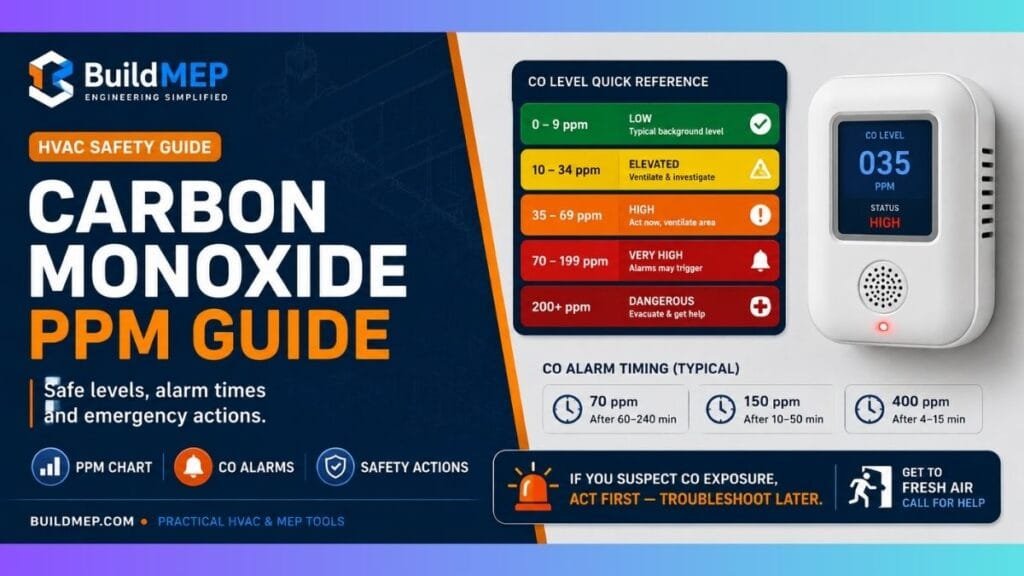
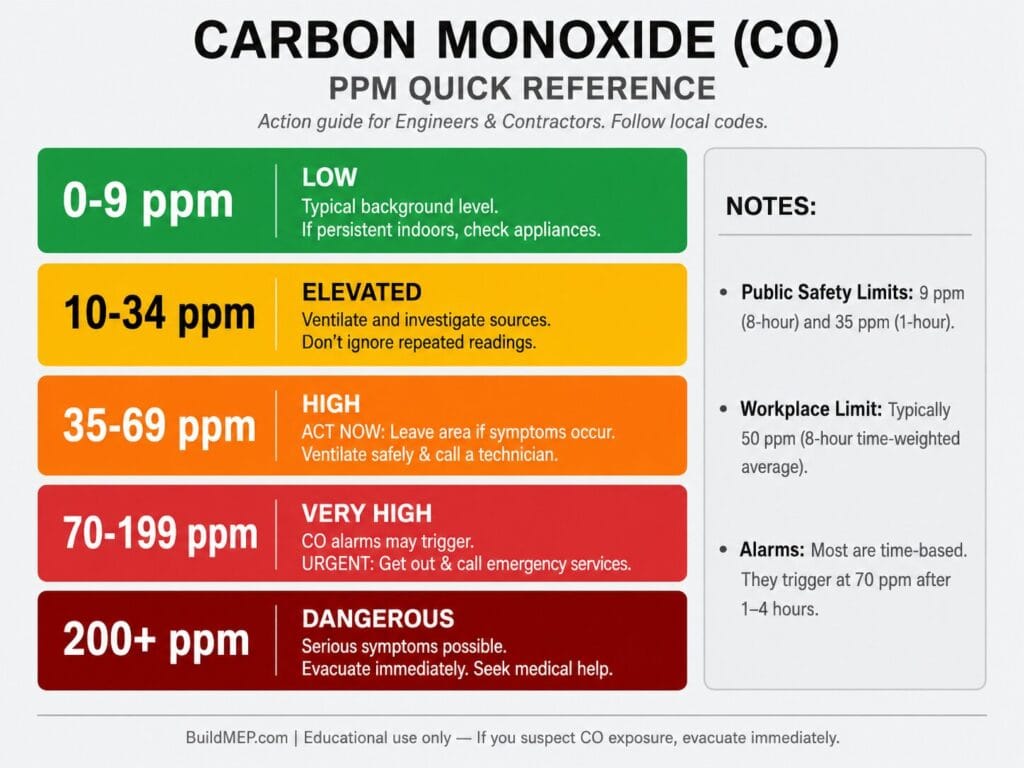
Carbon Monoxide PPM Action Chart
The following chart is a conservative practical guide for an occupied indoor space. It is not a medical diagnosis, a legal exposure standard or a replacement for the instructions supplied with your detector.
| CO reading | How to interpret it | Practical response |
|---|---|---|
| 0 ppm | No CO detected within the instrument’s measurement capability. | Normal preferred reading. Continue routine alarm testing and appliance maintenance. |
| 1–9 ppm | A low reading that may be temporary, background-related or evidence of a small source. | Watch the trend. Investigate if it persists, rises or is unusual for the location. |
| 10–34 ppm | An elevated indoor reading that should not be dismissed simply because the audible alarm is silent. | Move to fresh air if anyone has symptoms. Arrange prompt investigation of appliances, combustion and ventilation. |
| 35–69 ppm | A significant concentration, particularly when exposure continues. | Limit exposure and move people out of the affected area. Follow the site procedure or contact a qualified emergency or gas-safety service. |
| 70–199 ppm | A dangerous concentration. Standard residential alarms are designed to respond within a defined time range at 70 ppm. | Leave immediately. Contact emergency services or the responsible safety team. Do not wait for symptoms. |
| 200 ppm and above | A high and potentially life-threatening concentration. | Treat it as an emergency. Evacuate, call for help and do not re-enter until the area has been declared safe. |
Important: A lower concentration over a longer period can still cause harm. People with heart or lung disease, pregnant people, infants and older adults may be more vulnerable.
Why Exposure Time Matters
Carbon monoxide enters the bloodstream through the lungs and interferes with oxygen delivery to the body. The total dose therefore depends on both the concentration and the length of exposure.
A ten-minute exposure is not the same as spending an entire night at the same reading. Physical activity can also increase the amount inhaled because a working person breathes more air than someone at rest.
This is why recognised limits normally include an averaging period, such as one hour, eight hours or 24 hours. A ppm figure without its time period and intended application can be misleading.
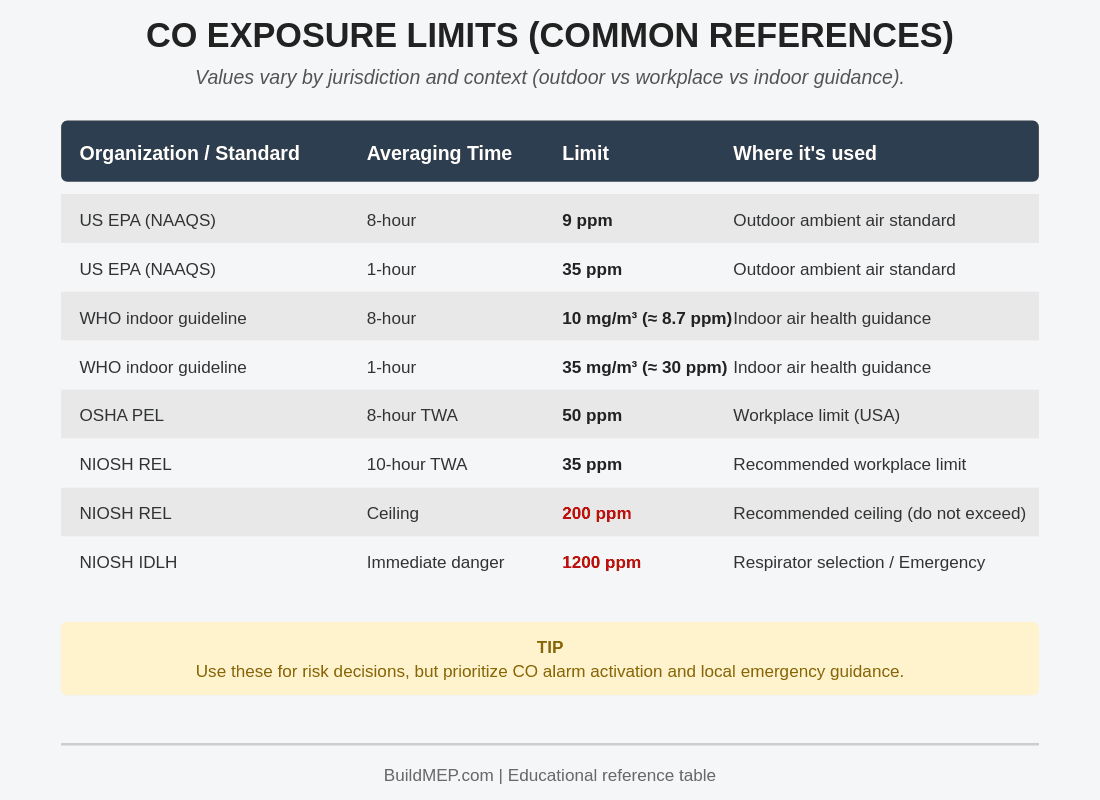
Official Carbon Monoxide Exposure Guidelines
The following values come from recognised organisations, but they are not interchangeable. Always check what population, location and averaging period each value was designed for.
| Organisation | Published value | What the value applies to |
|---|---|---|
| WHO, 2021 | 4 mg/m³ over 24 hours (approximately 3.5 ppm) | A health-based global air-quality guideline. |
| WHO indoor-air guidance | 100 mg/m³ for 15 minutes; 35 mg/m³ for 1 hour; 10 mg/m³ for 8 hours; 7 mg/m³ for 24 hours | Health-based guideline values for different exposure periods. |
| US EPA | 35 ppm over 1 hour; 9 ppm over 8 hours | National Ambient Air Quality Standards for outdoor air—not universal indoor safety limits. |
| OSHA | 50 ppm as an 8-hour time-weighted average | A US occupational permissible exposure limit. |
| NIOSH | 35 ppm time-weighted average; 200 ppm ceiling; 1,200 ppm IDLH | Recommended occupational limits and the concentration considered immediately dangerous to life or health. |
What this means in practice: The OSHA value should not be presented as a desirable level for a home, school or bedroom. Likewise, the EPA 9 ppm and 35 ppm values are outdoor ambient-air standards, not residential alarm settings.
When Does a Carbon Monoxide Alarm Sound?
A residential CO alarm does not normally sound the moment it detects a trace of carbon monoxide. Standard alarms are designed to respond according to both concentration and time, partly to reduce nuisance alarms.
Typical UL 2034 response-time requirements used in US consumer alarm testing are shown below.
| Test concentration | Required alarm activation window |
|---|---|
| 70 ppm | 60–240 minutes |
| 150 ppm | 10–50 minutes |
| 400 ppm | 4–15 minutes |
These are alarm performance windows—not safe exposure times. Do not remain in a contaminated area while waiting for the alarm to sound. Follow the instructions for the exact alarm installed, because features and applicable standards can vary by country and model.
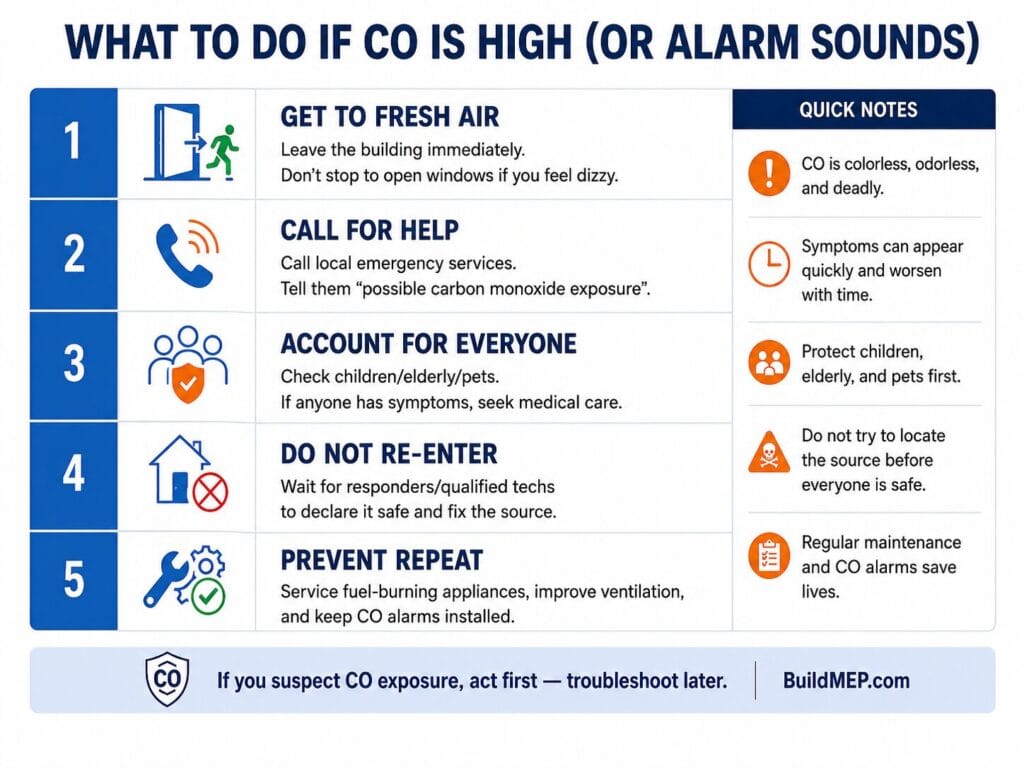
What to Do When a CO Alarm Sounds
- Move everyone outside. Take children, older occupants, visitors and pets into fresh air.
- Contact emergency services. Call from outside and explain that a carbon monoxide alarm has activated or a high reading has been measured.
- Confirm that everyone is accounted for. CO exposure can cause weakness and confusion, so check that nobody remains inside.
- Do not re-enter. Opening doors and windows may lower the display temporarily without correcting the source.
- Repair the fault before restarting equipment. A competent person should inspect the appliance, flue, ventilation, and combustion conditions.
Symptoms of Carbon Monoxide Exposure
Carbon monoxide poisoning can resemble flu or food poisoning. Common symptoms include:
- headache;
- dizziness;
- weakness or unusual tiredness;
- nausea or vomiting;
- chest pain;
- shortness of breath;
- confusion; and
- loss of consciousness.
Symptoms should not be predicted from a ppm reading alone. People respond differently depending on the concentration, exposure time, health condition, and activity level. Someone who is asleep may not notice the early warning signs.
Seek medical attention when CO exposure is suspected, even if the person starts to feel better after reaching fresh air.
Common Sources of Carbon Monoxide
CO is produced when fuels such as gas, petrol, diesel, kerosene, coal, wood or charcoal burn without enough oxygen. Common sources include:
- damaged or poorly maintained boilers and furnaces;
- cracked furnace heat exchangers;
- gas water heaters with poor flue draft;
- blocked chimneys, flues or exhaust ducts;
- poor combustion at gas cookers and burners;
- portable generators used indoors or close to doors and windows;
- vehicle exhaust entering from an attached garage;
- charcoal grills or shisha used inside enclosed spaces;
- fireplaces with inadequate draft; and
- temporary fuel-fired heaters used on construction sites.
A blue gas flame does not prove that the full installation is safe. The appliance, combustion-air supply and flue system still require proper inspection and maintenance.
Carbon Monoxide Prevention Checklist
- Install approved CO alarms on every occupied level and near sleeping areas, following the manufacturer’s instructions.
- Test alarms regularly and replace them at the end of their stated service life.
- Have fuel-burning equipment inspected by a competent technician.
- Keep chimneys, flues, and exhaust outlets clear.
- Never operate a generator indoors, in a garage, or near doors, vents, and windows.
- Never use charcoal or a fuel-burning barbecue inside an enclosed room.
- Do not leave a vehicle running inside a garage, even with the door open.
- Do not use a gas oven to heat a room.
- Check that combustion-air openings have not been blocked.
- Investigate repeated low-level readings instead of waiting for a full alarm.
CO Detection in Parking Garages and Plant Rooms
Commercial CO detection is not the same as a stand-alone residential alarm. In a parking garage, fixed sensors may start ventilation at one setpoint and generate a higher-level alarm if the concentration continues to rise.
The final setpoints and control sequence must follow the approved project specification, local code and authority requirements. Residential alarm timing should not simply be copied into a BMS sequence. In diesel-heavy garages (loading docks, bus and truck areas, ambulance bays), CO detection alone is often not the full picture — see our NO2 vs CO detection guide for when NO2 monitoring is also needed.
For parking garages, boiler rooms, and generator areas, the design team should consider the following:
- likely sources and areas where CO may accumulate;
- sensor coverage, mounting height and manufacturer guidance;
- access for testing, calibration and replacement;
- ventilation start, staging and alarm sequences;
- local alarm indication and BMS monitoring;
- fail-safe behaviour when a sensor or communication link fails; and
- functional testing during commissioning and planned maintenance.
BuildMEP note: A BMS alarm is useful for monitoring and ventilation control, but it should not be treated as the only life-safety warning where a dedicated alarm is required.
Practical Examples
A digital monitor shows 8 ppm in a home
A short, isolated reading does not automatically prove that an emergency exists. Check whether it returns to zero and whether a fuel-burning appliance is operating. If the reading persists or rises, arrange an inspection rather than ignoring it because the audible alarm is silent.
A boiler-room sensor shows 35 ppm
Treat the reading seriously. Restrict unnecessary access, follow the site safety procedure and investigate the burner, boiler, ventilation and flue system. The OSHA eight-hour limit is not permission to continue normal work during an uncontrolled plant-room incident.
A home alarm activates during the night
Wake everyone, move outside and call for help. Do not silence the alarm and return to sleep because nobody has a headache.
Frequently Asked Questions
Is 9 ppm of carbon monoxide safe?
EPA’s 9 ppm value is an eight-hour outdoor ambient-air standard, not a universal indoor safety threshold. A persistent or increasing indoor reading should be investigated.
Is 10 ppm carbon monoxide dangerous?
The immediate risk is much lower than at 100 ppm, but a persistent indoor reading should not be dismissed. Check the trend, possible combustion sources and whether anyone has symptoms.
Will a CO alarm sound at 30 ppm?
Many standard residential alarms are designed not to produce the main alarm at low concentrations such as 30 ppm. Some models may show a digital reading or provide a separate low-level warning. Check the instructions for the installed alarm.
Why does my detector display CO without sounding?
The concentration may be below the main alarm point, or the required response time may not have passed. The displayed reading should still be investigated, especially when it persists, rises or is accompanied by symptoms.
Is the OSHA 50 ppm limit safe for a house?
No. It is an occupational eight-hour time-weighted exposure limit. It should not be treated as a recommended concentration for homes or sleeping areas.
Can opening a window solve a CO problem?
Ventilation may lower the displayed concentration temporarily, but it does not repair a failed appliance, blocked flue or other source. The cause must be identified and corrected before normal use resumes.
Technical References
- World Health Organization — Global Air Quality Guidelines (2021)
- World Health Organization — Guidelines for Indoor Air Quality: Selected Pollutants
- US EPA — National Ambient Air Quality Standards Table
- US EPA — Carbon Monoxide Levels in Homes
- OSHA — Carbon Monoxide Chemical Data
- NIOSH — Pocket Guide to Carbon Monoxide
- US CPSC — Carbon Monoxide Alarm Conformance Testing to UL 2034
- CDC — Carbon Monoxide Poisoning Basics
Safety note: This article is a general engineering and public-safety reference. Follow the instructions supplied with the installed alarm, the approved site procedure and advice from local emergency or medical services.