
Practical HVAC Controls Guide
Demand-controlled ventilation does not mean “put a CO₂ sensor on the wall and open the fresh-air damper at 1,000 ppm.” It means changing ventilation in response to measured demand while preserving the minimum outdoor airflow required by the adopted code and the approved design.
The difficult part is deciding what represents demand, how the BMS converts that signal into an airflow command, and which standard or code governs the application.
Several BuildMEP guides mention DCV in passing. The parking-garage CO and NO₂ guide, for example, recommends modulating fans from measured contaminant levels. Occupied rooms use a related idea, but the sensor, target and control sequence are different. This guide separates those two applications and follows the control logic through to the BMS.
Occupancy-based CO₂ DCV
CO₂ is used as a proxy for people-generated ventilation demand. The system varies outdoor air without dropping below the required occupied minimum.
Contaminant-based ventilation
CO, NO₂ or another pollutant directly drives exhaust-fan operation. The philosophy is demand-based, but the applicable sensors, limits, codes and fail-safe sequence are different.
What DCV Actually Controls
For a normally occupied zone designed under the ASHRAE 62.1 Ventilation Rate Procedure, the breathing-zone outdoor airflow is built from a people component and an area component:
A conventional fixed-occupancy design uses the design population, Pz, whenever the zone is occupied. CO₂-based DCV estimates how much of the people component is currently needed and resets the ventilation demand accordingly. In the prescribed CO₂ sequence introduced through Addendum ab to ASHRAE 62.1-2022 and incorporated into the current standard, the area component acts as the lower end of the normal occupied control range. At full design demand, the zone returns to its design ventilation rate.
Why CO₂ Works—and What It Does Not Prove
People exhale CO₂, so occupant-generated indoor CO₂ can be useful as a tracer for occupancy-related demand. If more people enter a conference room, the indoor concentration normally rises unless ventilation rises with it. That makes CO₂ practical for classrooms, meeting rooms, theaters and other spaces with large changes in population.
It is still only a proxy. CO₂ generation changes with activity, body size and other occupant factors. A low reading does not prove that every indoor contaminant is low, and a CO₂ sensor does not detect cleaning chemicals, particulates, off-gassing or vehicle exhaust. ASHRAE’s 2025 position document is explicit that indoor CO₂ is not an overall indicator of indoor air quality.
The Correct Control Framing: Outdoor CO₂ Plus a Differential
In a CO₂-based ASHRAE 62.1 sequence, the BMS may display one indoor setpoint in ppm, but that value is derived from two parts:
Under the current prescribed method, Camb may be assumed as 400 ppm without direct measurement or dynamically measured by a CO₂ sensor located within 4 ft (1.2 m) of the outdoor-air intake. The allowed differential comes from the applicable occupancy category and edition of the standard. Where the project's design occupant density differs from the table's default density, the differential may also require the standard's adjustment calculation. The result may be 1,000 ppm in one design and a different number in another; it should be traceable to the design basis, not copied from a previous BMS database.
Where the old “700 ppm above outdoors” rule fits
The familiar 700 ppm-above-outdoors relationship is useful history, not a universal modern setpoint. It came from steady-state work relating roughly 15 cfm/person of outdoor air for sedentary adults to visitor perception of body odor. It was not a toxicity limit. Current ASHRAE 62.1 CO₂ control uses occupancy-specific differentials rather than one blanket 700 ppm value for every space.
ASHRAE 62.1 and 90.1 Have Different Jobs
| Reference | What it contributes | Practical design question |
|---|---|---|
| ASHRAE 62.1 | Minimum ventilation and acceptable-IAQ requirements, including the CO₂ DCV control sequence and sensor provisions. | How must the ventilation system behave if CO₂ DCV is used? |
| ASHRAE 90.1 | Energy-efficiency requirements that can require DCV for qualifying spaces and systems, subject to the adopted edition and exceptions. | Is DCV mandatory for this space and system under the energy-code path? |
| Local code / AHJ / project specification | Adoption, amendments, exceptions and the enforceable project requirement. | Which edition and addenda actually apply here? |
Do not put one fixed ASHRAE 90.1 trigger into a region-neutral specification. Older editions are commonly summarized by a fixed floor-area and occupant-density threshold. Newer 90.1 requirements use table-driven parameters tied to factors such as climate zone, the occupant outdoor-air component, heat-recovery status and system characteristics. Later addenda also clarify how CO₂-based control coordinates with 62.1.
Current CO₂ Sensor Requirements Worth Putting in the Submittal
The present ASHRAE 62.1 language is much more specific than “provide a good-quality CO₂ sensor.” For the prescribed CO₂ DCV method, the sensor is to be manufacturer-certified accurate within ±75 ppm at 600, 1,000 and 2,500 ppm, at sea level and 77°F (25°C). It is also to be factory calibrated and certified by the manufacturer not to require calibration more often than once every five years.
The sequence must also recognize sensor failure. Under the current provision, a detected failure generates a signal and resets ventilation to the required design-population minimum rather than leaving the zone at its reduced DCV airflow.
CO₂ sensor submittal check
- Accuracy is stated at all three required concentrations—not only as a full-scale percentage.
- The stated test conditions and altitude/pressure compensation are understood.
- The factory-calibration and recalibration claim is documented.
- The BMS exposes sensor fault or out-of-range status.
- The sequence defines the airflow command after a sensor fault.
- The selected output—0–10 V, 4–20 mA, BACnet or Modbus—matches the controller and point schedule.
If the signal interface is the uncertain part, use the BuildMEP guide to BACnet, Modbus, 0–10 V and three-position BMS control signals before approving the point schedule.
Where CO₂-Based DCV Is Usually Worth Using
The strongest candidates are zones that are sometimes nearly empty and sometimes close to design population: classrooms, training rooms, conference rooms, auditoriums, worship spaces, theaters and some fitness areas. In these spaces, fixed design-occupancy ventilation can spend many hours conditioning outdoor air for people who are not there.
DCV is less compelling where occupancy is stable, the people component is small, or another requirement already holds outdoor airflow at a higher rate. Examples can include private offices with predictable occupancy, spaces dominated by building-source contaminants, laboratories, healthcare areas, kitchens and zones whose makeup-air or exhaust requirement controls the airflow. The adopted code may also exclude or treat these spaces differently.
Multizone VAV: Do Not Treat the AHU as One Big Room
A single-zone unit can map one zone demand directly to its outdoor airflow. A multizone VAV air handler has a harder job: each terminal sees a different population, supply airflow and ventilation fraction, while the AHU must provide enough outdoor air for the system as a whole.
CO₂ sensing is usually most valuable in dense zones with genuinely variable occupancy. It is not automatically necessary in every office. But “install sensors only in a few rooms” is not a complete control strategy either. The designer still has to account for every zone, recalculate or reset system outdoor-air demand correctly, respect terminal airflow limits and maintain compliance as VAV airflow changes.
ASHRAE research project RP-1747 developed a practical BAS sequence for multiple-zone systems and reported modeled HVAC energy savings ranging from 7% to 44% against non-DCV baselines in the studied cases. That range is evidence that the opportunity can be significant—not a savings guarantee for every project.
Sensor Location: Measure the Air You Intend to Control
The current prescribed method starts with space sensing: install CO₂ sensors 3 to 6 ft (0.9 to 1.8 m) above the floor, with at least one sensor per ventilation zone and at least one per 5,000 ft² (460 m²) of net occupiable area. If one ventilation zone contains more than one room, each room is sensed and ventilation is controlled to the room requiring the most ventilation.
Keep a space sensor away from direct supply-air jets, doors, operable windows, localized breathing plumes and dead pockets. Other sensor locations are permitted only where they are demonstrated to measure the average breathing-zone CO₂ accurately. That qualification matters for return-duct sensing: a return reading averages whatever reaches the duct and can hide a poorly mixed breathing zone or dilute one crowded room with air from emptier rooms. A common return sensor on a multizone AHU is not a substitute for the required room-level demand information.
A Practical BMS Example
Classroom served by a single-zone AHU
Assume the approved design schedule gives:
- Area/building component: 90 L/s
- Design-occupancy breathing-zone outdoor airflow: 300 L/s
- Measured outdoor CO₂: 450 ppm
- Allowed differential selected by the designer: 600 ppm
The BMS maximum zone control concentration is therefore 450 + 600 = 1,050 ppm.
| Zone CO₂ | Control position | Illustrative breathing-zone OA demand |
|---|---|---|
| 450 ppm or lower | Bottom of normal occupied DCV range | 90 L/s area component |
| 750 ppm | Halfway from outdoor to Cmax | 195 L/s |
| 1,050 ppm or higher | Full design demand | 300 L/s |
| Sensor fault | Fail to design-population ventilation | 300 L/s |
The controller should prove actual outdoor airflow where the design requires it. Damper percentage alone is not airflow: wind, filter loading, fan pressure and economizer operation all change the relationship. If the AHU arrangement and ventilation path are not clear, resolve that before finalizing the sequence.
These values are an arithmetic example only. Use the adopted standard, approved ventilation schedule and project sequence for real setpoints.
CO₂ DCV Setpoint and Design Helper
Check the control target and indicative zone demand
Enter the project values. The helper applies a proportional sequence between the area component and the design-occupancy breathing-zone airflow. Use the final project differential after any required occupant-density adjustment.
Example values loaded. This is a design-check helper, not a code-compliance calculator.
The Other Application: Parking-Garage Contaminant Control
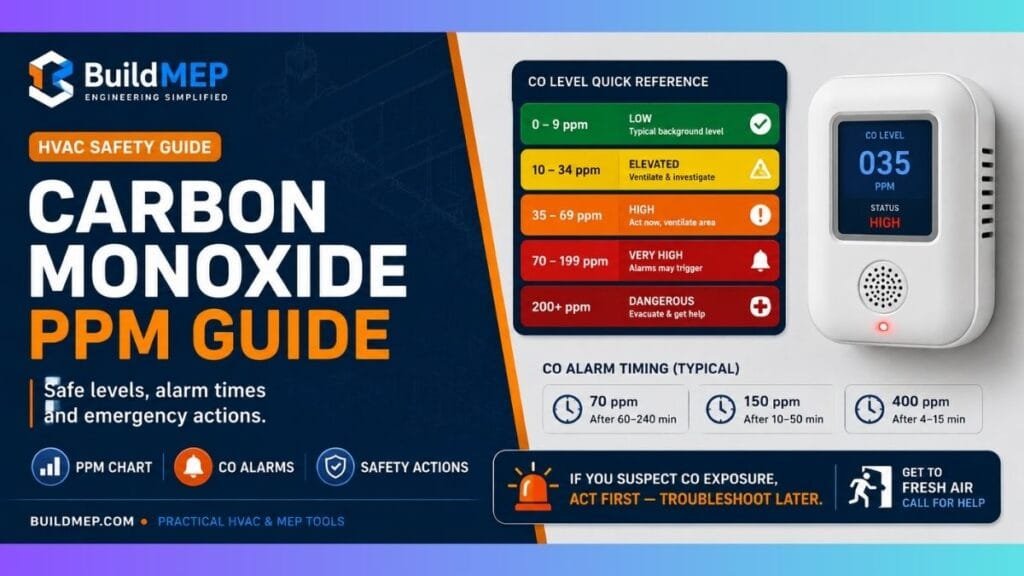
A parking garage may also vary ventilation according to measured demand, but human CO₂ is not the design signal. Vehicle exhaust is the source, so CO and—where diesel traffic or other sources justify it—NO₂ are the relevant measurements. Fan staging, alarm thresholds, sensor coverage, purge operation and failure mode come from the applicable mechanical/building code, environmental or occupational requirements, the AHJ and the approved sequence.
The important distinction is simple:
CO₂ room DCV
Estimates the people-related component of outdoor-air demand. The sensor is a proxy for occupancy.
CO/NO₂ garage control
Responds to the contaminant itself. The sensor is measuring the hazard or control pollutant of interest.
The control philosophy is related, but the setpoints are not interchangeable. Continue with NO₂ versus CO detection for parking garages, then use the parking-garage CO sensor selection guide when reviewing detector outputs and maintenance features.
A Practical DCV Design and Commissioning Workflow
- Confirm the governing documents. Record the locally adopted ventilation and energy-code editions, amendments, exceptions and project specification.
- Identify the real source of demand. Use occupancy-based control for people-related demand; use pollutant-specific sensing where a contaminant source governs ventilation.
- Calculate the fixed and variable airflow components. Document the area component, design people component, zone distribution effectiveness and system outdoor-air calculation.
- Select the CO₂ differential correctly. Take it from the applicable occupancy category and adopted edition. State the outdoor basis and resulting Cmax in the sequence.
- Select and locate sensors. Verify accuracy, calibration, fault reporting, signal compatibility and representative placement.
- Write the sequence in airflow terms. Define minimum, proportional and maximum demands; economizer interaction; occupied standby where applicable; and sensor-failure response.
- Commission with trends. Trend zone CO₂, outdoor CO₂ or its configured basis, zone airflow, outdoor airflow, VAV command, damper command, fan status and fault flags through a real occupancy cycle.
What a useful trend should show
- CO₂ rises after people enter, followed by a smooth increase in ventilation demand.
- The outdoor airflow does not drop below the applicable occupied floor.
- The design demand is reached at Cmax, without needing an unexplained offset.
- Actual airflow follows the setpoint; damper movement alone is not accepted as proof.
- A simulated sensor fault returns ventilation to the documented safe/default state and generates an alarm.
- Unoccupied, occupied-standby, warm-up, purge and economizer modes do not fight the DCV loop.
Common Mistakes
- Copying 1,000 ppm into every project. Derive the control value from the outdoor basis and the applicable differential.
- Calling the setpoint an IAQ or health limit. CO₂ does not represent every contaminant, and the DCV value has a specific control purpose.
- Controlling a damper position instead of outdoor airflow. A 20% damper command does not guarantee 20% outdoor air.
- Ignoring the area component. Reducing the people component does not normally erase the building-related ventilation demand during occupied DCV operation.
- Using a mixed return-air sensor for unlike zones. Averaging can hide the room that actually needs ventilation.
- Applying a single-zone rule to multizone VAV. System ventilation efficiency and zone primary airflow still matter.
- Omitting the failure mode. A bad sensor should not strand the system at reduced airflow.
- Using CO₂ logic in a garage. Vehicle-contaminant control requires its own sensors, limits and code review.
Frequently Asked Questions
Does DCV always save energy?
No. It is most effective where actual occupancy is often well below design occupancy and outdoor air has a meaningful heating, cooling or dehumidification cost. Stable occupancy, large exhaust requirements or an already-dominant area component can reduce the benefit.
Is 1,000 ppm a universal CO₂ limit?
No. A BMS setpoint may land near 1,000 ppm, but the current control framing is outdoor CO₂ plus the permitted differential for the occupancy category. The result is a DCV control value, not a universal IAQ or health threshold.
Can DCV reduce outdoor air to zero?
Not as a general rule. Normal occupied CO₂ DCV retains the applicable building/area component. Some editions and occupancy categories include separate occupied-standby provisions, but they must be applied exactly as allowed and should not be confused with ordinary DCV turndown.
Should the CO₂ sensor be in the room or return duct?
Use the location that represents the controlled zone. A room sensor is usually clearer for an individual room. A return-duct sensor can work for a true single-zone system if mixing and sampling are representative; a common multizone return sensor can mask local demand.
Does every VAV zone need a CO₂ sensor?
Not automatically. Sensors are usually most valuable in dense, variable-occupancy zones. The final design must still account for all zones and implement a compliant system outdoor-air sequence.
Is parking-garage fan control the same as CO₂ DCV?
No. Both vary ventilation with measured conditions, but garage control responds to pollutants such as CO and NO₂ and follows different codes, thresholds, placement rules and failure logic.
Authoritative References
- ASHRAE Standards 62.1 and 62.2—official overview of the current ventilation and IAQ standards.
- Addendum ab to ANSI/ASHRAE Standard 62.1-2022—publicly available CO₂ DCV control and sensor language incorporated into the current edition.
- ASHRAE Position Document on Indoor Carbon Dioxide (2025)—limitations and appropriate interpretation of indoor CO₂.
- ANSI/ASHRAE/IES Standard 90.1—official energy-standard overview.
- ASHRAE 90.1-2022 changes—includes the revision of DCV parameters by climate zone and Standard 62.1 airflow requirements.
- Addendum o to ANSI/ASHRAE/IES Standard 90.1-2022—coordination and clarification for CO₂-based DCV.
- ASHRAE Research Project RP-1747—practical CO₂-based DCV logic for multiple-zone DDC systems.