
BuildMEP Parking Garage Ventilation Guide
Parking-garage gas detection tends to get boiled down to one line: petrol vehicles mean CO, diesel vehicles mean NO₂. That's useful background, but it's nowhere near enough for an actual design. You still need to check the adopted code, the garage classification and how the ventilation system is meant to operate before deciding which detectors are actually required.
Under recent editions of the International Mechanical Code, an enclosed parking-garage ventilation system can run continuously or automatically. When the automatic gas-based control path is used, CO detectors are paired with NO₂ detectors. Vehicle mix still matters for risk, zoning and layout, but it doesn't override what the adopted code says.
Code editions and local amendments vary. Confirm the garage classification, adopted mechanical and energy codes, detector listing, manufacturer instructions and AHJ requirements before locking in setpoints, mounting positions or the final control sequence.
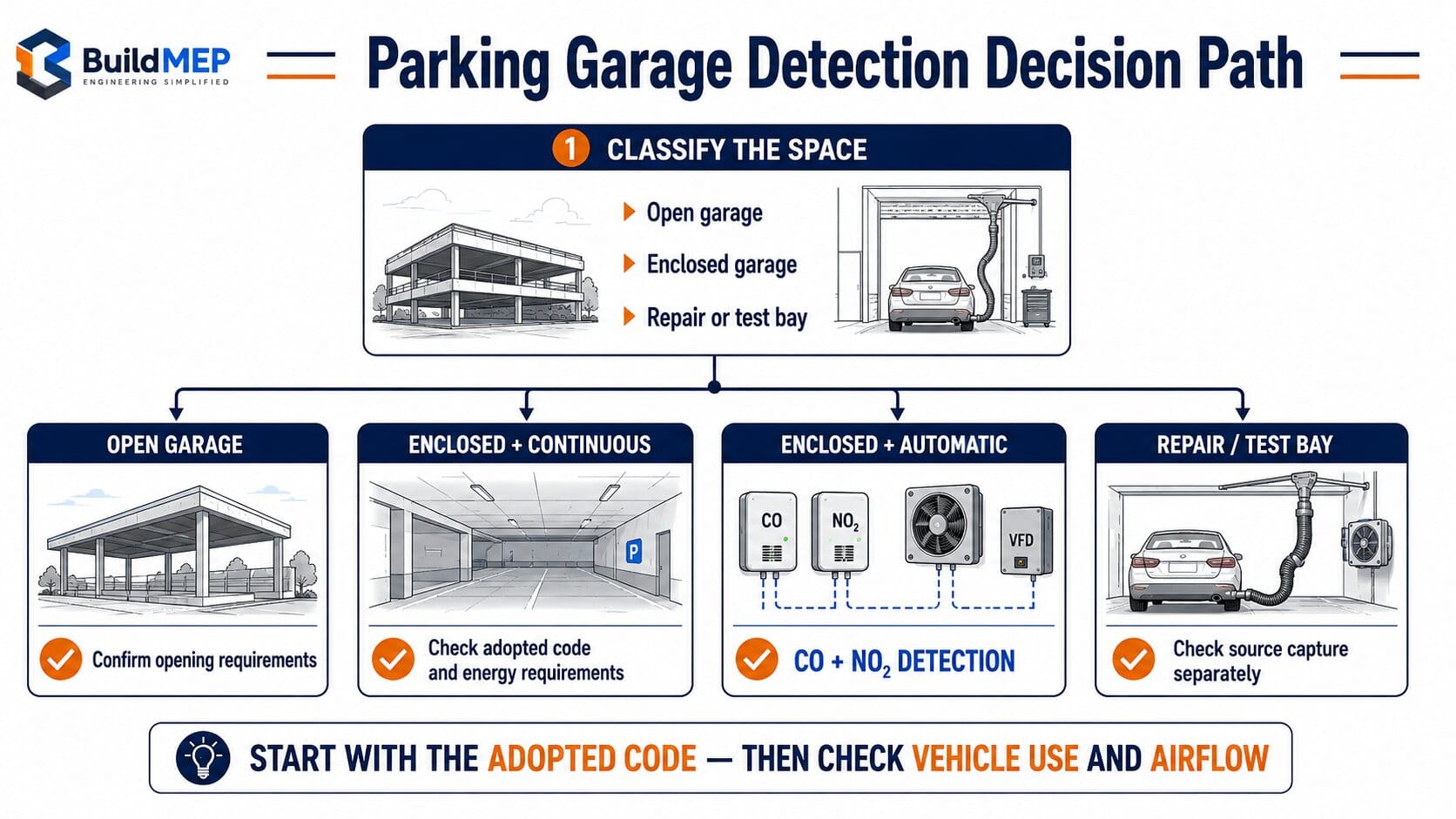
The decision starts with the ventilation path
The most useful first question isn't "Are diesel vehicles expected here?" It's "How is this garage classified, and how will its ventilation system actually operate?"
| Project condition | First design check |
|---|---|
| Garage qualifies as open | The enclosed-garage mechanical ventilation rule may not even apply. Confirm the adopted building-code definition and permanent-opening requirements. |
| Enclosed garage with continuous ventilation | Gas detection might not be required under the base IMC path, though the energy code, local amendments, owner standard or risk assessment may still call for it. |
| Enclosed garage with automatic gas control | Recent IMC editions call for CO detectors paired with NO₂ detectors. |
| Repair garage or engine test area | Check the separate ventilation and direct source-capture requirements that apply to stationary vehicle operation. |
Why CO and NO₂ are measured separately
CO
CO comes from incomplete combustion. Gasoline vehicles have traditionally been the main garage concern, especially during cold starts, idling or poor engine operation.
Diesel engines produce CO too, so it's not really fair to call it a gasoline-only contaminant.
NO₂
NO₂ falls under the broader nitrogen-oxide exhaust problem. Diesel traffic is a major NO₂ concern, and exhaust after-treatment can shift how much NO₂ actually shows up in diesel exhaust.
Gasoline engines produce nitrogen oxides as well, so NO₂ isn't chemically exclusive to diesel vehicles either.
A low CO reading doesn't tell you NO₂ is also low. The two gases have different health effects, exposure criteria, sensors and control values.
What the recent IMC code path actually means
Section 404.1 of the 2024 IMC lays out two basic operating paths for the mechanical ventilation serving an enclosed parking garage:
or automatic operation
CO + NO₂ detection
On the automatic path, the code also covers full-on and standby airflow modes. Detectors have to meet the referenced listing requirement and be installed per that listing and the manufacturer's instructions.
If a project is using detector-based fan control under this code path, I wouldn't pull the NO₂ sensors just because the parking schedule leans mostly passenger cars. Check the exact wording of the adopted code first, and get the AHJ to sign off before making that call.
Vehicle mix still matters
Code compliance sets the minimum arrangement, but how vehicles actually use the space still shapes the engineering design.
Traffic and idling
Ramps, ticket barriers, pickup points and loading zones can build up localized concentrations even when the garage-wide reading looks fine.
Diesel presence
Bus, truck, ambulance and regular delivery traffic deserve specific attention when you're defining NO₂ zones and the ventilation response.
Stationary engines
Service bays and test areas can need direct tailpipe capture instead of relying on general garage exhaust alone.
Mixed occupancies
A parking garage tied to a loading dock or repair area shouldn't be treated as one uniform passenger-car environment.
Don't copy a generic setpoint table
There's no single CO/NO₂ setpoint table you can safely drop into every project. Values floating around online might come from a mechanical code, a local amendment, an occupational exposure limit, a manufacturer default, an owner standard, or a control sequence written for a completely different ventilation rate.
An exposure limit applies over a defined averaging period or acts as a ceiling. A fan-control value is part of an engineered sequence meant to keep the garage from reaching an unacceptable concentration.
A realistic sequence might include low ventilation, higher ventilation, a high-gas alarm, and separate reset values for hysteresis. Every value and time delay should trace back to the approved design basis, not some generic example table.
Sensor location isn't one universal height
"Just put both sensors at breathing-zone height" is too vague to be useful. Some adopted codes prescribe different locations for CO versus NO₂, while the base IMC focuses more on detector listing and manufacturer instructions.
Height is only one piece of the placement puzzle. The layout also needs to account for:
- the detector's listed coverage and manufacturer spacing limits;
- ramps, queues, idling points and loading zones;
- dead zones, partitions, low beams and poor air mixing;
- supply-air jets and exhaust points that might dilute or pull gas away from a sensor;
- separate fan-control and ventilation zones;
- protection from vehicle impact, water and dirt; and
- safe access for calibration, bump testing and replacement.
Coverage has to follow both the listed sensing arrangement and the way air and vehicles actually move through the garage.
Quick Garage Detection Logic Helper
This helper points you to the first code path worth investigating. It doesn't replace the adopted code or an AHJ review.
Always confirm the current adopted mechanical, building and energy codes, local amendments and detector listing.
Control sequence checks that matter
The detector schedule is only one piece of the system. The sequence should clearly spell out:
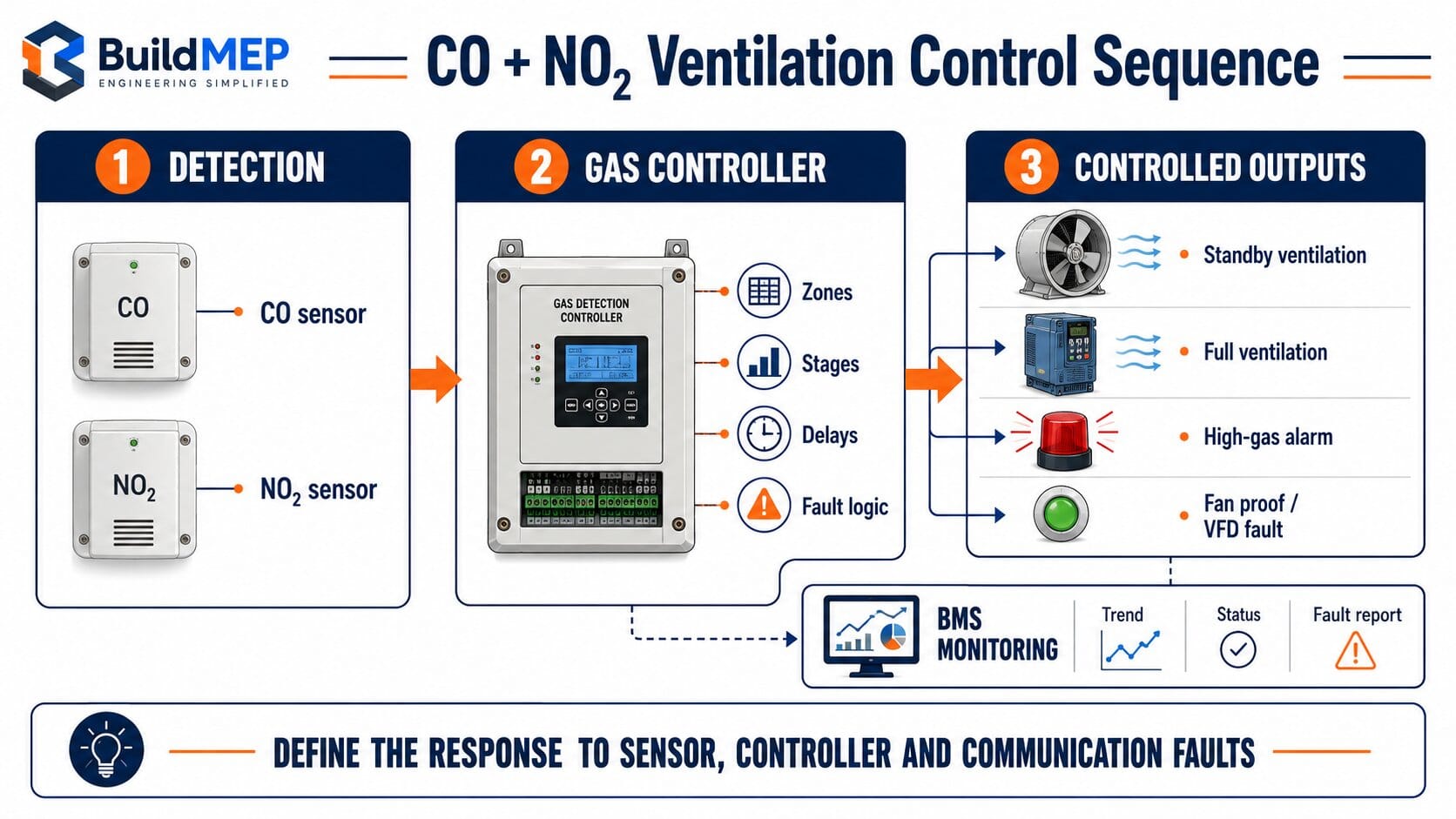
- normal standby airflow and minimum fan status;
- first-stage and full-ventilation response;
- which sensors control which fan or ventilation zone;
- rising and falling values, delays and anti-short-cycling logic;
- high-gas alarm and the required operator or occupant notification;
- manual override and emergency response;
- fan run proof, VFD fault and damper proof where applicable;
- the response to detector failure, communication loss or controller fault;
- BMS monitoring versus hardwired control functions; and
- testing, calibration and maintenance intervals.
A time schedule on its own isn't a substitute for required gas-based automatic control. If the system isn't using the continuous-ventilation path, the approved detector sequence has to be able to respond whenever contaminant levels climb.
Practical design and commissioning workflow
- Classify the space: open garage, enclosed garage, repair garage, loading area or mixed occupancy.
- Confirm the adopted codes: mechanical, building, fire and energy codes plus local amendments.
- Select the permitted ventilation path: continuous operation or approved automatic gas control.
- Apply the required gases: under recent IMC automatic-control provisions, CO detection is used alongside NO₂ detection.
- Review actual operation: diesel traffic, queues, idling and stationary engine use.
- Select listed equipment: range, accuracy, environment, cross-sensitivity, calibration and controller compatibility.
- Design the zones and sequence: sensors, fans, VFDs, dampers, alarms, faults and BMS interface.
- Get AHJ agreement: resolve interpretation questions before installation starts.
- Commission the response: test every stage, alarm, fan proof, fault and reset — not just the BMS graphics.
Common mistakes I'd avoid
- Starting with fuel mix instead of the adopted code. Vehicle mix affects risk and layout, but it doesn't override a paired-detection requirement.
- Saying every enclosed garage needs CO detection. Recent IMC editions also offer a continuous-ventilation path.
- Using CO as a stand-in for NO₂. The two gases need to be measured separately when both are part of the design.
- Treating a repair bay like ordinary parking. Stationary engines may need direct source capture.
- Copying setpoints straight from a brochure. Manufacturer defaults aren't automatically the project's design criteria.
- Using one mounting height for every product. Follow the adopted code, detector listing and manufacturer instructions instead.
- Testing only the BMS graphics. Prove out the physical fan, VFD, damper, alarm and fault response too.
Frequently asked questions
Does every enclosed parking garage need gas detection?
Not necessarily under the base 2024 IMC path. The ventilation can run continuously or automatically with the required detector arrangement. The energy code, local amendments or owner requirements can change the answer for a specific project.
Can I use CO-only detection in a passenger-car garage?
Not where the adopted recent IMC provision calls for CO detectors paired with NO₂ detectors under automatic ventilation control. Confirm the exact local code rather than assuming passenger-car use gets you an exemption.
Can one detector sense both gases?
Combination CO/NO₂ detectors exist. Just confirm each sensing element carries the required listing, range, accuracy and calibration procedure.
Can BACnet control the garage fans directly?
BACnet works well for BMS monitoring, trending and supervisory control. The approved sequence still has to define what happens if the controller, network or BMS fails. See the BuildMEP BMS control signals guide.
Are exposure limits the same as fan-control setpoints?
No. Exposure limits apply over a defined averaging period or as a ceiling. Fan-control values are part of an engineered sequence meant to prevent unacceptable exposure.
Related BuildMEP guides
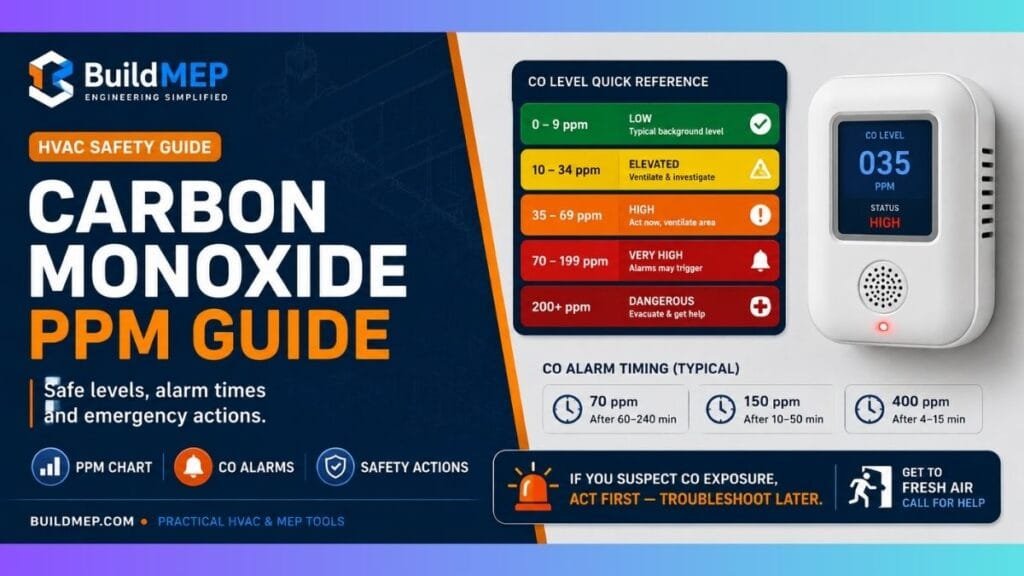
- Carbon Monoxide Levels Chart: Safe PPM Ranges Explained
- Best CO Sensors for Parking Garages
- Demand-Controlled Ventilation Explained
- BACnet vs Modbus vs 0–10 V vs 3-Position Control
Technical references
- 2024 International Mechanical Code, Section 404.1
- International Mechanical Code, Section 502.14: Motor Vehicle Operation
- NIOSH Pocket Guide: Nitrogen Dioxide
- US EPA: About Diesel Fuels
Start with the adopted code and the approved ventilation strategy. Then use the real vehicle pattern, listed detector data and commissioning sequence to round out the design.