
BuildMEP HVAC Efficiency Guide
A spec sheet showing 12 EER next to another showing 16 SEER2 doesn't actually tell you which unit performs better. The two numbers come from different rating methods entirely. Before you compare them, check the metric, the test procedure, the operating condition and the equipment class.
EER or EER2 is an efficiency ratio at one stated rating condition. SEER or SEER2 is a standardized seasonal cooling ratio. COP is useful output divided by energy input in matching units. EER and COP convert cleanly into each other only when they describe the same condition and system boundary; SEER2 can be expressed as a seasonal W/W figure, but it can't be turned into a point EER2 without the equipment's actual test data.
Why the numbers don't line up directly
All three metrics weigh useful heating or cooling against electrical input, but they don't necessarily describe the same operating point.
EER / EER2
Cooling capacity divided by total electrical power at one stated set of rating conditions.
SEER / SEER2
Total standardized seasonal cooling divided by total seasonal electrical energy.
COP
Useful heating or cooling output divided by electrical input, both expressed in the same energy units.
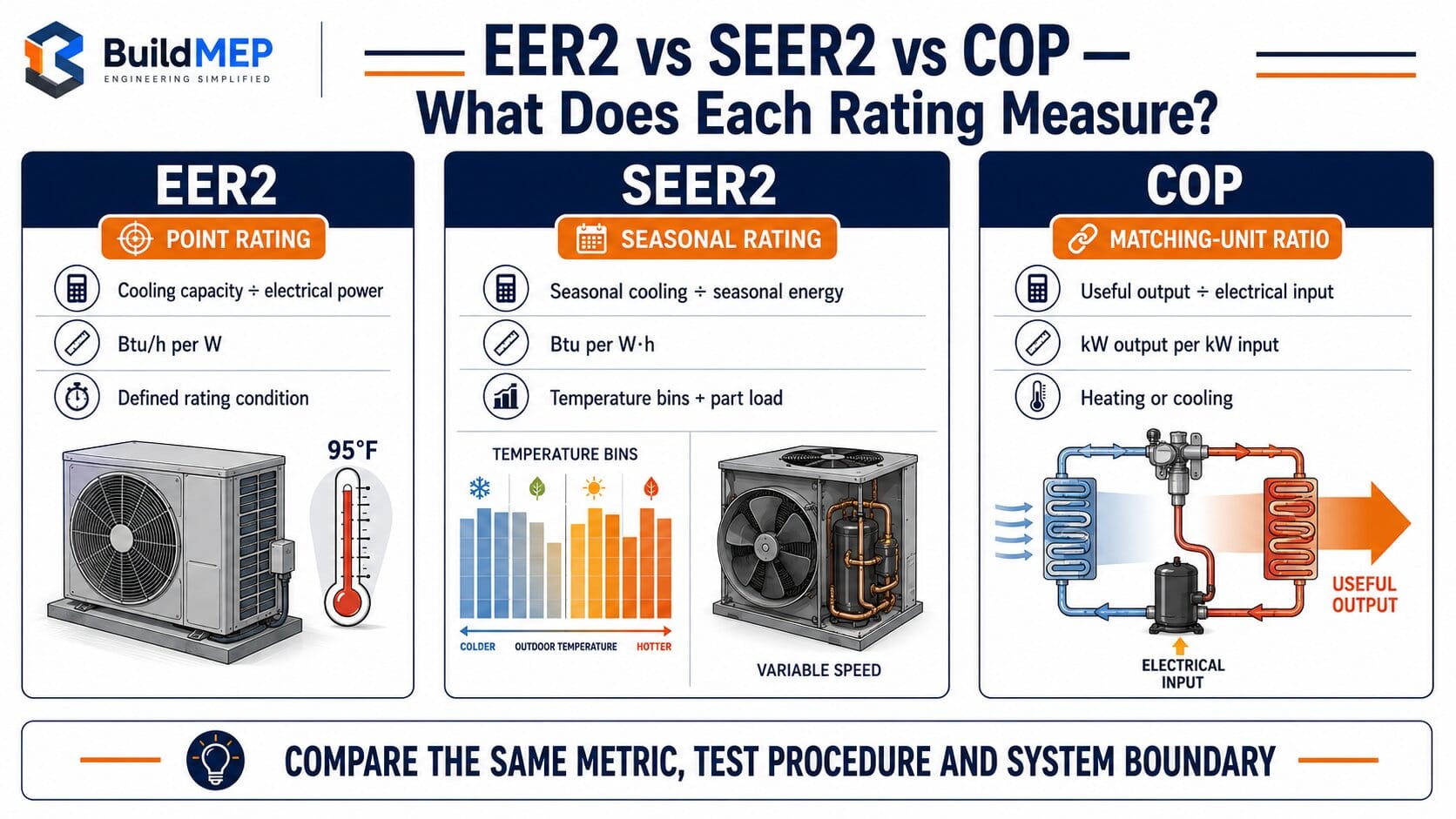
EER2 isn't a test of "the hottest day of the year." It's a steady-state ratio at one defined rating condition. A real project might run above or below that outdoor temperature, with different indoor conditions, airflow, load and installation losses on top.
EER and EER2: performance at a stated condition
AHRI Standard 210/240-2026 defines EER2 as cooling capacity in Btu/h divided by total power in watts at a given set of rating conditions. The published full-load value for this equipment gets identified as EER2 at the AFull condition.
Entering outdoor air is 95°F dry-bulb / 75°F wet-bulb, and entering indoor air is 80°F dry-bulb / 67°F wet-bulb. These are standardized lab rating conditions — not a universal stand-in for the hottest operating day.
EER2 is genuinely useful when you're comparing matched systems at the same published rating point. In hot climates it gives you a decent full-load reference, but it still won't predict the full annual bill. Actual energy use comes down to the local weather profile, sizing, runtime, duct losses, controls and installation quality.
SEER and SEER2: standardized seasonal cooling
SEER2 is the total heat removed over a standardized annual cooling season, divided by the total electrical energy consumed across that same season. The calculation runs on defined temperature bins and accounts for cycling, staging or variable-capacity operation as the test procedure specifies.
That's why a variable-speed unit can post a much higher SEER2 than EER2. The seasonal calculation captures lower-load operation, where modulation often cuts cycling losses and boosts efficiency. EER2, by contrast, reports one particular steady-state rating point.
It's not the measured seasonal efficiency of your specific building in Doha, Colombo, London or anywhere else. It's a standardized comparison rating. Real seasonal performance shifts with climate, indoor setpoint, humidity, equipment sizing, controls and installation.
What changed from SEER to SEER2?
The newer procedure reworked how central air conditioners and heat pumps get tested, including the external static pressure used for a lot of ducted systems. Because the procedure itself changed, an older SEER value and a newer SEER2 value shouldn't be treated as directly interchangeable.
Don't apply one blanket "SEER-to-SEER2 reduction percentage" across the board. The difference depends on the equipment configuration and the certified test results. When comparing products, stick to ratings produced under the same test procedure.
COP: the clean W/W ratio
COP comes out dimensionless because useful output and electrical input are expressed in matching units. A cooling COP of 3.5 means 3.5 kW of heat is removed for every 1 kW of electrical input within the stated measurement boundary.
COP can describe cooling or heating, but it always needs an operating condition attached. A heat pump's heating COP shifts with outdoor temperature, supply-water or supply-air temperature, load and defrost operation. A chiller's COP shifts with load, chilled-water temperature, condenser condition and which auxiliaries are counted.
Compressor-only COP, unit COP and whole-plant COP are not the same thing. Pump, fan, cooling-tower and control power may or may not be included. The conversion formulas only hold up when both numbers share the same boundary.
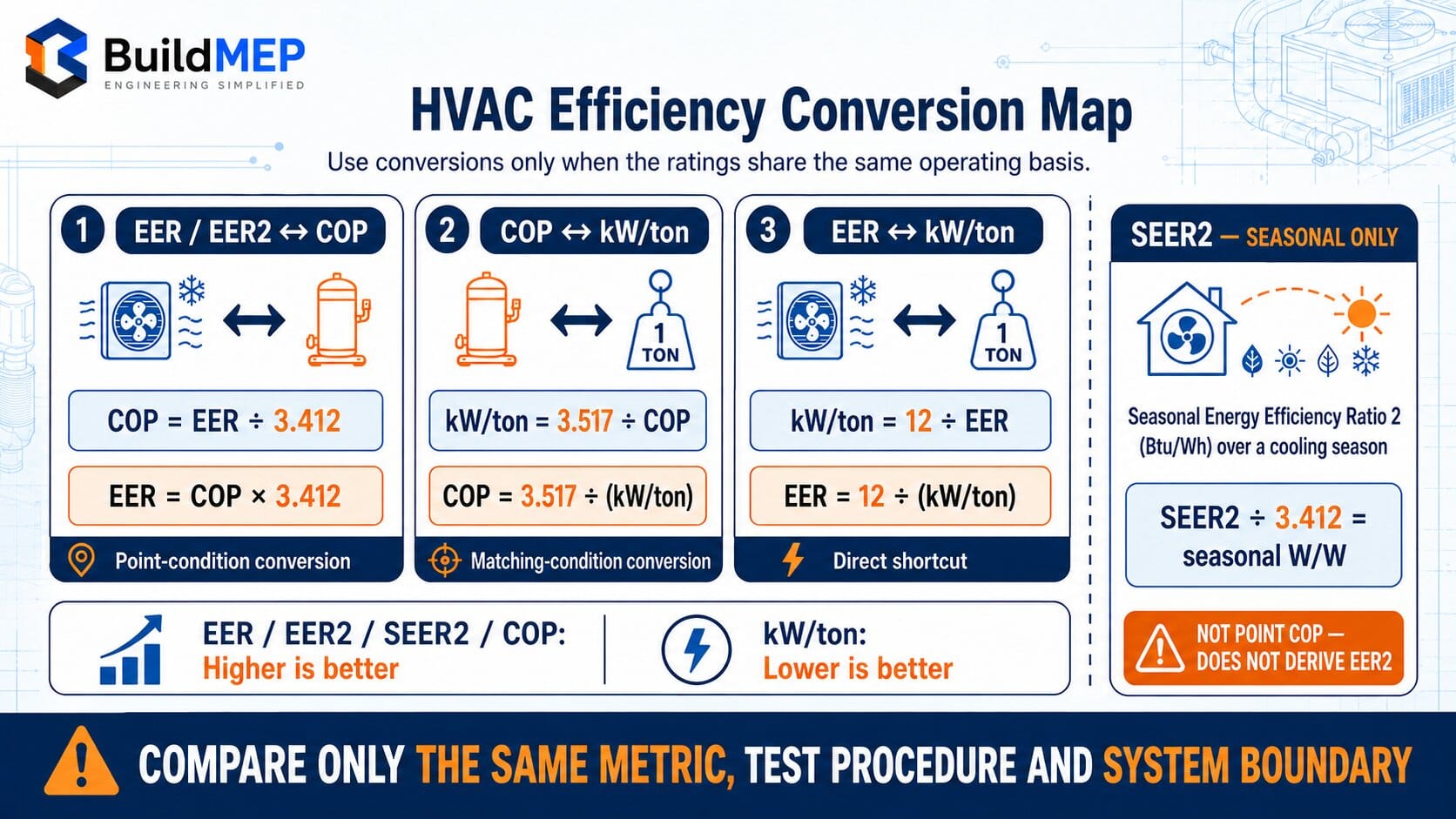
Correct conversions
EER ↔ point COP
Use only for the same operating condition and system boundary.
COP ↔ kW/ton
For cooling efficiency with consistent equipment boundaries.
EER ↔ kW/ton
One refrigeration ton equals 12,000 Btu/h.
SEER2 → seasonal W/W
This is just a unit conversion of the seasonal rating — not a point COP, and not a way to back into EER2.
EER, COP and kW/ton Conversion Helper
Pick the metric you already have. SEER2 gets handled separately since it's a seasonal rating.
This helper only converts units. It doesn't correct for different test conditions, load points, climates or equipment boundaries.
Which rating belongs to which equipment?
| Equipment or comparison | Common rating basis | Important check |
|---|---|---|
| Residential central AC and air-source heat pump cooling | SEER2 and EER2 under the applicable current procedure | Compare certified matched-system ratings using the same procedure. |
| Air-source heat pump heating | HSPF2 for seasonal heating; COP at stated heating points | Check region and outdoor test temperature. One COP doesn't describe a whole winter. |
| Commercial unitary AC and heat pumps | EER and IEER under the applicable equipment standard | IEER is a weighted part-load metric; confirm product class and rating standard. |
| Water-chilling packages | Full-load COP or kW/ton plus IPLV/NPLV | Compare the same load basis, water temperatures, condenser conditions and auxiliary boundary. |
| Room or window air conditioners | CEER under the applicable room-AC procedure | Don't assume the central-AC SEER2 procedure applies here. |
| Portable air conditioners | SACC and CEER under the portable-AC procedure | Don't compare the box's capacity or efficiency directly with central-system SEER2. |
Related commercial metrics
IEER
Integrated Energy Efficiency Ratio combines performance at defined part-load points for applicable commercial unitary equipment. It's not just SEER2 under a different name.
IPLV / NPLV
Integrated or non-standard part-load value combines chiller performance at defined load points and conditions. Full-load efficiency still needs to be checked on its own.
A practical comparison workflow
- Identify the equipment class. Central AC, commercial package unit, room AC, portable AC and chiller ratings all follow different procedures.
- Match the metric. Compare SEER2 with SEER2, EER2 with EER2, IEER with IEER, or chiller IPLV with IPLV.
- Check the test standard and edition. Don't mix old SEER and current SEER2 values without certified equivalent data.
- Check the operating condition. COP, EER and kW/ton only mean something once you know the load, temperatures and flow conditions.
- Check the boundary. Confirm whether indoor fan, condenser fan, pumps, cooling tower or other auxiliaries are included.
- Bring in climate and load profile after the certified comparison. EER2 supports a hot-condition review; SEER2 supports a standardized seasonal comparison; neither replaces an energy model.
- Review installation factors. Oversizing, low airflow, duct leakage, fouled coils and poor controls can wipe out the expected savings.
Common mistakes I'd avoid
- Comparing SEER2 directly with EER2. They use different rating methods, even though both land in Btu/W·h units.
- Calling 95°F the worst-case day. It's a defined rating condition; plenty of projects run outside it.
- Turning SEER2 into point COP. Dividing by 3.412 gives you a seasonal W/W ratio, not EER2 and not a single-condition COP.
- Applying one SEER-to-SEER2 factor to every product. Use certified values under the same procedure instead.
- Using central-AC metrics for room or portable units. These product classes run on different DOE procedures and metrics entirely.
- Ignoring the measurement boundary. Unit efficiency and whole-plant efficiency can be worlds apart.
- Confusing thermal kW with electrical kW. One ton equals 3.517 kW of cooling capacity — not 3.517 kW of electrical consumption.
Frequently asked questions
Is higher always better?
Higher is better for EER, SEER and COP. Lower is better for kW/ton. Either way, only compare ratings taken at the same standard, condition and boundary.
Why is SEER2 usually higher than EER2?
SEER2 folds in standardized part-load and cycling performance across a whole cooling season. EER2 reports one defined steady-state rating point. That gap is expected, especially for well-controlled multi-stage or variable-capacity equipment.
Can I estimate EER2 from SEER2?
Not reliably with some universal factor. Ask for the certified EER2 or the manufacturer's rated performance instead. Two systems with similar SEER2 can still land on very different full-load EER2 values.
Should I use EER2 instead of SEER2 in a hot climate?
Use both if you can get them. EER2 gives you a common high-outdoor rating point, while SEER2 gives the standardized seasonal comparison. For a serious energy decision, pull in local weather data and the manufacturer's performance map.
Does a better rating guarantee a lower electricity bill?
No. Load, runtime, tariff, sizing, duct leakage, maintenance and control all factor in. See the BuildMEP AC running-cost guide for the energy-cost side of things.
Related BuildMEP guides
- How Much Does It Cost to Run an Air Conditioner?
- Heat Load Calculator
- BACnet vs Modbus vs 0–10 V vs 3-Position Control
Technical references
- AHRI Standard 210/240-2026: Unitary Air-conditioning and Air-source Heat Pump Equipment
- 10 CFR Part 430, Appendix M1: Central Air-conditioner and Heat Pump Test Procedure
- AHRI Standard 340/360: Commercial and Industrial Unitary Equipment
- AHRI Standard 551/591-2026: Water-chilling and Heat Pump Water-heating Packages
- ENERGY STAR: Room Air Conditioners
The metric alone never tells the whole story. Match the equipment class, standard, test condition and system boundary before deciding one unit beats another.