Duct sizing is one of those calculations everyone in HVAC ends up doing constantly, and it’s deceptively easy to get wrong. Go too small on a duct and you’re stuck with whistling registers and a fan working overtime. Go too big and you’ve burned through sheet metal budget and ceiling space you didn’t have to spare. The tool most people reach for to avoid both problems is a duct sizing calculator. Most engineers just call it a “ductulator.”
This article covers how the math behind that calculation actually works, plus a worked example, typical velocity targets, and a few free calculators if you’d rather not do the arithmetic by hand. The short version: required duct area equals airflow divided by velocity. Work out the area, then convert it into a round diameter or a rectangular width and height.
What Is a Duct Sizing Calculator?
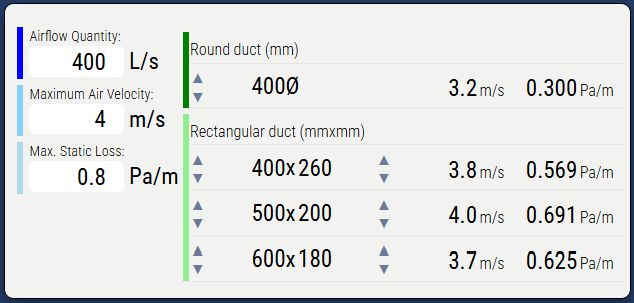
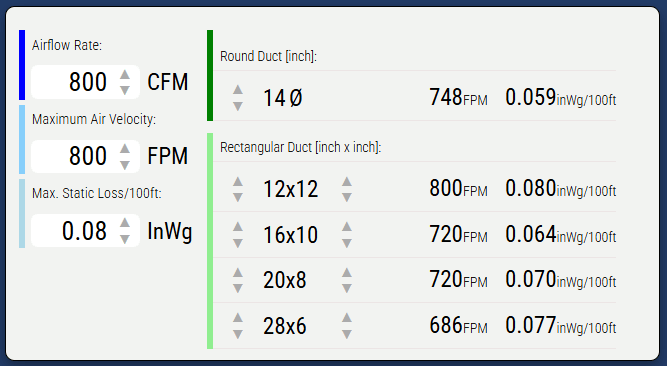
At its core, a Free HVAC Ductulator answers one question: given this much airflow, what size duct do I actually need? The original versions were circular slide rules: line up the CFM scale against velocity or friction rate, and read the diameter straight off the wheel. Plenty of contractors still keep one in the truck. Digital versions and phone apps do the exact same calculation, just without the cardboard.
How Duct Sizing Works — The Equal Friction Method
Most commercial systems get sized using what’s called the equal friction method: every run loses roughly the same pressure per unit length, so the whole system stays balanced without needing a damper wedged into every branch. Three numbers drive the whole thing:
- Airflow (Q), in CFM or L/s
- Velocity (V), in FPM or m/s
- Friction rate — pressure loss per 100 feet of duct, in inches of water gauge or Pa/m
Once you know two of the three, the math is straightforward: area equals airflow divided by velocity. From there you’re just converting that area into a standard duct size.
Round vs. Rectangular Duct Conversion
Round wins on efficiency — less friction, less metal for the same airflow. But it eats more vertical clearance than a flat rectangular duct doing the same job, and in a lot of buildings, that clearance just isn’t there. So rectangular tends to win on space, even though you pay for it in friction loss.
To keep the friction rate honest when you switch shapes, there’s a standard equivalent-diameter conversion — the Huebscher formula:
De = 1.30 × [(a × b)0.625] ÷ [(a + b)0.25]
Here, a and b are the two side lengths of the rectangular duct, and De is the diameter of the round duct that gives you the same friction rate at the same airflow. Most calculators run this in the background so you never touch it by hand, but it’s worth knowing what’s actually happening under the hood.
Typical HVAC Duct Velocity Guidelines
There’s no single “correct” velocity; it depends on noise tolerance, duct material, and whatever your local code requires. But these ranges are what most engineers default to:
| Application | Typical Velocity (FPM) |
|---|---|
| Residential branch ducts | 500–700 |
| Residential main trunk ducts | 700–900 |
| Commercial branch ducts | 700–1,000 |
| Commercial main trunk ducts | 1,000–1,500 |
| Industrial / high-velocity systems | 1,500–2,500+ |
How to Size a Duct, Step by Step
Here’s how it plays out with real numbers. Say you’ve got a branch duct that needs to carry 400 CFM, targeting 700 FPM.
Divide the two and you get a required area of 0.571 square feet, or about 82.3 square inches. Solve for a round diameter and you land around 10.2 inches, which isn’t a standard size, so you’d round up to whatever your sheet metal supplier stocks next. Need rectangular instead? Pick a width that fits your ceiling space, then solve for the height that gets you back to that same 82.3 square inches.
Working from a friction rate instead of a target velocity? Same idea, just read the diameter straight off an equal-friction chart at your CFM and friction-rate intersection instead of solving for area by hand.
Free HVAC Ductulator from online
If doing this by hand isn’t your idea of a good time, plenty of free online calculators exist. ductulator.com, for one, takes your airflow and either velocity or friction rate and spits out a duct size instantly. Same math as above, just automated.
On a job site with just your phone? There are duct-sizing apps on both Google Play and the App Store. Just check that whichever one you pick handles rectangular output too, not only round, and supports metric if you ever work outside the US.
Common Duct Sizing Mistakes to Avoid
Duct sizing mistakes are some of the most common, and the most annoying to fix once the ductwork’s already hung. We cover more of these in our guide to common HVAC design mistakes, but the ones specific to sizing tend to repeat themselves job after job:
- Applying one friction rate to the whole system regardless of how long each run actually is
- Accounting for straight-duct friction and forgetting fittings and transitions entirely
- Chasing a velocity number without ever checking it against noise criteria
- Rounding down to save on metal instead of rounding up to the nearest stock size
- Designing off the drawing length instead of how the duct actually gets routed in the field
Why Duct Sizing Affects HVAC Efficiency and Comfort
This isn’t just a sheet-metal question. Duct size determines how much of the air your AHU or FCU is pushing out actually makes it to the space it’s supposed to condition. Undersize it and you starve the terminal units downstream. Oversize it and you’re wasting static pressure, fan energy, and money on metal you didn’t need. Neither one gets you the system you designed on paper.
Ventilation-air ducts are especially unforgiving here: under-deliver on outdoor air and you’re also affecting indoor air quality, which is why we cover related ventilation thresholds in our carbon monoxide safe-level guide.
Duct Sizing and Sheet Metal Takeoff
Once you’ve settled on duct sizes, the next question is usually how much sheet metal you actually need to order or fabricate. Our SMACNA duct sheet calculator takes finished duct dimensions and converts them straight into sheet metal area and gauge. Need more tools like it? Our MEP Tools section has the rest.
Frequently Asked Questions
What is a duct sizing calculator (ductulator)?
People call it a “ductulator” more often than its actual name, but it’s just a calculator that tells you what duct size you need for a given airflow, at whatever velocity or friction rate you’re targeting. Engineers, designers, and techs use it for supply, return, and exhaust ductwork alike.
What inputs do I need to size a duct?
Just two things, really: airflow in CFM or L/s, and either a target velocity or an allowable friction rate. Once you have those, the required duct area falls right out of the math.
Is there a standard method for duct sizing?
The equal friction method is what most commercial jobs use, since it keeps pressure loss per foot consistent across the whole system. For smaller residential jobs, straight velocity-based sizing is usually simpler and good enough.
Does it matter if I use round or rectangular ducts?
It does. Round is more efficient (less friction, less material) but takes up more vertical space. Rectangular fits tighter ceilings but loses a bit on friction. An equivalent-diameter formula lets you convert between the two without throwing off your friction rate.
Do I need special software to size a duct?
Not really. A physical slide rule, a free online calculator, or just doing the airflow-over-velocity math yourself all land you at the same duct size. Software’s just there to save you the arithmetic.