


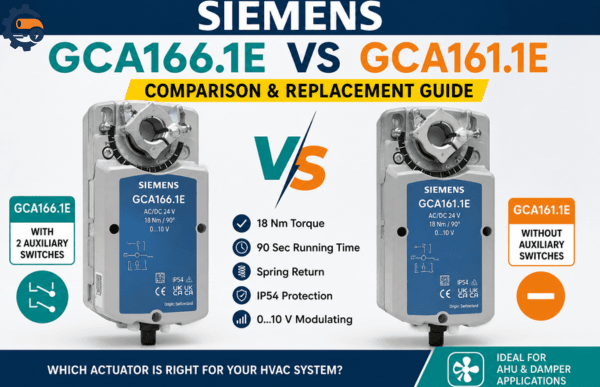
Choosing the wrong replacement actuator on an air handling unit (AHU) doesn’t just mean a mechanical mismatch — it can knock out a fan interlock, drop a feedback signal the BMS depends on, or throw a control sequence into fault. Two Siemens OpenAir actuators get compared constantly for exactly this reason: the GCA166.1E and the GCA161.1E.
They share the same body, the same torque rating, the same wiring logic. On paper, they look interchangeable. In practice, only one direction of that swap is safe — get it backwards and you’re chasing a fault that traces back to one missing wire, not a broken actuator.
This guide compares Siemens GCA166.1E vs GCA161.1E using the manufacturer’s own technical documentation, explains what the one real difference means for your control sequence, and tells you exactly which replacement direction is safe.
Quick answer: GCA166.1E and GCA161.1E are electrically and mechanically identical except for one thing — GCA166.1E adds two adjustable auxiliary switches. GCA166.1E can safely replace GCA161.1E. The reverse is not recommended if those switches are wired into your control sequence.
Siemens GCA166.1E vs GCA161.1E — Quick Comparison Table
Both actuators belong to Siemens’ 18 Nm OpenAir GCA-1 platform. Here’s how the datasheets line up side by side:
| Specification | Siemens GCA161.1E | Siemens GCA166.1E |
|---|---|---|
| Product Family | OpenAir spring-return damper actuator | OpenAir spring-return damper actuator |
| Control Type | Modulating | Modulating |
| Supply Voltage | 24 V AC / 24 V DC | 24 V AC / 24 V DC |
| Control Signal | 0…10 V DC | 0…10 V DC |
| Position Feedback Signal | 0…10 V DC | 0…10 V DC |
| Nominal Torque | 18 Nm (160 lb-in) | 18 Nm (160 lb-in) |
| Spring Return Function | Yes | Yes |
| Motor Running Time | 90 sec (90° rotation) | 90 sec (90° rotation) |
| Spring Return Time | 15 sec | 15 sec |
| Nominal Rotation Angle | 90° | 90° |
| Maximum Rotation Angle | 95° ±2° | 95° ±2° |
| Damper Size | Up to 3 m² | Up to 3 m² |
| Shaft Compatibility | Round 8–25.6 mm / Square 6–18 mm | Round 8–25.6 mm / Square 6–18 mm |
| Manual Override | Yes | Yes |
| Position Indicator | Yes | Yes |
| Protection Rating | IP54 | IP54 |
| Ambient Temperature | -32°C to +55°C | -32°C to +55°C |
| Cable Length | 0.9 m prewired | 0.9 m prewired |
| Auxiliary Switches | No | Yes — 2 adjustable SPDT |
| Auxiliary Switch Range | N/A | 0°–90° in 5° steps |
| Direct Replacement for GCA161.1E | — | Yes |
| Direct Replacement for GCA166.1E | No | — |
Specifications verified against Siemens’ official OpenAir™ GCA Series Technical Instructions (Document No. 155-173P25).
What Is the Difference Between GCA166.1E and GCA161.1E?
Strip away the model numbers and there’s exactly one functional difference: auxiliary switching. Torque, voltage, control signal, spring-return timing, and shaft compatibility are all identical.
Siemens GCA161.1E — Standard Modulating Actuator
The GCA161.1E is the base actuator in this torque class. It runs on:
- 24 V AC or 24 V DC supply
- 0–10 V DC modulating control signal
- 0–10 V DC position feedback
- 18 Nm nominal torque with spring-return fail-safe
- 90-second motoring time, 15-second spring-return close
It has no built-in auxiliary switches. If your sequence doesn’t need a dry-contact signal from the actuator itself, this is the simpler option.
Siemens GCA166.1E — Adds Dual Auxiliary Switches
The GCA166.1E is the same actuator with two independently adjustable SPDT auxiliary switches added. Per Siemens’ technical documentation, both switches adjust in 5° steps across the full 0–90° rotation, ship factory-set at 5° and 85°, and carry 2° of switching hysteresis to prevent false triggering. Contact ratings run 24–250 VAC at 6 A resistive, or 12–30 VDC at 2 A — enough to drive most relay or BMS dry-contact inputs directly.
Those switches are what make GCA166.1E useful for:
- Supply fan interlock / fan-enable-on-damper-open logic
- Damper open/closed proof signals
- BMS dry-contact status feedback
- Alarm signaling
- AHU start/stop sequencing
Can Siemens GCA166.1E Replace GCA161.1E?
Yes. Because the two actuators share identical core specifications, GCA166.1E is a safe, direct replacement for GCA161.1E in nearly every application. If the auxiliary switches aren’t wired to anything, they simply sit unused — they don’t interfere with modulating control, spring-return behavior, or feedback.
✅ Safe replacement direction: GCA166.1E → GCA161.1E
Can Siemens GCA161.1E Replace GCA166.1E?
Generally, no. Swapping a GCA161.1E into a slot built for GCA166.1E removes both auxiliary switches — along with whatever interlock or feedback logic depended on them. It’s one of the retrofit mistakes worth checking for before parts get ordered, alongside the wiring and sequencing errors in our guide to common HVAC design mistakes. A missing auxiliary switch rarely shows up until commissioning, and by then it’s a site visit, not a five-minute fix.
Potential consequences:
- Supply fan fails to start (missing damper-open proof)
- Position feedback gap at the control panel
- Nuisance BMS alarms
- Failed commissioning or sequence-of-operation testing
❌ Not recommended: GCA161.1E → GCA166.1E, unless you’ve physically confirmed no auxiliary switch is wired or required.
Real-World HVAC Application Example
Picture an AHU fresh-air damper running a GCA166.1E. One auxiliary switch feeds a “damper proven open” signal into the supply fan’s start permissive — standard practice on AHU and FAHU fan interlock logic.
Swap that actuator for a GCA161.1E and the proof signal disappears entirely. The fan permissive never makes up, the fan won’t start, and the BMS throws a fault. The actuator itself works fine — it’s just missing the one wire the sequence was built around.
Which Siemens Actuator Should You Stock as a Spare?
For maintenance teams and MEP contractors managing spares across multiple AHUs, carrying two separate SKUs for what’s functionally one actuator platform wastes shelf space.
Standardize on GCA166.1E instead. Since it does everything GCA161.1E does, plus the auxiliary switches, one SKU covers both installation types:
- Fewer part numbers to track
- Faster emergency replacement — no guessing which variant is needed
- Lower procurement overhead
- Less downtime risk during an urgent swap
Whichever actuator you standardize on, make sure it’s reflected in your submittal and compliance documentation — spare-parts lists that don’t match approved submittals are a common source of RFIs at closeout.
Both models are rated for over 60,000 full strokes and 1.5 million repositions at rated torque, so the choice comes down to control logic, not durability.
Common HVAC Applications for GCA161.1E and GCA166.1E
Both actuators show up across the same equipment types covered in our HVAC guides:
- Air handling units (AHUs)
- Fresh air / outdoor air dampers
- Return air dampers
- Exhaust air dampers
- Smoke control damper systems
- BMS-integrated HVAC control loops
Fresh-air damper position directly affects ventilation rate and, by extension, indoor air quality — if you’re sizing outdoor air dampers around IAQ targets, our carbon monoxide safe-level guide covers the related thresholds.
GCA166.1E is the stronger default anywhere interlocks, proof-of-position, or alarm feedback are part of the sequence of operation.
Siemens GCA166.1E Alternative Brands
If Siemens isn’t a hard spec requirement, comparable spring-return modulating actuators are available from Belimo, Schneider Electric, Johnson Controls, and Honeywell — we cover more cross-brand swaps in our Find Alternatives section.
Before substituting any brand, verify:
- Supply voltage and control signal compatibility
- Torque rating against your damper’s actual requirement
- Spring-return timing and fail-safe direction
- Shaft size — round and square dimensions
- Whether your sequence needs auxiliary switches or a feedback potentiometer
Final Verdict: Which Actuator Should You Choose?
If replacement flexibility matters — and for most facilities, it does — Siemens GCA166.1E is the smarter default:
- Identical core performance to GCA161.1E
- Built-in auxiliary switch capability
- Covers a wider range of applications
- Simplifies spare-parts stocking
If your application genuinely doesn’t need auxiliary switching and unit cost is the deciding factor, GCA161.1E remains a valid, lower-cost choice.
Either way, confirm against your actual control drawings and sequence of operations before ordering — datasheet compatibility is necessary, but the wiring on your specific job is what actually decides it.
Frequently Asked Questions
What is the main difference between Siemens GCA166.1E and GCA161.1E?
Auxiliary switching. GCA166.1E includes two adjustable SPDT auxiliary switches; GCA161.1E does not. Every other core specification is identical.
Can GCA166.1E replace GCA161.1E?
Yes. Because the core specifications match exactly, GCA166.1E is a safe direct replacement for GCA161.1E in virtually all HVAC applications.
Can GCA161.1E replace GCA166.1E?
Not usually. Doing so removes the auxiliary switch functionality, which may be required for fan interlocks or AHU control sequencing.
Which actuator is better for spare stock?
GCA166.1E. It covers every application GCA161.1E does, plus installations that require auxiliary switching, so one SKU replaces two.
Is GCA166.1E more expensive than GCA161.1E?
Usually, yes, because of the added auxiliary switch hardware. Standardizing on one universal model, however, often lowers total inventory cost.